
The Kisumu Prison land recovery case has intensified after the Ethics and Anti-Corruption Commission (EACC) filed court proceedings to reclaim property allegedly acquired fraudulently. The commission seeks to recover public land in Kisumu currently occupied by Winam Estate and restore ownership to the Kenya Prisons Service.
Key Overview
- EACC files land recovery suits.
- Property valued at up to KSh4.3 billion.
- Grace Ogot named in court filings.
- Winam Estate occupies disputed land.
- Kenya Prisons Service seeks restoration.
- Land allegedly acquired through fraud.
- Environment and Land Court to hear case.
- Public land protection remains a priority.
Kisumu Prison Land Recovery Case Targets KSh4.3 Billion Winam Estate
The Kisumu Prison land dispute has entered a new legal phase after the Ethics and Anti-Corruption Commission (EACC) initiated court proceedings to recover a parcel of public land in Kisumu allegedly acquired through fraud more than three decades ago. The commission is seeking to reclaim approximately 7.6 acres of land currently occupied by Winam Estate, arguing that the property rightfully belongs to the Kenya Prisons Service.
According to court filings, the disputed property is now valued at approximately KSh790 million in its undeveloped state and an estimated KSh4.3 billion when existing developments are included. The case represents one of Kenya’s most significant ongoing land recovery efforts involving alleged irregular allocation of public land.
EACC Moves to Recover Kisumu Prison Land
The Ethics and Anti-Corruption Commission (EACC) has filed civil suits before the Environment and Land Court seeking to cancel land titles associated with the disputed property.
The commission is asking the court to revoke ownership documents issued for the subdivided parcels and restore the land to the Kenya Prisons Service, which maintains that the property has historically formed part of its official land holdings.
The recovery proceedings follow investigations launched after a formal complaint was lodged by the Kenya Prisons Service in February 2022 regarding the alleged illegal occupation, subdivision and transfer of the property.
According to the commission, the land was reserved for prison use long before the disputed transactions took place.
Context is everything. Stay ahead of shifting trends with today’s market updates, and uncover emerging opportunities using the Serrari Group Market Index and Marketplace. Then, take control of your own financial future by exploring our Money & Life Reset Transformation Blueprint ™ to build stronger habits, create better systems, and design a path toward lasting wealth.
Grace Ogot Named in Court Proceedings
In its court documents, the EACC alleges that the late Grace Ogot, together with former Commissioner of Lands Wilson Gachanja and other public officials, participated in the fraudulent acquisition of the property during 1989.
Grace Ogot was one of Kenya’s most prominent public figures, serving as a celebrated author, journalist, nurse, diplomat and former Assistant Minister for Home Affairs and National Heritage before her death in 2015.
The commission alleges that the disputed land was obtained using forged allocation documents, an altered Part Development Plan and other irregular documentation that facilitated the transfer of government property into private ownership.
These allegations will ultimately be determined through the court process, where the parties involved will have the opportunity to present evidence.
Disputed Land Forms Part of Kenya Prisons Property
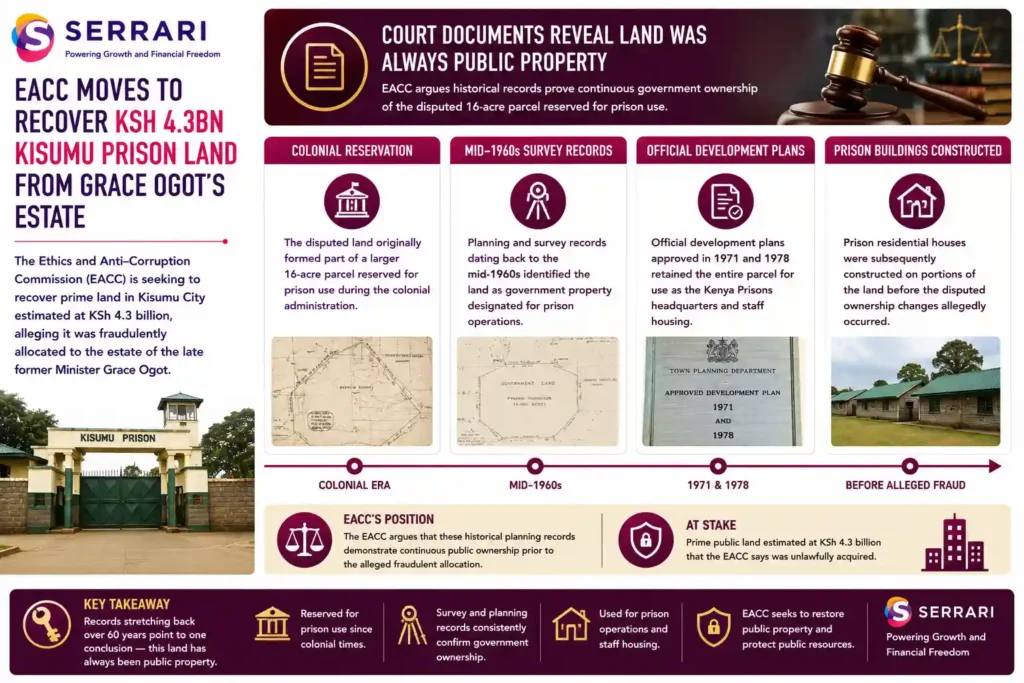
According to documents filed in court, the disputed Kisumu Prison land originally formed part of a larger 16-acre parcel reserved for prison use during the colonial administration.
Planning and survey records dating back to the mid-1960s reportedly identified the land as government property designated for prison operations.
The commission further states that official development plans approved in 1971 and 1978 retained the entire parcel for use as the Kenya Prisons headquarters and staff housing.
Prison residential houses were subsequently constructed on portions of the land before the disputed ownership changes allegedly occurred.
The EACC argues that these historical planning records demonstrate continuous public ownership prior to the alleged fraudulent allocation.
Land Later Subdivided into Private Parcels
According to the commission’s investigations, the property was later subdivided into 92 separate land parcels.
Ownership of these parcels was subsequently transferred to private individuals, many of whom developed residential properties on the land.
The area later became known as Winam Estate, which is also commonly referred to as Grace Ogot Estate.
The large-scale subdivision and subsequent development significantly increased the property’s value, contributing to the commission’s estimate that the land and associated developments are now collectively worth approximately KSh4.3 billion.
The outcome of the legal proceedings could therefore have substantial implications for current landowners, depending on the court’s determination.
Public Land Protection Remains a National Priority
The case highlights the continuing efforts by the EACC to recover government land alleged to have been acquired unlawfully.
Public land recovery has become an important component of Kenya’s anti-corruption strategy as authorities investigate historical allocations involving state property.
Many recovery cases involve allegations that land reserved for public institutions—including schools, hospitals, prisons and other government agencies—was irregularly transferred into private ownership through fraudulent documentation or abuse of public office.
Where evidence supports recovery, the commission seeks court orders restoring ownership to the relevant government institution.
Kenya Property Law Provides Legal Framework
The proceedings will be determined under Kenya’s legal framework governing land ownership, public property and environmental disputes.
The Environment and Land Court has jurisdiction to determine disputes involving title, ownership and occupation of land.
If the court finds that titles were acquired unlawfully, it may order their cancellation and restore ownership to the Kenya Prisons Service.
Conversely, the court will consider evidence presented by all parties before reaching its determination.
The case therefore underscores the importance of due process in resolving complex historical land disputes involving multiple property owners and competing legal claims.
Anti-Corruption Efforts Continue
The latest recovery action reflects the EACC’s broader mandate to investigate alleged corruption involving public resources.
Recovering public assets forms an important part of the commission’s efforts to safeguard government property while promoting accountability in public administration.
Land recovery cases often involve lengthy investigations due to historical documentation, multiple ownership transfers and the need to reconstruct events spanning several decades.
As a result, the litigation process may take considerable time before final judgments are delivered.
Outlook for the Kisumu Prison Land Case
The Kisumu Prison land recovery case is likely to become one of Kenya’s closely watched public land disputes given the significant value of the property and the historical allegations contained in the court filings. The Ethics and Anti-Corruption Commission (EACC) is seeking to restore the disputed land to the Kenya Prisons Service, while the Environment and Land Court will determine the legality of the ownership transfers based on the evidence presented.
The outcome could have broader implications for future land recovery efforts, reinforcing the role of Kenya property law in addressing historical disputes involving government land and alleged irregular allocations.
FAQs
Why is the Kisumu Prison land in court?
The Ethics and Anti-Corruption Commission (EACC) has filed civil suits alleging that approximately 7.6 acres of Kenya Prisons Service land in Kisumu was acquired fraudulently in 1989. The commission is seeking court orders to cancel the disputed titles and restore the land to the government.
What is the value of the disputed land?
According to the EACC, the land is valued at approximately KSh790 million excluding developments. Including residential developments built on the site, the estimated value rises to around KSh4.3 billion.
Who currently occupies the disputed property?
The disputed land has been subdivided into 92 parcels and is now occupied by Winam Estate, also known as Grace Ogot Estate, where residential developments have been constructed over the years.
What will the court decide?
The Environment and Land Court will examine the evidence presented by all parties to determine whether the land titles were lawfully acquired. Depending on its findings, the court may uphold the existing ownership or order cancellation of the titles and restoration of the land to the Kenya Prisons Service.
Your financial future isn’t something you wait for—it’s something you build.
The real question is: when do you begin?
Move beyond simply staying informed.
Navigate the markets with clarity—track trends through the Serrari Group Market Index, uncover opportunities in the Serrari Marketplace, and build practical knowledge with our Curated Wealth Builder Platform.
Stay connected to what truly matters.
Get daily insights on macro trends and financial movements across Kenya, Africa, and global markets—delivered through the Serrari Newsletter.
Growth opens doors.
Advance your career through professional programs including ACCA, HESI A2, ATI TEAS 7 , HESI EXIT , NCLEX – RN and NCLEX – PN, Financial Literacy!🌟—designed to move you forward with confidence.
See where money is flowing—clearly and in real time.
Track Money Market Funds, Treasury Bills, Treasury Bonds, Green Bonds, and Fixed Deposits, alongside global and African indexes, key economic indicators, and the evolving Crypto and stablecoin landscape—all within Serrari’s Market Index.