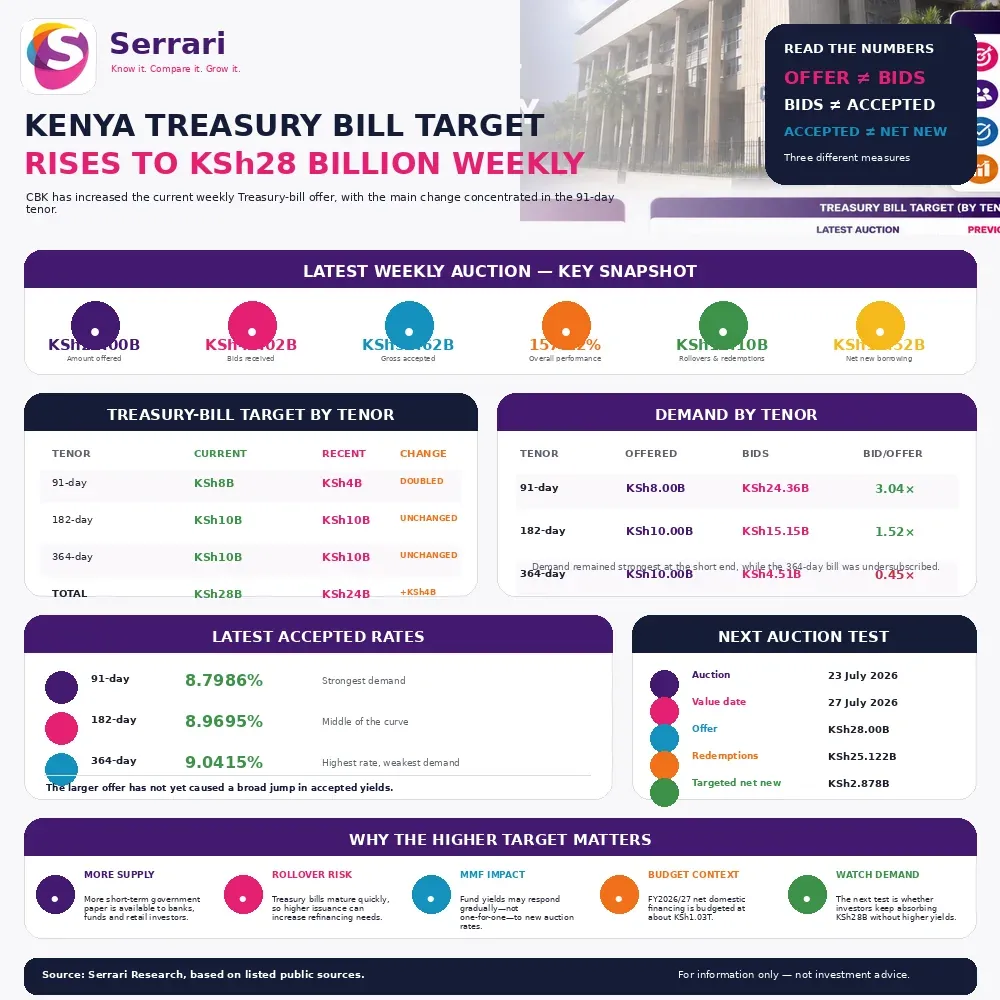
The CBK Treasury-bill auction target has risen to KSh28 billion in the current weekly cycle, increasing the supply of short-term government securities available to banks, funds and retail investors. The higher target creates more investment capacity, especially in the 91-day bill, but it also comes as Kenya’s FY2026/27 financing plan relies heavily on domestic borrowing. Investors should distinguish the amount offered, the amount bid, the amount accepted and the actual yield awarded. KSh44.02 billion in bids is demand, not money raised; KSh30.62 billion accepted is gross accepted borrowing, not automatically net new financing.
LIVEKenya MMF rates: Average 9.15% across 27 funds · top fund 11.01% · 21 OctCompare funds →Key Overview
- CBK offered KSh28.00 billion in the latest Treasury-bill auction.
- Investors submitted KSh44.02 billion in bids.
- CBK accepted KSh30.62 billion.
- Overall performance stood at 157.22%.
- The 91-day bill target is now KSh8 billion, compared with a recent KSh4 billion offer.
- Accepted rates were 8.7986% for 91 days, 8.9695% for 182 days and 9.0415% for 364 days.
- FY2026/27 net domestic financing is budgeted at KSh1.03 trillion.
- The fiscal deficit including grants is budgeted at KSh1.146 trillion.
Kenya Treasury Bill Target Rises to KSh28 Billion Weekly
CBK Offers More Short-Term Paper
The latest auction marks a clear increase in the current weekly Treasury-bill supply. CBK offered KSh8 billion in 91-day bills, KSh10 billion in 182-day bills and KSh10 billion in 364-day bills, giving a total offer of KSh28 billion. By comparison, a late-June auction cited by People Daily had an advertised offer of KSh24 billion, with KSh4 billion directed to the 91-day bill.
That means the main increase has been placed at the shortest end of the curve. The 182-day and 364-day targets remained at KSh10 billion each, while the 91-day target doubled from KSh4 billion to KSh8 billion.
Demand Still Exceeded Supply
The latest auction was oversubscribed overall. Investors submitted KSh44.02 billion in bids against KSh28.00 billion offered, producing a performance rate of 157.22%. CBK accepted KSh30.62 billion, above the advertised amount.
The strongest demand was again in the shortest tenor. The 91-day bill attracted KSh24.36 billion in bids against KSh8 billion offered, while the 182-day bill attracted KSh15.15 billion against KSh10 billion offered. The 364-day bill was the weak point, drawing KSh4.51 billion against KSh10 billion offered.
Amount Offered Is Not Amount Raised
For retail investors, the most important distinction is between offer size, bids received and accepted amount. The offer size is what CBK initially places before the market. Bids received show investor demand. The accepted amount is what CBK chooses to take.
Even the accepted amount is not the same as net new borrowing. CBK’s results show KSh19.10 billion of the latest accepted amount was linked to rollovers and redemptions, while People Daily reported that about KSh11.52 billion represented net new borrowing for government financing requirements.
The Budget Context Matters
The timing matters because Kenya has entered FY2026/27 with a large domestic financing requirement. The National Treasury’s FY2026/27 financial statement shows a deficit including grants of KSh1.146 trillion, net foreign financing of KSh116.17 billion and net domestic financing of KSh1.030 trillion. Government securities financing is listed at KSh1.119 trillion.
That does not mean every weekly Treasury-bill increase is automatically refinancing stress. But it does show why investors should read higher short-term issuance alongside the government’s broader domestic borrowing plan.
Investor Opportunity or Refinancing Pressure?
For investors, the higher target creates more room to access short-term government paper. Banks, money-market funds, pension funds and individuals using DhowCSD may have a larger weekly supply to bid into. That can support portfolio liquidity and provide a reference point for Kenya money-market rates.
For the government, higher short-term supply can also increase rollover needs if issuance remains elevated. Treasury bills mature quickly, meaning today’s funding has to be repaid or refinanced within 91, 182 or 364 days. That is why the increase is both an investor opportunity and a fiscal signal.
Context is everything. Stay ahead of shifting trends with today’s market updates, and uncover emerging opportunities using the Serrari Group Market Index and Marketplace. Then, take control of your own financial future by exploring our Money & Life Reset Transformation Blueprint ™ to build stronger habits, create better systems, and design a path toward lasting wealth.
Yields Have Not Jumped Yet
The yield message is more balanced. The latest accepted rates were 8.7986% for the 91-day bill, 8.9695% for the 182-day bill and 9.0415% for the 364-day bill. CBK’s comparison table shows the 91-day and 182-day rates eased slightly from the previous auction, while the 364-day rate rose from 8.9923% to 9.0415%.
That means the larger target has not yet produced a broad upward reset across all tenors. Demand remains strong at the short end, helping absorb supply without forcing the 91-day yield higher in the latest result.
Money-Market Funds Will Watch the Curve
Money-market funds and cash-heavy portfolios will watch this closely. Treasury bills are a core reference instrument in Kenya’s money market, and higher supply can affect the yields available to funds when they roll short-term portfolios.
LIVET-bill rates: 91-day 8.76% · 182-day 8.87% · 364-day 9.04% · auction of 8 OctSee rates →However, fund returns will not move one-for-one with CBK auction results. Portfolio maturity, management fees, liquidity buffers, timing of reinvestment and existing holdings all influence how quickly Treasury-bill yields affect fund returns.
The Next Auction Tests Continuity
CBK’s auction page shows the next 91-day, 182-day and 364-day issues auctioning on 23 July and value-dated 27 July, with previous average interest rates of 8.7986%, 8.9695% and 9.0415%. The latest results also list KSh28 billion offered for that next auction, with KSh25.122 billion in redemptions and targeted net new borrowing of KSh2.878 billion. (Central Bank of Kenya)
This is the immediate test. If CBK continues offering KSh28 billion and investors keep oversubscribing the 91-day bill, the market will read the increase as absorbable. If demand weakens, yields may need to adjust.
Conclusion
Kenya Treasury Bill Target levels have risen to KSh28 billion weekly, giving investors more short-term government paper just as the state begins a financial year with a large domestic borrowing requirement. The doubled 91-day allocation is the clearest change, and investors have so far absorbed the supply strongly.
The correct reading is balanced. Higher supply improves access for investors and can support money-market allocation. But it also raises questions about rollover pressure, government cash needs and the maturity profile of domestic borrowing. The next auction will show whether demand remains strong enough to absorb the larger target without pushing yields materially higher.
FAQs
1. What is the new Kenya Treasury Bill Target?
CBK’s latest Treasury-bill auction offered KSh28 billion across three tenors: KSh8 billion in 91-day bills, KSh10 billion in 182-day bills and KSh10 billion in 364-day bills. The 91-day allocation is the main increase compared with a recent KSh24 billion auction structure.
2. Did CBK raise KSh44 billion?
No. KSh44.02 billion was the amount investors bid, not the amount raised. CBK accepted KSh30.62 billion. Of that, part went to rollovers and redemptions, while the balance represented net new borrowing for government financing needs.
3. What were the latest Kenya T-bill rates?
The latest accepted average rates were 8.7986% for the 91-day bill, 8.9695% for the 182-day bill and 9.0415% for the 364-day bill. The 364-day bill had the highest accepted rate, but the 91-day bill received the strongest demand.
4. Why does the higher weekly target matter?
The higher target matters because it increases the supply of short-term government paper available to investors. It may also signal the government’s need to manage heavy domestic borrowing and refinancing requirements in FY2026/27, when net domestic financing is budgeted at about KSh1.03 trillion.
5. Is the KSh28 billion weekly target permanent?
Not confirmed. CBK’s auction notices confirm the current KSh28 billion target, and Business Daily has reported the target increase, but CBK can adjust offer amounts from one auction to another. Investors should refresh the auction notice each week before bidding. (Business Daily)
Sources: CBK, Business Daily, People Daily, National Treasury, Public Debt Management Office
Your financial future isn’t something you wait for—it’s something you build.
The real question is: when do you begin?
Move beyond simply staying informed.
Navigate the markets with clarity—track trends through the Serrari Group Market Index, uncover opportunities in the Serrari Marketplace, and build practical knowledge with our Curated Wealth Builder Platform.
Stay connected to what truly matters.
Get daily insights on macro trends and financial movements across Kenya, Africa, and global markets—delivered through the Serrari Newsletter.
Growth opens doors.
Advance your career through professional programs including ACCA, HESI A2, ATI TEAS 7 , HESI EXIT , NCLEX – RN and NCLEX – PN, Financial Literacy!🌟—designed to move you forward with confidence.
See where money is flowing—clearly and in real time.
Track Money Market Funds, Treasury Bills, Treasury Bonds, Green Bonds, and Fixed Deposits, alongside global and African indexes, key economic indicators, and the evolving Crypto and stablecoin landscape—all within Serrari’s Market Index.