















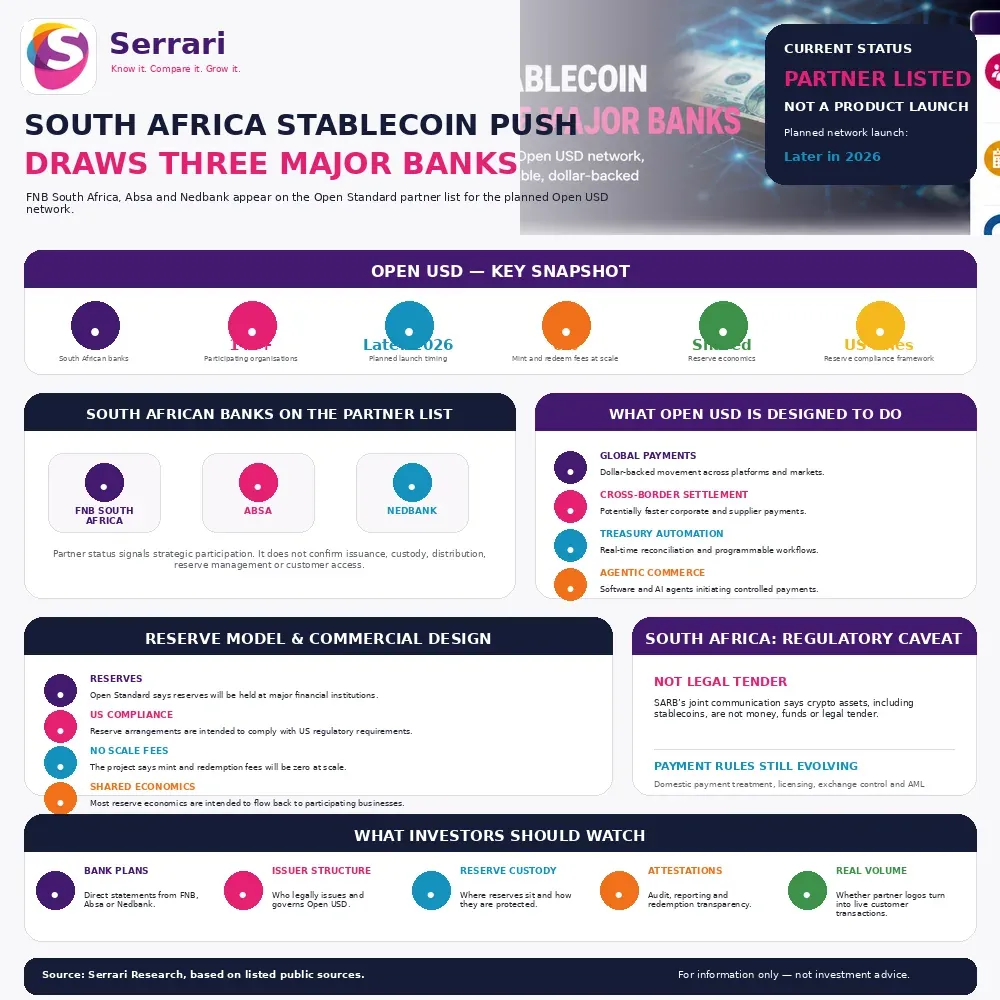
The Open USD stablecoin is planned as a dollar-backed stablecoin operated by Open Standard, an independent company backed by more than 140 participating organisations. For South Africa, the important development is that FNB, Absa and Nedbank appear on the official partner list, alongside global firms such as Visa, Mastercard, Stripe, BNY, Standard Chartered, Coinbase and Yellow Card. This does not yet mean South African customers can buy, hold or settle with OUSD through those banks. It signals that major African banks are exploring how stablecoin infrastructure could fit into corporate payments, cross-border settlement, merchant payouts and programmable finance. (joinopenstandard.com)
Key Overview
- Three South African banks are listed as Open Standard partners: FNB South Africa, Absa and Nedbank.
- Open Standard says more than 140 businesses are involved in Open USD.
- Open USD is planned as a US-dollar stablecoin for global money movement.
- The project is expected to launch later in 2026.
- Open Standard says the network will have no mint or redemption fees at scale.
- Reserve economics are designed to be shared with participating businesses.
- Open Standard says reserves will be maintained at major financial institutions in compliance with US regulatory requirements.
- No official circulation target, reserve size, bank investment amount or South African retail launch date has been disclosed. (joinopenstandard.com)
South Africa Stablecoin Push Draws Three Major Banks
Three Banks Join the Partner List
The official Open Standard partner directory lists Absa, FNB South Africa and Nedbank among the organisations participating in the Open USD ecosystem. TechCentral’s 19 July report highlighted the South African angle, noting that the three banks sit alongside global payments and technology companies in the consortium. (joinopenstandard.com)
That makes the story more than another crypto partnership. Banks are not simply experimenting with tokens at the edge of finance. They are positioning around infrastructure that could support corporate settlement, treasury automation, machine-to-machine payments and cross-border dollar movement.
Open USD Is Built for Business Payments
Open Standard describes Open USD as a stablecoin for global money movement and says businesses need an open, low-cost, high-throughput asset for payments, remittances and trading. Its official announcement says Open USD has three design principles: scale, shared reserve economics and collaborative governance. (joinopenstandard.com)
The model is aimed at businesses rather than speculative retail trading alone. Open Standard says companies can mint and redeem Open USD at no cost, while partners receive most reserve earnings after a management fee. That is important because reserve economics are a core part of the stablecoin business model, especially when short-term dollar assets generate income. (joinopenstandard.com)
Why South African Banks May Care
For South African banks, the strategic question is corporate payments. African businesses often deal with slow cross-border settlement, correspondent banking friction, dollar liquidity needs, supplier payments and multi-country treasury operations. A dollar stablecoin could become a new rail for moving value between platforms, banks, fintechs and corporate systems.
Absa’s own stablecoin analysis says stablecoins are being used in Africa to hold and transfer dollar-denominated value, reduce remittance and cross-border-payment friction, and help payment companies move liquidity between markets without tying up working capital in prefunded accounts. (Absa Group)
Programmable Payments Are the Real Angle
The more advanced angle is programmability. Absa’s treasury guide explains that stablecoins on smart-contract platforms can attach conditions and logic to payments, such as releasing supplier funds only when goods are delivered or splitting payments across subsidiaries according to treasury rules. (Absa | Corporate and Investment Banking)
Open Standard also lists “agentic commerce” as a target use case, saying Open USD can enable agents to make programmatic payments instantly. That is where the bank participation becomes more interesting. The banks may be preparing for a future where software systems, corporate platforms and AI agents initiate payments inside controlled, compliant workflows. (joinopenstandard.com)
Partner Status Is Not Product Launch
The biggest caveat is that Open USD has not launched. Open Standard says OUSD will launch later this year, but no exact commercial launch date has been disclosed. The partner list also does not confirm that each bank will issue, custody, distribute or offer OUSD to customers. (joinopenstandard.com)
That distinction matters for investors. A bank appearing on a consortium list is not the same as a regulated product launch, a balance-sheet commitment, a reserve-custody mandate, or a customer-facing stablecoin service. The next phase is proof of implementation.
Context is everything. Stay ahead of shifting trends with today’s market updates, and uncover emerging opportunities using the Serrari Group Market Index and Marketplace. Then, take control of your own financial future by exploring our Money & Life Reset Transformation Blueprint ™ to build stronger habits, create better systems, and design a path toward lasting wealth.
Regulation Remains the Main Constraint
South Africa’s regulatory position is still developing. A May 2026 joint communication from SARB and other regulators clarified that crypto assets used for domestic payments are not considered payments under the National Payment System Act, currently fall outside that Act, and are not money, funds or legal tender. The same communication says crypto assets include stablecoins for the purposes of the domestic-payment discussion. (Reserve Bank of South Africa)
The document also says SARB is conducting analytical work on the regulatory treatment of crypto assets for payment purposes as the market evolves. This means bank participation in a stablecoin consortium will still have to fit within exchange-control rules, financial-services licensing, anti-money-laundering obligations and future payment-system regulation. (Reserve Bank of South Africa)
The African Demand Signal Is Real
Stablecoin demand in Africa is already visible. Absa’s analysis cites BVNK data showing stablecoin supply up more than 500% over five years and stablecoin ownership among crypto-active African users at 79%. It also cites Yellow Card data showing stablecoins accounted for 43% of total cryptocurrency transaction volume in sub-Saharan Africa in 2024. (Absa Group)
Those figures help explain why African banks are paying attention. Stablecoins are already being used for dollar access, remittances, treasury management and cross-border payments. The open question is whether regulated banks can turn that usage into compliant products without importing crypto-market risks into the banking system.
Competition Could Shift
Open USD could affect competition in several directions. Banks may use stablecoin infrastructure to defend corporate-payment relationships. Fintechs may use it to offer faster payouts and cheaper cross-border settlement. Existing stablecoin issuers may face pressure if large platforms prefer a shared network with reserve economics returned to participants.
For South African banks, the opportunity is to remain relevant if corporate money movement becomes more programmable. The risk is that new rails could also disintermediate parts of traditional banking if clients move liquidity through platforms that sit outside normal bank-account structures.
What Investors Should Watch
Investors should watch whether FNB, Absa or Nedbank publish their own statements, product plans or regulatory disclosures. They should also watch Open Standard’s final issuer structure, reserve-custody arrangements, audit and attestation standards, supported blockchains, redemption terms, compliance controls and launch date.
The most important test will be whether the consortium moves from partner logos to real transaction volume. Until then, the opportunity is strategic, but the commercial value remains unproven.
Conclusion
South Africa Stablecoin activity has entered a more serious phase because FNB, Absa and Nedbank are now linked to Open Standard’s planned Open USD network. Their presence suggests regulated African banks are studying stablecoins not just as crypto assets, but as possible infrastructure for programmable payments, corporate treasury and cross-border settlement.
The opportunity is significant: faster dollar movement, automated business payments and new treasury products. But the risks are equally important: regulation, reserves, redemption, compliance, governance and financial stability. For now, Open USD is a planned network, not a launched customer product from the three banks. Investors should read the development as early positioning, not completed adoption.
FAQs
1. What is the South Africa Stablecoin story?
The story is that FNB South Africa, Absa and Nedbank appear on Open Standard’s official partner list for Open USD, a planned US-dollar-backed stablecoin. Their participation links major South African banks to a global consortium focused on programmable payment infrastructure. (joinopenstandard.com)
2. What is Open USD?
Open USD, or OUSD, is a planned dollar-backed stablecoin operated by Open Standard. The organisation describes it as open infrastructure for global financial activity, designed for payments, trading, remittances, platforms and agentic commerce. Open Standard says OUSD will launch later in 2026. (joinopenstandard.com)
3. Are FNB, Absa and Nedbank issuing OUSD to customers?
Not yet, based on available public information. The banks are listed as partners, but there is no disclosed customer product, retail launch date, investment amount, reserve role or confirmation that each bank will issue, custody or distribute OUSD. Partner status should not be treated as product availability.
4. Why could stablecoins matter for African payments?
Stablecoins can support faster cross-border settlement, dollar-denominated treasury movement, programmable supplier payments and real-time reconciliation. Absa’s stablecoin guide says they can act like programmable cash, but also require risk management around issuer exposure, capital controls, reporting obligations and wallet security. (Absa | Corporate and Investment Banking)
5. What are the main risks?
The main risks include regulatory uncertainty, reserve governance, redemption terms, bank implementation choices, financial-crime controls, cybersecurity, exchange-control compliance and financial-stability concerns. SARB’s joint communication says crypto assets used for domestic payments are not legal tender and are not currently payments under the National Payment System Act. (Reserve Bank of South Africa)
Sources: TechCentral, Open Standard, Absa, Absa CIB, Reserve Bank of South Africa
Your financial future isn’t something you wait for—it’s something you build.
The real question is: when do you begin?
Move beyond simply staying informed.
Navigate the markets with clarity—track trends through the Serrari Group Market Index, uncover opportunities in the Serrari Marketplace, and build practical knowledge with our Curated Wealth Builder Platform.
Stay connected to what truly matters.
Get daily insights on macro trends and financial movements across Kenya, Africa, and global markets—delivered through the Serrari Newsletter.
Growth opens doors.
Advance your career through professional programs including ACCA, HESI A2, ATI TEAS 7 , HESI EXIT , NCLEX – RN and NCLEX – PN, Financial Literacy!🌟—designed to move you forward with confidence.
See where money is flowing—clearly and in real time.
Track Money Market Funds, Treasury Bills, Treasury Bonds, Green Bonds, and Fixed Deposits, alongside global and African indexes, key economic indicators, and the evolving Crypto and stablecoin landscape—all within Serrari’s Market Index.