The GENIUS Act deadline matters because US regulators were required to finalise stablecoin implementation rules within one year of enactment, but several rules remain proposed rather than final. That creates a shorter preparation runway for payment stablecoin issuers, banks, custodians, compliance teams and investors. The law still sets core requirements, including permitted issuer status, one-to-one eligible reserves, redemption policies, monthly reserve disclosures and restrictions on paying stablecoin holders interest or yield. However, operational details around licensing, customer identification, AML controls, sanctions compliance, state-federal coordination and foreign issuer treatment remain unfinished or in transition. (GovInfo)
Key Overview
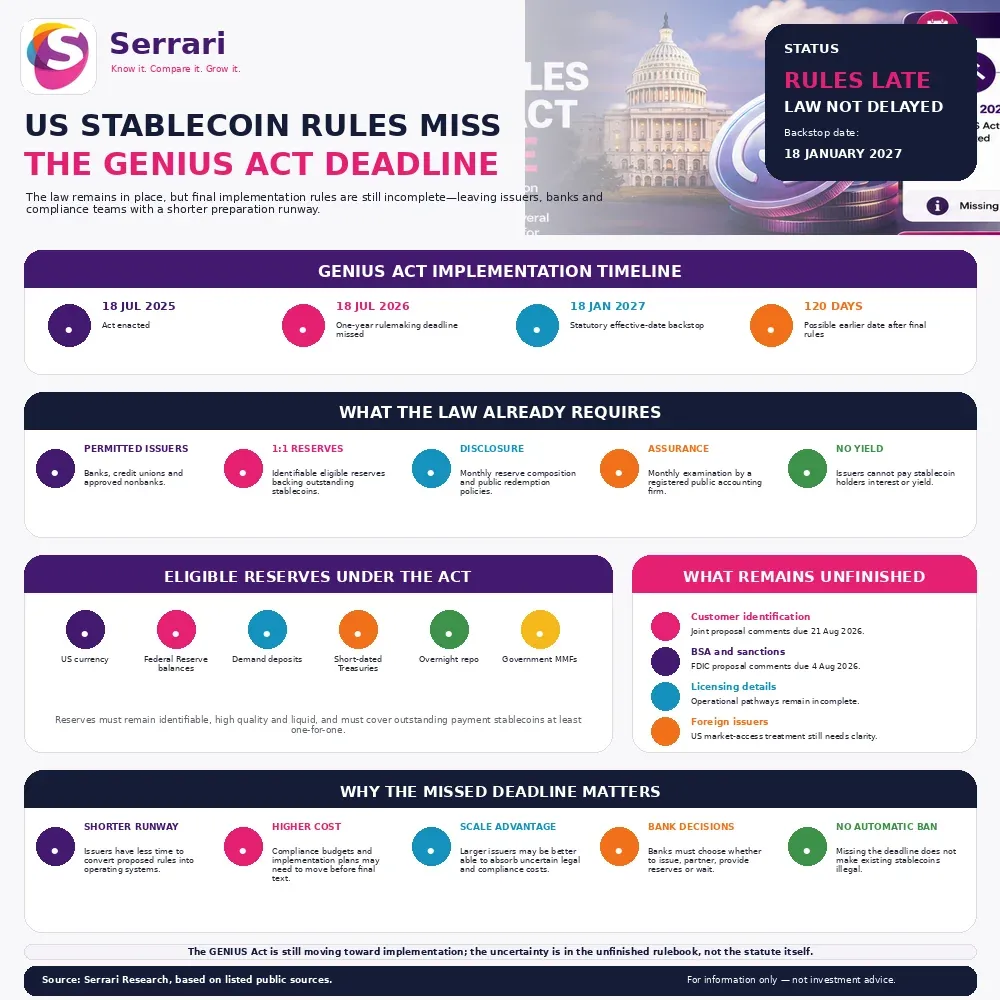
- The GENIUS Act was enacted on 18 July 2025.
- The one-year rulemaking deadline fell on 18 July 2026.
- Current reporting confirms regulators reached the deadline without completing final stablecoin rules.
- The statutory effective date remains 18 January 2027 unless final regulations trigger an earlier date under the Act.
- The principal federal banking regulators involved include the OCC, Federal Reserve, FDIC and NCUA.
- The joint customer-identification proposal remains open for comments until 21 August 2026.
- The FDIC’s BSA and sanctions proposal remains open for comments until 4 August 2026.
- The missed deadline does not automatically make existing stablecoins illegal or postpone the GENIUS Act itself. (GovInfo)
US Stablecoin Rules Miss the GENIUS Act Final Deadline
A Missed Deadline, Not a Delayed Law
The most important distinction is between the law and the regulations. The GENIUS Act is already enacted law. Section 13 required regulators to promulgate implementing regulations within one year of enactment, but missing that deadline does not automatically repeal, suspend or postpone the statute. (GovInfo)
Section 20 sets the effective date as the earlier of 18 months after enactment or 120 days after primary federal payment stablecoin regulators issue final implementing regulations. Since enactment was on 18 July 2025, the 18-month backstop points to 18 January 2027 unless final rules create an earlier applicable date. (GovInfo)
The Remaining Rulebook Is Still Moving
The unfinished rulebook is the practical issue. The Federal Register shows the customer-identification proposal is still a joint proposed rule from FinCEN, the OCC, the Federal Reserve, FDIC and NCUA, with comments due by 21 August 2026. That proposal would treat permitted payment stablecoin issuers as financial institutions under the Bank Secrecy Act and require them to maintain effective customer identification programmes. (Federal Register)
Separately, the FDIC’s proposed rule for FDIC-supervised permitted payment stablecoin issuers would implement Bank Secrecy Act and sanctions compliance standards, with comments due by 4 August 2026. These open comment windows show why final implementation is still incomplete after the statutory deadline. (Federal Register)
AML and Sanctions Controls Remain Central
Treasury had already moved on illicit-finance implementation. In April, FinCEN and OFAC issued a joint proposed rule to implement the GENIUS Act’s anti-money-laundering and sanctions-compliance requirements. Treasury said the proposal would apply financial-institution obligations to permitted payment stablecoin issuers and require effective sanctions compliance programmes. (U.S. Department of the Treasury)
The proposal itself said FinCEN and OFAC were considering final-rule effective dates 12 months after issuance of final rules, giving issuers time to implement requirements. That means even when final rules arrive, some compliance obligations may still require transition periods and operational build-out. (Federal Register)
What the Law Already Says About Reserves
The absence of final rules does not mean there is no framework. The GENIUS Act already requires permitted payment stablecoin issuers to maintain identifiable reserves backing outstanding payment stablecoins on at least a one-to-one basis. Eligible reserves include US coins and currency, balances at the Federal Reserve, demand deposits, short-dated Treasury bills, notes or bonds, certain overnight repo arrangements and government money market fund exposures that meet the statute’s limits. (GovInfo)
The law also requires issuers to publicly disclose redemption policies and monthly reserve composition. Each month, information from the prior month-end report must be examined by a registered public accounting firm, and senior executives must certify the accuracy of the monthly report. (GovInfo)
Why Investors Should Care
For investors, the delay creates regulatory uncertainty rather than a clean market shock. Stablecoin issuers still know the broad direction: permitted issuer status, eligible reserves, redemption standards, disclosures and compliance controls. But they do not yet have every final rule needed to complete licensing, operating models and compliance budgets.
That uncertainty affects stablecoin issuers, banks, custodians, fintech partners and payment companies. It may also favour larger issuers with legal, compliance, treasury and lobbying capacity. Smaller issuers may face a harder time building systems around proposals that can still change.
Context is everything. Stay ahead of shifting trends with today’s market updates, and uncover emerging opportunities using the Serrari Group Market Index and Marketplace. Then, take control of your own financial future by exploring our Money & Life Reset Transformation Blueprint ™ to build stronger habits, create better systems, and design a path toward lasting wealth.
Banks Face Strategic Choices
ABA Banking Journal’s implementation analysis argued that the Act is pushing banks to decide how they want to participate in the stablecoin ecosystem. Options include becoming a permitted payment stablecoin issuer, supporting issuers through custody or reserve services, partnering with fintechs, or staying on the sidelines while the market develops. (ABA Banking Journal)
The missed rule deadline makes those choices harder, not less urgent. Banks must decide whether to invest ahead of final rules or wait for clarity and risk falling behind early movers.
Foreign Issuers Still Need Clarity
Foreign stablecoin issuers are another unresolved area. The GENIUS Act includes a foreign payment stablecoin issuer category and requires Treasury to issue rules for relevant foreign-issuer provisions. It also contemplates registration and monitoring mechanics for foreign issuers seeking US market access. (GovInfo)
That matters because several large stablecoin issuers operate globally. Unclear foreign-issuer treatment can affect exchange access, wallet integrations, liquidity venues and whether non-US issuers can compete cleanly inside the US regulatory perimeter.
What Happens Next
The next milestones are comment deadlines and final-rule publication. The FDIC proposal comments close on 4 August, while the joint customer-identification proposal comments close on 21 August. Regulators can still finalise rules rapidly, but final text may differ from the proposals. (Federal Register)
Investors should watch whether final rules clarify licensing pathways, reserve asset limits, redemption timelines, disclosure templates, attestations, AML obligations, sanctions screening and foreign issuer treatment. These details will shape compliance costs and competitive positioning.
Conclusion
US Stablecoin Rules missed the GENIUS Act’s one-year final-rule deadline, but the law itself remains on track toward implementation. The missed deadline creates a shorter runway, not a later start. Issuers and banks now have to prepare around a statute with clear broad requirements but unfinished operating rules.
For investors, the key message is balance. The delay does not mean stablecoins have become illegal, nor does it mean the GENIUS Act has been postponed. It means the market has entered a more compressed implementation phase where licensing, compliance, reserve management and disclosure systems must be built while final rules are still emerging.
FAQs
1. Did US regulators miss the GENIUS Act deadline?
Yes. Section 13 of the GENIUS Act required regulators to issue implementing regulations within one year of enactment, and the Act was enacted on 18 July 2025. Current reporting and the continuing presence of proposed, not final, rule packages show that the 18 July 2026 deadline passed without final rules being completed. (GovInfo)
2. Has the GENIUS Act been postponed?
No. The missed rulemaking deadline does not postpone the GENIUS Act itself. Section 20 says the Act takes effect on the earlier of 18 months after enactment or 120 days after final implementing regulations are issued. The 18-month statutory backstop is 18 January 2027. (GovInfo)
3. Which stablecoin rules are still unfinished?
Several areas remain in proposal or finalisation stages, including customer identification, AML and sanctions compliance, licensing procedures, foreign issuer treatment, and detailed implementation standards for permitted payment stablecoin issuers. The customer-identification proposal remains open until 21 August, while the FDIC BSA and sanctions proposal remains open until 4 August. (Federal Register)
4. Does the missed deadline make existing stablecoins illegal?
No. The missed rulemaking deadline does not automatically make existing stablecoins illegal. It leaves issuers, banks and platforms operating through a transition period where the statute has been enacted but final implementing details are incomplete. Existing arrangements may still depend on state licences, federal guidance and each issuer’s current compliance posture.
5. Why does this matter for investors?
It matters because final rules will shape issuer licensing, reserve management, redemption rights, disclosures, attestations, compliance costs and market access. Larger issuers may be better positioned to absorb uncertain compliance costs, while smaller issuers may wait for final clarity before committing capital.
Sources: US Government Publishing Office, The Block, Crowdfund Insider, ABA Banking Journal, Federal Register, US Treasury, Federal Register
Your financial future isn’t something you wait for—it’s something you build.
The real question is: when do you begin?
Move beyond simply staying informed.
Navigate the markets with clarity—track trends through the Serrari Group Market Index, uncover opportunities in the Serrari Marketplace, and build practical knowledge with our Curated Wealth Builder Platform.
Stay connected to what truly matters.
Get daily insights on macro trends and financial movements across Kenya, Africa, and global markets—delivered through the Serrari Newsletter.
Growth opens doors.
Advance your career through professional programs including ACCA, HESI A2, ATI TEAS 7 , HESI EXIT , NCLEX – RN and NCLEX – PN, Financial Literacy!🌟—designed to move you forward with confidence.
See where money is flowing—clearly and in real time.
Track Money Market Funds, Treasury Bills, Treasury Bonds, Green Bonds, and Fixed Deposits, alongside global and African indexes, key economic indicators, and the evolving Crypto and stablecoin landscape—all within Serrari’s Market Index.