
















The ORBT30 ETF is a newly listed South Africa equity ETF that gives investors one-trade exposure to 30 JSE-listed companies across resources, financials and diversified shares. It passively tracks the MerQube South Africa Top 30 Index and uses a sector-balanced approach that targets roughly one-third exposure to each of the three groups. Because the fund has almost no live trading history, investors should not judge it on past performance. The important early questions are whether the index methodology provides useful diversification, whether bid–ask spreads remain reasonable, whether liquidity develops, what the total cost is, and how closely the ETF tracks its underlying index.
Key Overview
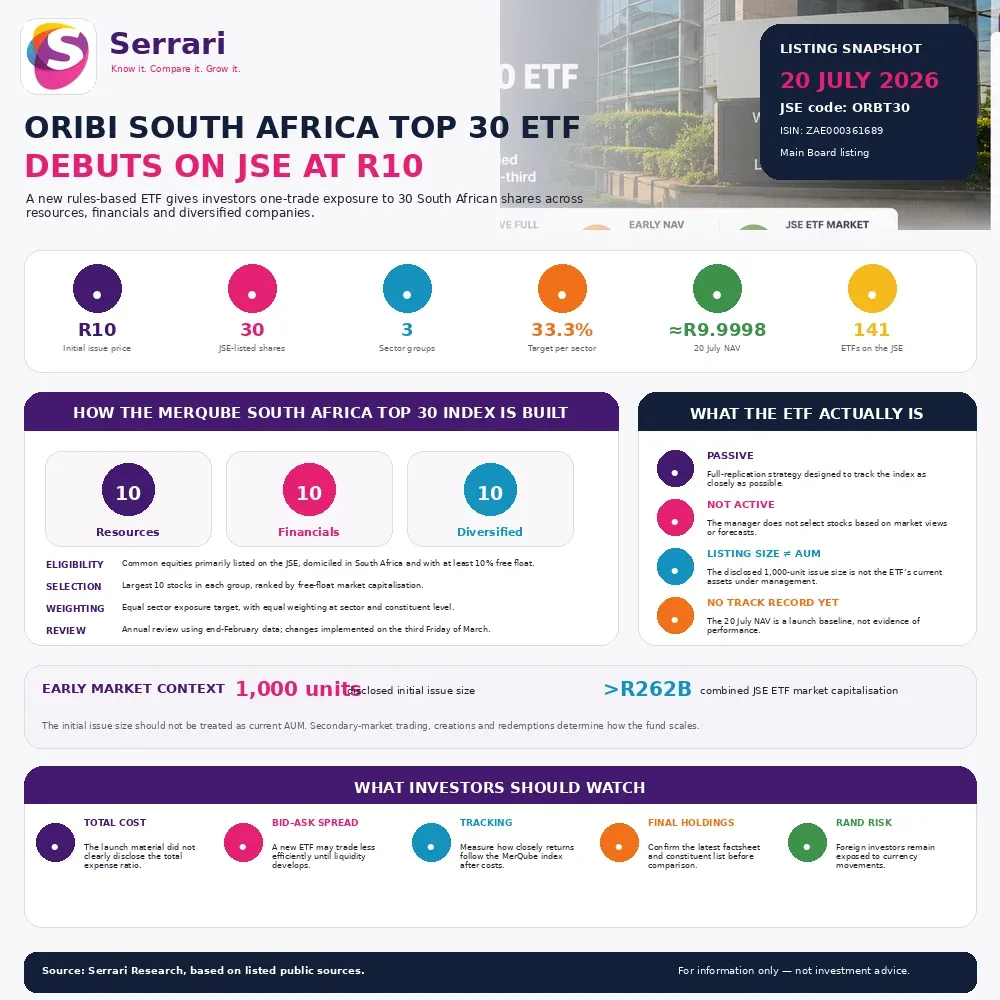
- The ETF listed on the JSE Main Board on 20 July 2026.
- JSE code: ORBT30.
- ISIN: ZAE000361689.
- Initial issue price: R10 per unit.
- Initial issue size disclosed in SENS: 1,000 units.
- The ETF tracks the MerQube South Africa Top 30 Index.
- The index selects 10 resources, 10 financials and 10 diversified shares.
- Each of the three sector groups targets roughly 33.3% exposure.
- Prescient reported a 20 July NAV of approximately R9.9998.
- The listing brought the total number of ETFs on the JSE to 141, with combined ETF market capitalisation above R262 billion. (JSE)
Oribi South Africa Top 30 ETF Debuts on JSE at R10
A New Investable Index Product
This is more than an index announcement. The Oribi South Africa Top 30 Index Prescient ETF is now an investable product on the JSE Main Board, giving investors listed access to a portfolio designed around South Africa’s leading resources, financials and diversified companies. The JSE described the product as a simple and transparent way to access South Africa’s leading listed companies through a single investment. (JSE)
That matters because South African investors already have several equity-index options, but many traditional benchmarks can be shaped heavily by the largest market-cap names. ORBT30 introduces another design question: can equal sector allocation offer a more balanced domestic-equity exposure?
How the Index Is Built
MerQube’s launch coverage says the index represents the largest 10 stocks from each of three groups: resources, financials and diversified. The methodology uses common equities primarily listed on the JSE and domiciled in South Africa, with a minimum free-float factor of 10%. Within each sector group, securities are ranked by free-float market capitalisation. (ETF Express)
The index then targets equal exposure across the three sector blocks. MerQube says the structure assigns each sector a 33.3% weight and applies equal weighting at sector and constituent level, with annual review and reconstitution based on end-February data and implementation on the third Friday of March. Investors should still confirm the latest official factsheet and final holdings before using the ETF in a formal fund comparison. (ETF Express)
Why Sector Balance Matters
The core investment argument is balance. A market-cap-weighted index rewards the largest companies with the largest weights. That can be efficient, but it can also create concentration risk when a small number of mega-cap names dominate returns.
ORBT30’s sector-balanced design tries to reduce that problem by allocating across resources, financials and diversified shares. This may help investors avoid relying too heavily on one part of the South African equity market. However, it does not remove sector-cycle risk. Resources remain sensitive to commodity prices, financials to credit conditions and interest rates, and diversified companies to domestic and global earnings cycles.
Passive Replication, Not Active Stock Picking
The SENS listing document says the ETF’s investment policy is to track the index as closely as possible, using a passive full-replication approach. It also states that the manager will not buy and sell securities based on economic, financial or market analysis, but solely to ensure that the portfolio tracks the index.
That distinction is important. Investors are not buying an active manager’s view on South Africa. They are buying the rules of the MerQube South Africa Top 30 Index. If a company remains in the index, the ETF is expected to hold it even if its short-term fundamentals deteriorate, unless index rules remove it.
The Launch Size Is Not AUM
The SENS document lists an issue size of 1,000 and an issue price of 1,000 cents, or R10. That should not be presented as the ETF’s current assets under management. A listing-by-introduction can begin with a small disclosed issue size, while secondary-market trading, creations and redemptions determine how the fund scales over time.
The same document says investors may obtain participatory interests on the secondary market or by subscribing for new participatory interests on the primary market, and that the manager may create, issue, redeem or cancel participatory interests subject to the Act and deed.
Context is everything. Stay ahead of shifting trends with today’s market updates, and uncover emerging opportunities using the Serrari Group Market Index and Marketplace. Then, take control of your own financial future by exploring our Money & Life Reset Transformation Blueprint ™ to build stronger habits, create better systems, and design a path toward lasting wealth.
Early NAV Gives a Baseline, Not a Track Record
Prescient’s unit-price page showed the Oribi South Africa Top 30 Index Prescient ETF A at a 20 July NAV of 9.9998, with the JSE code ORBT30 and ISIN ZAE000361689. That is useful as a launch reference, but it is not enough to assess performance. (Prescient)
Investors need several months of trading and portfolio data before evaluating tracking difference, bid–ask spreads, market depth and whether the ETF remains easy to enter and exit. A new ETF can have a sound methodology but still require time for liquidity to develop.
Costs and Liquidity Need Monitoring
The total expense ratio was not clearly available in the retrieved launch material. That is a key gap for investors because costs reduce index returns over time. The SENS document itself notes that the portfolio’s ability to replicate the price and yield performance of the index will be affected by costs and expenses incurred by the portfolio.
Liquidity is another early test. ETFs trade on exchange, but the investor’s actual experience depends on bid–ask spreads, market-maker support, underlying-share liquidity and creation-redemption efficiency. A new ETF should be monitored closely before assuming it trades as smoothly as older, larger funds.
What Investors Should Compare
Investors comparing ORBT30 with traditional South African index funds should look beyond headline exposure. The key questions are: how concentrated is the benchmark, how much resources and financial-sector exposure does it carry, what is the cost, how tight are spreads, and how closely does the ETF track the index?
They should also consider currency exposure. For South African investors, ORBT30 is a domestic-equity product. For non-South African investors, rand depreciation or appreciation can materially affect returns in home-currency terms.
Conclusion
The Oribi South Africa Top 30 ETF gives investors a new way to access South African equities through a sector-balanced, rules-based JSE-listed product. Its design is straightforward: 30 shares, three sector groups, and roughly equal exposure across resources, financials and diversified companies.
The opportunity is simplicity and balance. The caution is that the ETF has almost no live performance history. Investors should therefore focus on methodology, costs, bid–ask spreads, liquidity, final holdings and tracking quality before treating ORBT30 as a direct substitute for older market-cap-weighted South African equity funds.
FAQs
1. What is the Oribi South Africa Top 30 ETF?
The Oribi South Africa Top 30 Index Prescient ETF is a JSE-listed exchange traded fund that tracks the MerQube South Africa Top 30 Index. It provides exposure to 30 South African shares across resources, financials and diversified companies, and trades under the JSE code ORBT30. (JSE)
2. When did ORBT30 list on the JSE?
ORBT30 listed on the JSE Main Board at 09:00 on Monday, 20 July 2026. The formal SENS listing announcement was published on 13 July 2026, with an issue price of R10 per unit and ISIN ZAE000361689.
3. How is the MerQube South Africa Top 30 Index constructed?
The index selects the largest 10 stocks from each of three groups: resources, financials and diversified. Eligible constituents must be common equities primarily listed on the JSE and domiciled in South Africa, with a minimum free-float factor of 10%. The index is reviewed annually. (ETF Express)
4. Does the ETF have a performance history?
Not meaningfully yet. The ETF only began trading on 20 July 2026, so investors should not rely on historical-return claims. Early analysis should focus on methodology, costs, bid–ask spreads, liquidity, tracking quality and final portfolio holdings.
5. What are the main risks?
The main risks include South African equity-market volatility, sector-cycle exposure, rand currency risk for foreign investors, liquidity risk, bid–ask spreads, tracking difference and cost uncertainty. Equal sector allocation can reduce some concentration risk, but it does not remove exposure to resources, financials or domestic-market cycles.
Sources: Johannesburg Stock Exchange, ETF Express, Prescient, Sharenet
Your financial future isn’t something you wait for—it’s something you build.
The real question is: when do you begin?
Move beyond simply staying informed.
Navigate the markets with clarity—track trends through the Serrari Group Market Index, uncover opportunities in the Serrari Marketplace, and build practical knowledge with our Curated Wealth Builder Platform.
Stay connected to what truly matters.
Get daily insights on macro trends and financial movements across Kenya, Africa, and global markets—delivered through the Serrari Newsletter.
Growth opens doors.
Advance your career through professional programs including ACCA, HESI A2, ATI TEAS 7 , HESI EXIT , NCLEX – RN and NCLEX – PN, Financial Literacy!🌟—designed to move you forward with confidence.
See where money is flowing—clearly and in real time.
Track Money Market Funds, Treasury Bills, Treasury Bonds, Green Bonds, and Fixed Deposits, alongside global and African indexes, key economic indicators, and the evolving Crypto and stablecoin landscape—all within Serrari’s Market Index.