














A Singapore sovereign green bond gives investors exposure to Singapore government credit while financing eligible green infrastructure under the Singapore Green Bond Framework. The planned 20-year Green SGS Infrastructure bond would sit between Singapore’s existing 30-year and 50-year sovereign green bonds, helping build a fuller green yield curve for Asian sovereign green bonds. Investors should focus on final pricing, coupon, duration risk, allocation reporting and how proceeds are directed into eligible projects such as clean transport, green buildings, renewable energy, water infrastructure and climate adaptation. The instrument is high-quality sovereign debt, but its long maturity still creates meaningful interest-rate sensitivity.
Key Overview
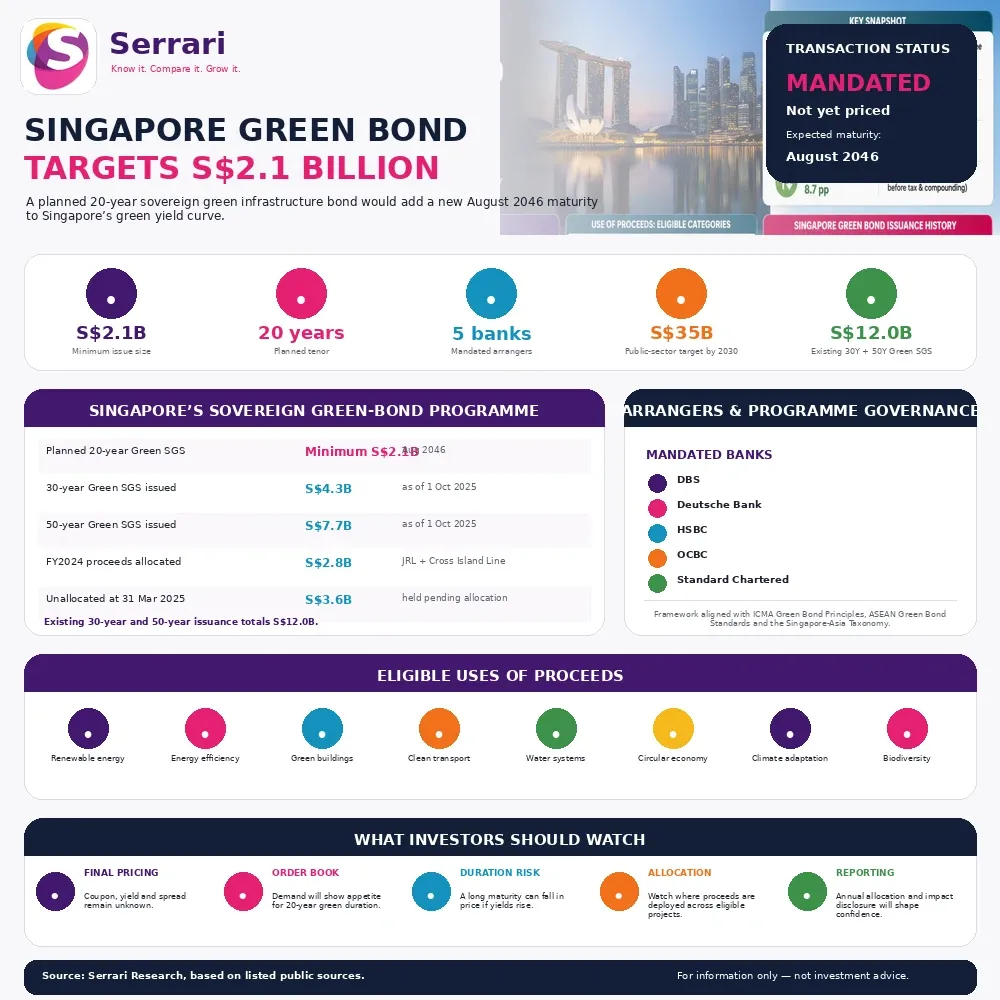
- Singapore has mandated five banks for a planned 20-year sovereign green infrastructure bond.
- The minimum issue size is S$2.1 billion, equivalent to about US$1.63 billion.
- The bond is expected to mature in August 2046.
- Proceeds will be allocated under Singapore’s Green Bond Framework.
- Singapore’s public sector plans to issue up to S$35 billion of green bonds by 2030.
- As of 1 October 2025, Singapore had issued S$7.7 billion of 50-year Green SGS and S$4.3 billion of 30-year Green SGS.
- FY2024 green proceeds allocated totalled S$2.8 billion, with S$3.6 billion unallocated as of 31 March 2025. (Ministry of Finance (MOF))
Singapore Green Bond Targets S$2.1 Billion This Week
Singapore Adds a New Point to the Green Curve
The planned transaction adds a new maturity point to Singapore’s sovereign green-bond curve. Existing Green SGS Infrastructure issuance has focused on very long maturities, including 30-year and 50-year securities. A new 20-year bond would give long-duration investors another reference point for pricing Singapore-dollar green debt. (Ministry of Finance (MOF))
That matters for Asian sustainable finance. Sovereign green bonds often help establish benchmarks that corporate issuers, statutory boards and infrastructure borrowers can use when pricing their own green or sustainability-linked debt. A 20-year Singapore government benchmark could therefore influence more than one transaction.
The Mandate Is Not Final Pricing
The transaction has been mandated, but it has not yet been priced. Business Times reported that the bond could launch as early as the current week, subject to market conditions. The Edge Malaysia carried the same Reuters details, including the five arranging banks, the minimum S$2.1 billion size and the August 2046 maturity. (The Business Times)
That distinction matters. Until pricing is announced, investors do not know the coupon, final yield, spread, order book, allocation split or final transaction size. The mandate tells the market what Singapore is preparing. Pricing will show actual demand.
Proceeds Sit Under a Formal Framework
Singapore’s Green Bond Framework is the governing structure. MOF says the framework was first launched in 2022 and last updated in January 2025. It is aligned with the ICMA Green Bond Principles, ASEAN Green Bond Standards and the Singapore-Asia Taxonomy for Sustainable Finance. (Ministry of Finance (MOF))
Eligible use-of-proceeds categories include renewable energy, energy efficiency, green buildings, clean transportation, sustainable water and wastewater management, pollution prevention and circular economy, climate-change adaptation, and biodiversity conservation. (Ministry of Finance (MOF))
Transport Has Been the Core Allocation So Far
Singapore’s FY2024 Green Bond Report shows that the government allocated S$2.8 billion of green-bond proceeds in FY2024 to the Jurong Region Line and Cross Island Line. The same report says the projects support the Singapore Green Plan 2030 and are expected to reduce land-transport emissions from their 2016 peak by 2040, contributing to the country’s net-zero target by 2050. (Ministry of Finance (MOF))
This gives investors a concrete example of how proceeds have been used. The planned bond is not just a capital-market instrument; it forms part of Singapore’s broader financing approach for nationally significant infrastructure.
The 2030 Target Is the Bigger Programme
The bond also fits Singapore’s public-sector target to issue up to S$35 billion of green bonds by 2030. MOF says this includes green bonds issued by the Government and statutory boards, supporting Singapore’s sustainable development while deepening the green-finance market. (Ministry of Finance (MOF))
This is important because investors should not view the planned 20-year bond in isolation. It is part of a programme designed to finance public-sector green infrastructure and create reference points for private-sector sustainable finance.
Context is everything. Stay ahead of shifting trends with today’s market updates, and uncover emerging opportunities using the Serrari Group Market Index and Marketplace. Then, take control of your own financial future by exploring our Money & Life Reset Transformation Blueprint ™ to build stronger habits, create better systems, and design a path toward lasting wealth.
Past Green SGS Demand Provides Context
MOF’s FY2024 report shows that Singapore issued its first 30-year sovereign green bond in June 2024 with an issuance size of S$2.5 billion, while the 50-year Green SGS was reopened in October 2024 with S$1.5 billion issued. Those transactions saw subscription rates of 2.4 times and 1.6 times, respectively. (Ministry of Finance (MOF))
That past demand will be watched closely against the new 20-year transaction. Strong demand could confirm institutional appetite for high-quality Singapore-dollar green duration. Softer demand could indicate that investors require more yield compensation for long maturity, even when sovereign credit quality is strong.
Duration Risk Still Matters
A long-duration sovereign green bond is not risk-free from a market-price perspective. Singapore’s strong credit profile may reduce default-risk concerns, but a 20-year maturity still exposes investors to interest-rate movements. If yields rise after issuance, the bond’s market price can fall. If yields decline, long-duration bonds can gain.
That matters for insurers, pension funds and asset managers. Some investors may welcome long-duration assets because they match long-term liabilities. Others may be cautious if they expect higher yields or prefer shorter reinvestment cycles.
Reporting Will Shape Investor Confidence
The Singapore Green Bond Framework commits the Government to annual allocation reporting and impact reporting until proceeds are fully allocated. MOF says the Government deploys net sovereign green-bond proceeds only to projects approved by the Green Bond Steering Committee, and unallocated proceeds are held in cash or short-term liquidity instruments pending allocation. (Ministry of Finance (MOF))
That reporting structure is central to investor confidence. Green-bond buyers need to see how money is allocated, which projects are financed, and what environmental outcomes are reported over time.
What Investors Should Watch
Investors should watch five items when pricing is announced: final issue size, coupon, yield, order book and allocation. They should also compare the 20-year issue with existing 30-year and 50-year Green SGS levels to see whether the new bond prices with a meaningful green premium or requires a duration concession.
The second question is use of proceeds. If proceeds are allocated mainly to transport infrastructure, the bond will continue the existing clean-transport pattern. If allocations broaden over time, the bond could show how Singapore’s green-bond programme expands into other eligible categories.
Conclusion
Singapore Green Bond issuance is entering a new phase. The planned minimum S$2.1 billion 20-year Green SGS Infrastructure bond would extend Singapore’s sovereign green curve and provide investors with another long-duration climate-finance instrument.
For investors, the transaction combines sovereign credit quality, infrastructure financing and green-bond reporting. But final pricing remains critical. The bond has not yet launched, and long maturity creates duration risk. The key test will be whether investors accept the new 2046 maturity as an attractive benchmark for Asian sustainable infrastructure finance.
FAQs
1. What is the planned Singapore Green Bond?
The planned Singapore Green Bond is a Singapore-dollar-denominated 20-year Green SGS Infrastructure bond expected to mature in August 2046. The minimum issue size is S$2.1 billion, or about US$1.63 billion. DBS, Deutsche Bank, HSBC, OCBC and Standard Chartered have been appointed to arrange the transaction. (The Business Times)
2. Has the bond already been priced?
No. The transaction has been mandated but not yet priced. The final coupon, yield, spread, order book, allocation and total issue size may change depending on market conditions. The mandate report says the bond could launch as early as this week, subject to market conditions. (The Business Times)
3. What can Singapore Green SGS proceeds finance?
Singapore’s framework allows proceeds to finance eligible green categories including renewable energy, energy efficiency, green buildings, clean transportation, sustainable water and wastewater management, pollution prevention and circular economy, climate adaptation, and biodiversity conservation. (Ministry of Finance (MOF))
4. How does the 20-year bond compare with existing Green SGS bonds?
The planned 20-year bond would add a new maturity point below Singapore’s existing 30-year and 50-year Green SGS Infrastructure bonds. MOF says that as of 1 October 2025, Singapore had issued S$4.3 billion of 30-year Green SGS and S$7.7 billion of 50-year Green SGS. (Ministry of Finance (MOF))
5. What are the main risks for investors?
The main risks are duration risk, final-pricing uncertainty, market-condition risk and allocation-follow-through risk. A high-quality sovereign issuer reduces credit concerns, but a 20-year bond can still fall in price if yields rise. Investors should also confirm eligibility and distribution rules before assuming the bond is accessible to every investor.
Sources: The Business Times, Reuters, The Edge Malaysia, Singapore MOF
Your financial future isn’t something you wait for—it’s something you build.
The real question is: when do you begin?
Move beyond simply staying informed.
Navigate the markets with clarity—track trends through the Serrari Group Market Index, uncover opportunities in the Serrari Marketplace, and build practical knowledge with our Curated Wealth Builder Platform.
Stay connected to what truly matters.
Get daily insights on macro trends and financial movements across Kenya, Africa, and global markets—delivered through the Serrari Newsletter.
Growth opens doors.
Advance your career through professional programs including ACCA, HESI A2, ATI TEAS 7 , HESI EXIT , NCLEX – RN and NCLEX – PN, Financial Literacy!🌟—designed to move you forward with confidence.
See where money is flowing—clearly and in real time.
Track Money Market Funds, Treasury Bills, Treasury Bonds, Green Bonds, and Fixed Deposits, alongside global and African indexes, key economic indicators, and the evolving Crypto and stablecoin landscape—all within Serrari’s Market Index.