South Africa recorded its largest current account surplus in more than four years in the first quarter of 2026, supported by stronger net gold exports and a sharp fall in imports. The improvement strengthens the country’s external position at a time when global energy shocks, inflation risks and capital-flow volatility remain key concerns for emerging markets.
Key Overview
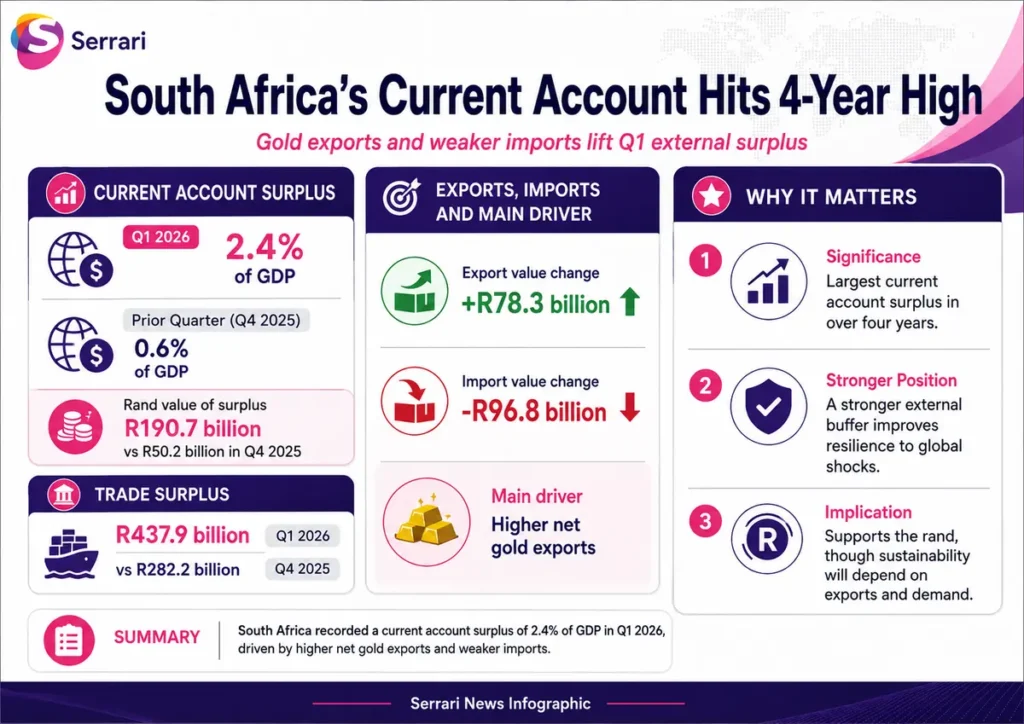
- South Africa’s current account surplus widened to 2.4% of GDP in Q1 2026.
- The surplus rose to R190.7 billion from R50.2 billion in Q4 2025.
- The trade surplus widened to R437.9 billion from R282.2 billion.
- Higher merchandise and net gold exports drove the improvement.
- Imports fell as both prices and volumes declined.
- The surplus was the largest since the third quarter of 2021.
Gold Exports Lift External Balance
South Africa’s current account improved sharply in the first quarter, rising to a surplus of 2.4% of GDP from 0.6% in the previous quarter. In rand terms, the surplus widened to R190.7 billion from R50.2 billion, according to central bank data.
The current account is the broadest measure of a country’s trade and income flows with the rest of the world. A surplus means South Africa earned more from exports, income and transfers than it paid out during the quarter.
The improvement was mainly driven by stronger goods trade. The trade surplus rose to R437.9 billion from R282.2 billion, as the value of merchandise and net gold exports increased while imports declined. The value of exports of goods and services rose by R78.3 billion, supported by both higher prices and stronger volumes.
Gold played a key role in the improvement. Elevated gold prices have supported South Africa’s export receipts, while stronger net gold exports helped offset pressure from services, income and transfer payments.
Context is everything. Stay ahead of shifting trends with today’s market updates, and uncover emerging opportunities using the Serrari Group Market Index and Marketplace. Then, take control of your own financial future by exploring our Money & Life Reset Transformation Blueprint ™ to build stronger habits, create better systems, and design a path toward lasting wealth.
Import Decline Adds to Surplus
The export gain was reinforced by a sharp fall in imports. The value of imported goods and services declined by R96.8 billion in the first quarter as both prices and volumes decreased.
That combination strengthened South Africa’s external position, but it also points to a mixed economic picture. Lower imports can improve the current account in the short term, yet they may also reflect softer domestic demand, weaker investment appetite or lower industrial activity.
The surplus beat expectations. Economists surveyed by Bloomberg had expected a current account surplus of 1.1% of GDP, compared with the reported 2.4%. The first-quarter reading marked the second consecutive quarterly surplus and the strongest current account position since the third quarter of 2021.
Rand Gets Support, But Risks Remain
A stronger current account can support the rand because it reduces the economy’s dependence on external financing. The improved balance also comes at a useful time, as South Africa faces renewed uncertainty from higher oil prices, global risk aversion and tighter monetary conditions.
However, the broader macro environment remains fragile. The South African Reserve Bank has warned that the country’s financial system is likely to remain resilient, but that the Middle East conflict has affected the outlook through oil markets, capital flows and household finances. In its financial stability review, the central bank said the oil price shock could continue to exert inflationary pressure and may delay relief for interest-rate sensitive households.
South Africa’s current account improvement therefore gives the economy some breathing room, but it does not remove underlying vulnerabilities. Investors will watch whether the trade surplus is sustained, whether gold prices remain supportive, and whether import weakness reflects temporary price effects or deeper demand softness.
Strong Quarter May Not Be Enough
The first-quarter surplus is a positive signal for South Africa’s external accounts, especially after years of pressure from weak growth, power constraints and fiscal concerns. It also helps improve market confidence at a time when investors are closely watching emerging-market resilience.
Still, the quality of the surplus matters. A surplus driven by high gold prices and lower imports may be less durable than one supported by broad export growth, rising manufacturing output and stronger productivity. If imports recover while gold prices ease, the current account could narrow again.
For now, South Africa enters the second quarter with a stronger external cushion, but the sustainability of the improvement will depend on commodity markets, domestic demand and global financial conditions.
Sources Used: Reuters / Bloomberg / Daily Investor / Zawya / South African Reserve Bank
Your financial future isn’t something you wait for—it’s something you build.
The real question is: when do you begin?
Move beyond simply staying informed.
Navigate the markets with clarity—track trends through the Serrari Group Market Index, uncover opportunities in the Serrari Marketplace, and build practical knowledge with our Curated Wealth Builder Platform.
Stay connected to what truly matters.
Get daily insights on macro trends and financial movements across Kenya, Africa, and global markets—delivered through the Serrari Newsletter.
Growth opens doors.
Advance your career through professional programs including ACCA, HESI A2, ATI TEAS 7 , HESI EXIT , NCLEX – RN and NCLEX – PN, Financial Literacy!🌟—designed to move you forward with confidence.
See where money is flowing—clearly and in real time.
Track Money Market Funds, Treasury Bills, Treasury Bonds, Green Bonds, and Fixed Deposits, alongside global and African indexes, key economic indicators, and the evolving Crypto and stablecoin landscape—all within Serrari’s Market Index.