Samsung Electronics reported its strongest quarterly earnings on October 29, 2026, as surging demand for artificial intelligence memory chips pushed operating profit to 107.4 trillion won ($80.5 billion). Yet its shares fell despite the historic result, underscoring investor concerns about demanding valuations, the durability of AI infrastructure spending and the timing of shareholder payouts.
Key Overview
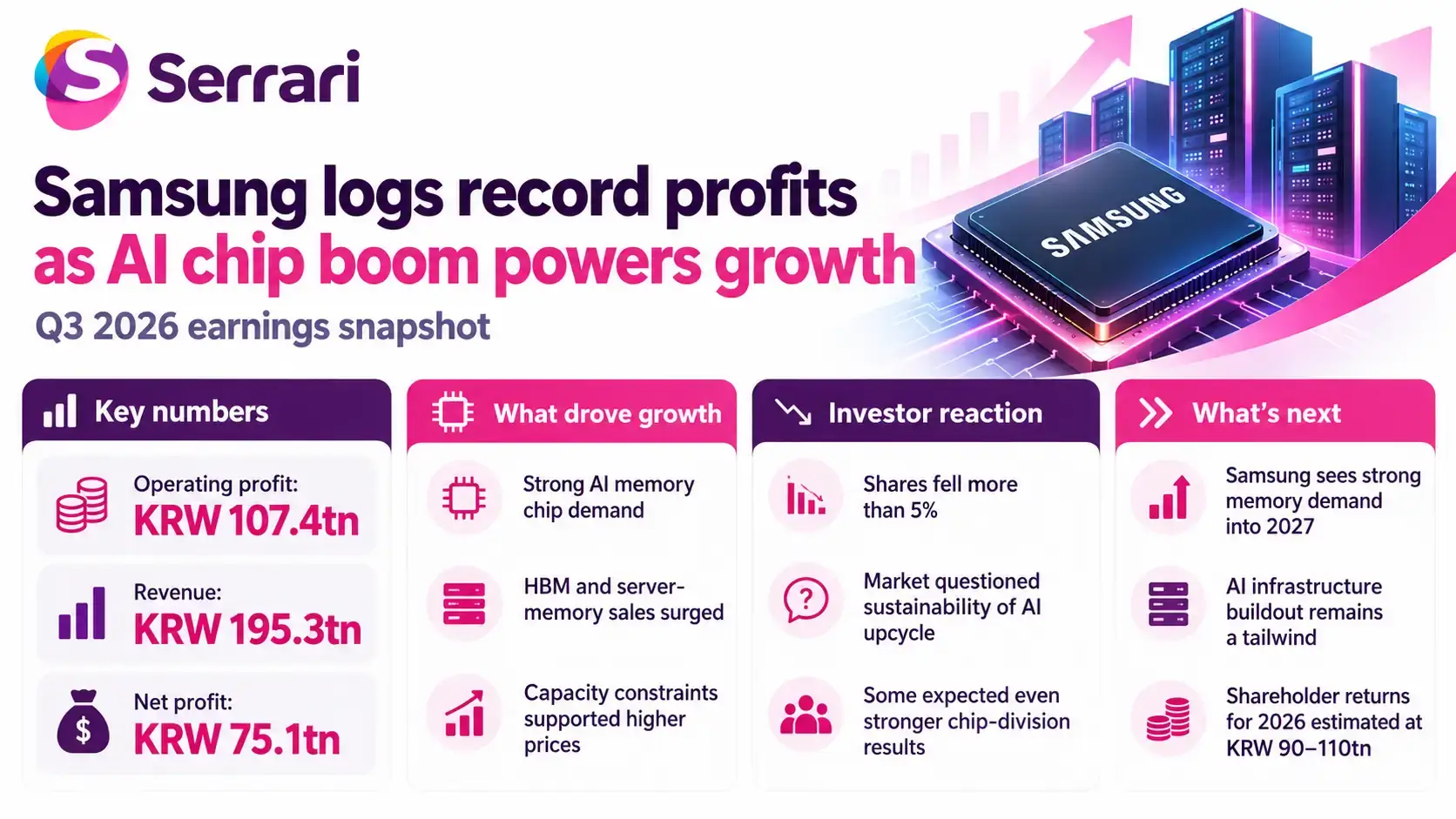
- Operating profit climbed 783.1% year on year to 107.44 trillion won in the July–September quarter.
- Revenue rose 126.9% to 195.25 trillion won, while net profit jumped 514.6% to 75.13 trillion won.
- Samsung’s semiconductor division generated 106.5 trillion won in operating profit, accounting for roughly 99% of the group total.
- Shares fell by more than 5% at one point on October 29, despite the record earnings.
- Samsung projects shareholder returns of 90–110 trillion won for 2026, with final execution details due in January 2027.
AI Memory Boom Powers Historic Earnings
Samsung’s third-quarter financial results showed revenue of 195.3 trillion won and operating profit of 107.4 trillion won, the first time the company has crossed the 100 trillion won quarterly operating-profit threshold. The semiconductor-focused Device Solutions division recorded 147.1 trillion won in revenue and 106.5 trillion won in operating profit, highlighting the overwhelming contribution of chip demand.
Demand from AI data centers has lifted sales of high-bandwidth memory (HBM), which works alongside powerful processors, as well as server DRAM and solid-state drives. Samsung said it increased HBM4 sales significantly during the quarter while benefiting from rising memory prices amid capacity constraints.
However, the boom has not benefited every business equally. Its Device eXperience division reported a 0.8 trillion won operating loss, reflecting pressure elsewhere in the group. Higher component costs can also squeeze electronics manufacturers that purchase memory for smartphones, computers and other consumer devices.
Why Shares Fell Despite Record Earnings
Samsung’s stock fell sharply in Thursday trading, losing more than 5% at one stage. Investors had already priced in exceptionally strong results, and some market participants expected even greater profitability from the semiconductor unit.
Headline operating profit exceeded some market consensus estimates, but net profit missed analysts’ forecasts. This distinction helps explain why record-breaking results did not automatically translate into a higher share price. Investors are increasingly focused on the sustainability of chip prices and whether AI spending can continue generating returns for the companies buying expensive computing infrastructure.
The uncertainty is not necessarily about immediate demand. It concerns how long the current shortage and premium pricing environment can persist as manufacturers expand production capacity.
Context is everything. Stay ahead of shifting trends with today’s market updates, and uncover emerging opportunities using the Serrari Group Market Index and Marketplace. Then, take control of your own financial future by exploring our Money & Life Reset Transformation Blueprint ™ to build stronger habits, create better systems, and design a path toward lasting wealth.
Samsung Expects AI Demand to Outrun Supply in 2027
Samsung’s 2027 semiconductor outlook forecasts historically high AI infrastructure investment and demand growth exceeding industry supply. The company plans to prioritize HBM, server memory and advanced chips, while pursuing longer-term customer contracts and preparing its Taylor, Texas, fabrication facility for operations.
Its planned 2026 capital expenditure stands at approximately 84.4 trillion won, including 76.8 trillion won for the semiconductor division. The investment should support future capacity, but also illustrates how much capital chipmakers must commit to remain competitive.
Shareholder Returns Become a Key Investor Test
Samsung also outlined shareholder-return plans totaling an estimated 90–110 trillion won for 2026. This includes a third-quarter cash dividend of 30 trillion won, with 35 trillion won already planned or completed and another 55–75 trillion won expected through dividends and substantial share repurchases and cancellations.
Importantly, the precise remaining payout arrangements and the next shareholder-return policy are scheduled for finalization at a board meeting in late January 2027. The proposed distributions may help address investor concerns about how the AI windfall is shared, but the company’s valuation will also depend on whether exceptional chip earnings prove sustainable.
Sources: Samsung Global Newsroom / Yonhap News Agency / Seoul Economic Daily / Reuters
Your financial future isn’t something you wait for—it’s something you build.
The real question is: when do you begin?
Move beyond simply staying informed.
Navigate the markets with clarity—track trends through the Serrari Group Market Index, uncover opportunities in the Serrari Marketplace, and build practical knowledge with our Curated Wealth Builder Platform.
Stay connected to what truly matters.
Get daily insights on macro trends and financial movements across Kenya, Africa, and global markets—delivered through the Serrari Newsletter.
Growth opens doors.
Advance your career through professional programs including ACCA, HESI A2, ATI TEAS 7 , HESI EXIT , NCLEX – RN and NCLEX – PN, Financial Literacy!🌟—designed to move you forward with confidence.
See where money is flowing—clearly and in real time.
Track Money Market Funds, Treasury Bills, Treasury Bonds, Green Bonds, and Fixed Deposits, alongside global and African indexes, key economic indicators, and the evolving Crypto and stablecoin landscape—all within Serrari’s Market Index.