Climate Fund Managers has secured approval for $140 million in catalytic financing from the Green Climate Fund (GCF) to support industrial decarbonisation in South Africa and Namibia. The investment will flow through the Southern African Industrial Decarbonisation Facility, linked to Climate Investor Three (CI3), a blended-finance platform seeking to mobilise $1.2 billion.
Key Overview
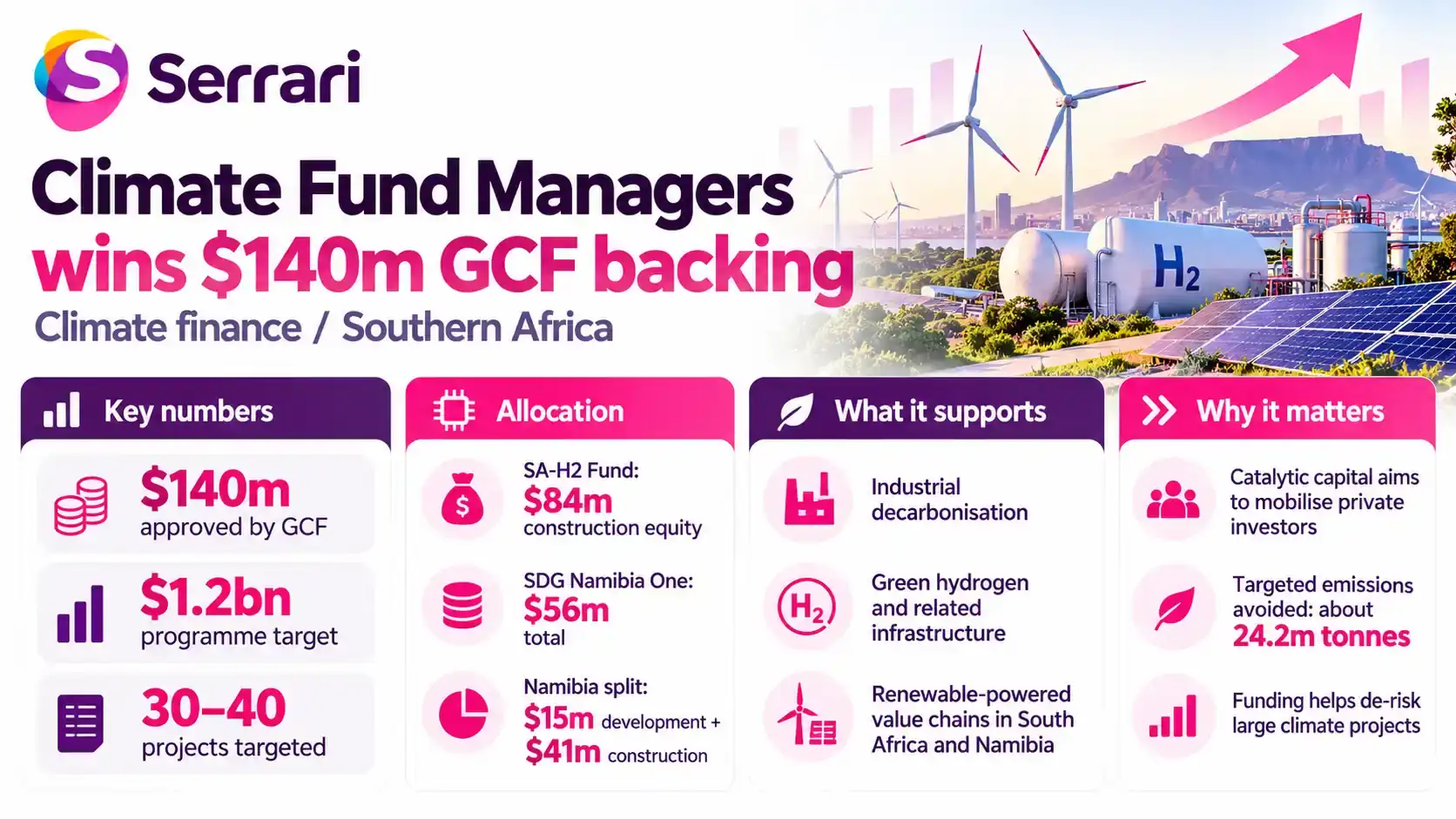
- GCF approved $140 million on October 27, 2026, for a programme valued at $1.2 billion.
- South Africa’s SA-H2 Fund is allocated $84 million in construction equity financing.
- Namibia’s SDG Namibia One Fund is allocated $56 million: $15 million for project development and $41 million for construction equity.
- The programme aims to support low-carbon industry, green hydrogen and associated infrastructure, with an estimated 24.2 million tonnes of avoided emissions over its lifetime.
- The Development Bank of Southern Africa will oversee the GCF-backed programme as accredited entity.
How the $140 Million Will Be Deployed
The approved GCF project record identifies $140 million in GCF equity alongside a proposed $1.06 billion in co-financing, bringing the planned programme value to $1.2 billion. This means the remaining capital is part of the financing plan, not an additional sum already disbursed by GCF.
According to the October 28 financing announcement, $84 million is earmarked for SA-H2’s construction equity tranche in South Africa. The remaining $56 million will support SDG Namibia One, split between $15 million for project preparation and $41 million for construction equity.
The two tranches address different obstacles. Early-stage funding helps pay for feasibility work, permits and technical planning, while construction equity supports projects once they are ready to build. Using concessional, risk-absorbing capital at these stages can make projects more attractive to commercial investors, although it cannot guarantee their profitability.
Green Hydrogen and Heavy Industry Take Centre Stage
CI3 targets renewable generation, hydrogen production, transport infrastructure and industrial customers that could replace emissions-intensive fuels and feedstocks. Its Southern African pipeline includes green ammonia, methanol, iron and fertiliser projects.
In South Africa, SA-H2 has signed development funding agreements involving Hive Hydrogen’s Coega green ammonia project and a wastewater-to-green-methanol facility. In Namibia, supported projects include Hyphen’s hydrogen development, HyIron’s Oshivela green iron venture and the Dâures fertiliser project. These agreements signal project preparation rather than completed facilities.
The GCF programme assessment and approved project profile set out expected climate benefits, including approximately 24.2 million tonnes of carbon-dioxide-equivalent emissions avoided. Such figures are forecasts that depend on successful financing, construction and operation.
Context is everything. Stay ahead of shifting trends with today’s market updates, and uncover emerging opportunities using the Serrari Group Market Index and Marketplace. Then, take control of your own financial future by exploring our Money & Life Reset Transformation Blueprint ™ to build stronger habits, create better systems, and design a path toward lasting wealth.
Existing Investors Provide a Starting Point
CI3 is not starting from zero. SA-H2 reached a R3 billion first close in August 2026, with commitments from development institutions, South African investors and insurers. CI3’s development tranche also secured initial commitments of €150 million from Invest International and the European Commission.
The GCF investment strengthens this funding base, but the $1.2 billion remains a mobilisation target. Investors will still assess power supply, long-term customer contracts, construction costs and whether green industrial products can compete commercially.
What the Approval Means for Southern Africa
For South Africa and Namibia, the opportunity extends beyond renewable electricity generation. Financing hydrogen-linked industrial value chains could support manufacturing activity, exports and employment if projects reach commercial operation.
The immediate test is execution: turning development agreements and approved financing into investable, operating assets. The GCF’s project listing shows the programme as approved but not yet under implementation, making fundraising, project readiness and financial close the next milestones to watch.
Sources: Green Climate Fund / Development Bank of Southern Africa / African Private Capital Association / Climate Fund Managers
Your financial future isn’t something you wait for—it’s something you build.
The real question is: when do you begin?
Move beyond simply staying informed.
Navigate the markets with clarity—track trends through the Serrari Group Market Index, uncover opportunities in the Serrari Marketplace, and build practical knowledge with our Curated Wealth Builder Platform.
Stay connected to what truly matters.
Get daily insights on macro trends and financial movements across Kenya, Africa, and global markets—delivered through the Serrari Newsletter.
Growth opens doors.
Advance your career through professional programs including ACCA, HESI A2, ATI TEAS 7 , HESI EXIT , NCLEX – RN and NCLEX – PN, Financial Literacy!🌟—designed to move you forward with confidence.
See where money is flowing—clearly and in real time.
Track Money Market Funds, Treasury Bills, Treasury Bonds, Green Bonds, and Fixed Deposits, alongside global and African indexes, key economic indicators, and the evolving Crypto and stablecoin landscape—all within Serrari’s Market Index.