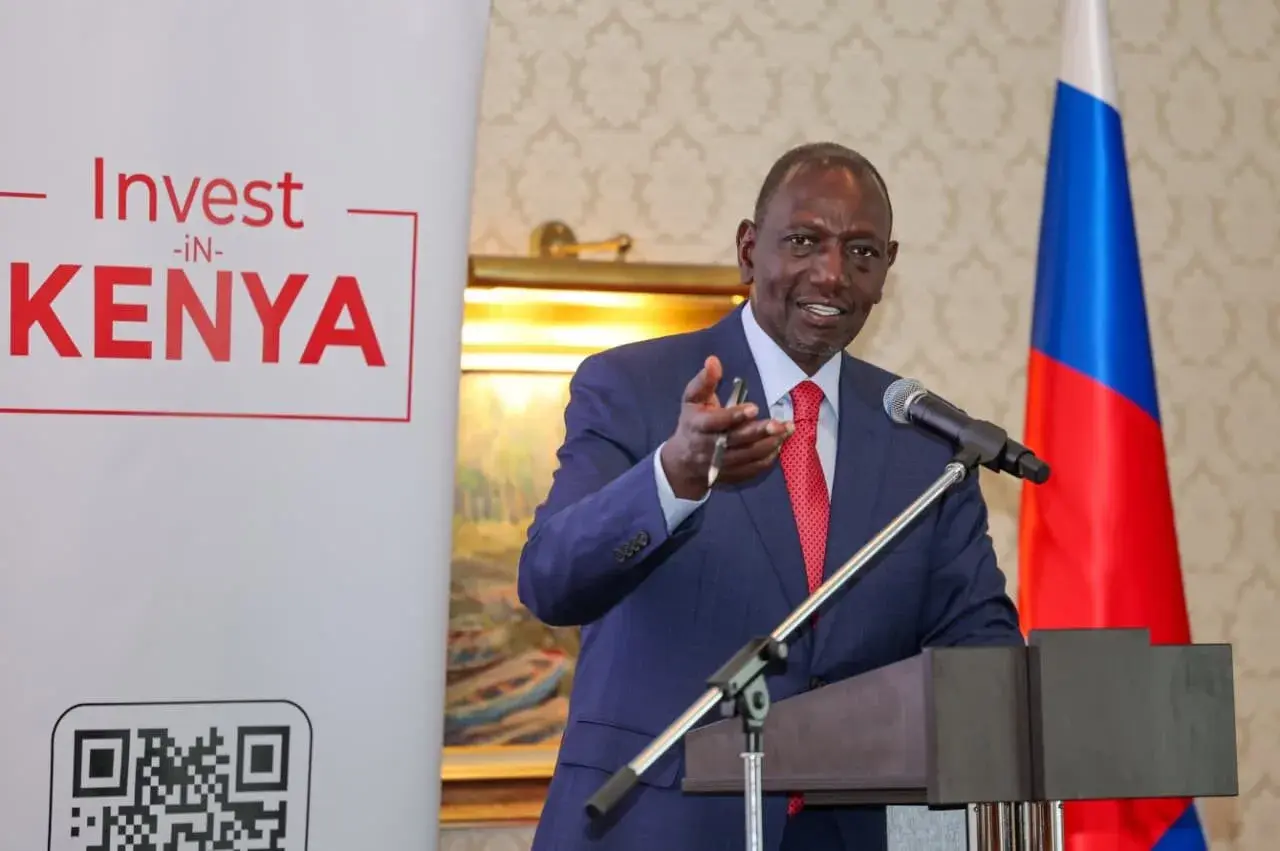
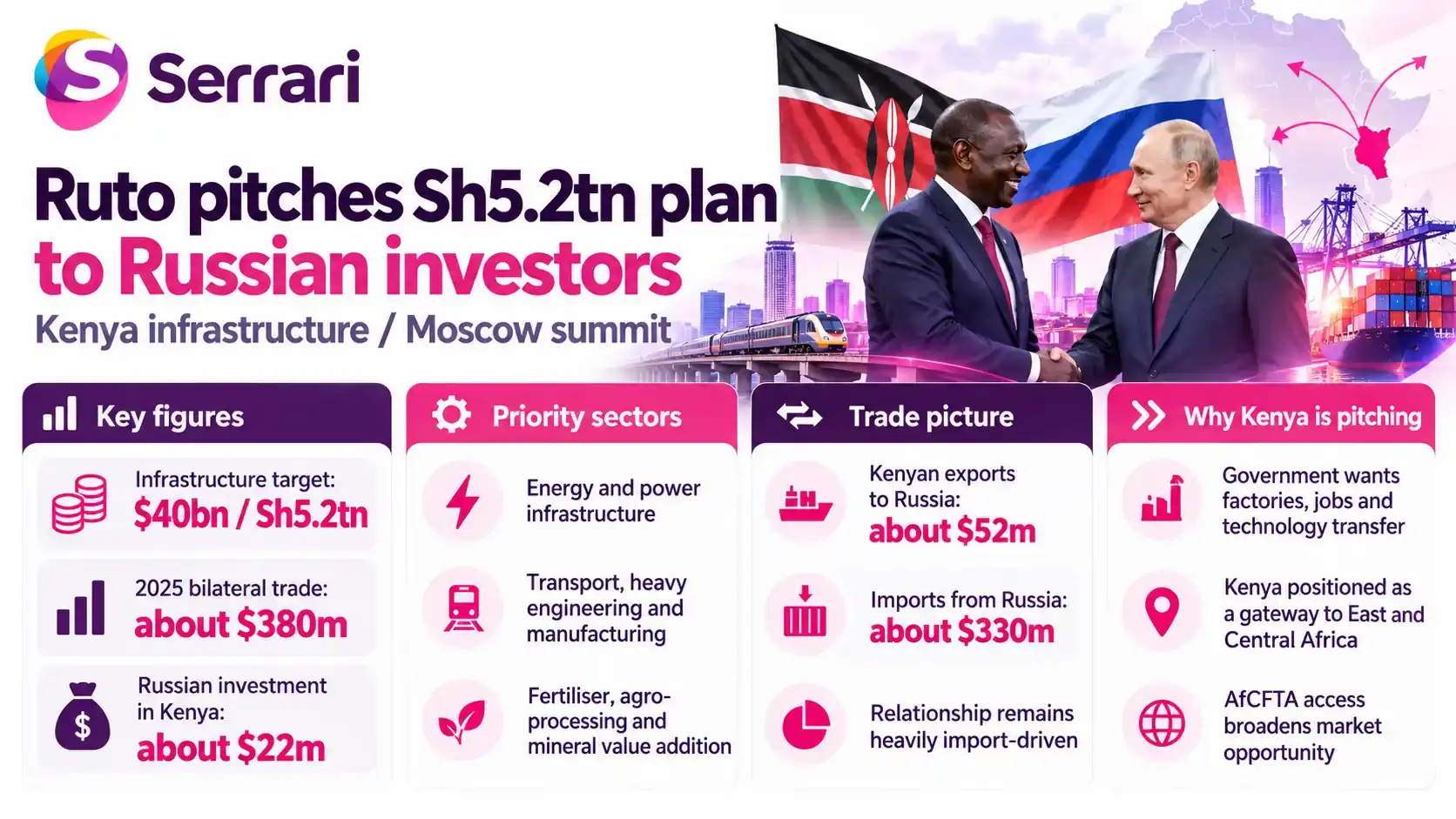
President William Ruto has invited Russian investors to participate in Kenya’s proposed $40 billion (about Sh5.2 trillion) infrastructure financing drive over the next decade, pitching manufacturing, energy and agricultural development at a business roundtable in Moscow on October 28, 2026. The proposal seeks to turn a largely import-driven relationship into one that creates factories and jobs in Kenya. However, the $40 billion is Kenya’s broader fundraising ambition, not a Russian investment pledge or a signed financing agreement.
Key Overview
- Kenya is targeting about $40 billion in infrastructure investment over ten years, with Russian firms invited to participate.
- Priority opportunities include transport, energy, fertiliser manufacturing, mineral processing, irrigation and industrial production.
- Ruto cited bilateral trade of approximately $380 million in 2025, including $52 million of Kenyan exports and $330 million of imports.
- The President estimated existing Russian investment in Kenya at just $22 million, illustrating the gap between current investment and Kenya’s ambitions.
- Financing arrangements, project commitments and implementation timelines for Russian investors have not been announced.
Kenya Pitches Infrastructure and Local Manufacturing
At the Russia–Kenya business roundtable, Ruto encouraged Russian companies to set up production facilities rather than rely on trading finished products. He linked Kenya’s ten-year infrastructure financing goal to opportunities in power generation, transportation, heavy engineering and manufacturing.
The President also highlighted geothermal energy, green hydrogen, electric mobility and power infrastructure as potential areas of cooperation. In agriculture, Kenya is seeking investment in irrigation, mechanisation, fertiliser production and processing facilities that could increase domestic value addition.
Ruto described Kenya as a platform for serving regional markets under the African Continental Free Trade Area. The investment case rests on combining foreign capital and technical expertise with Kenyan labour, resources and access to neighbouring economies. Whether that proposition attracts investors will depend on commercially viable projects, financing terms and regulatory clarity.
A Trade Relationship Dominated by Kenyan Imports
Kenya’s bilateral trade position provides context for the outreach. At the roundtable, Ruto placed 2025 trade at approximately $380 million, consisting of $330 million of imports from Russia and $52 million of Kenyan exports. On those figures, Kenya’s trade deficit was about $278 million.
Imports include wheat, fertiliser and iron and steel products, while Kenya exports tea, coffee, flowers and other agricultural produce. But the figures quoted in the speech should not be confused with Kenya’s own reported merchandise-trade statistics, which put 2025 imports from Russia at Sh33.33 billion and exports at Sh6.73 billion. The differing totals point to a need to establish the basis and coverage of each dataset before drawing precise comparisons.
Ruto’s proposal seeks to shift the balance toward local processing and manufacturing. Yet Russian investment, estimated by the President at $22 million, remains small relative to the proposed infrastructure programme.
Context is everything. Stay ahead of shifting trends with today’s market updates, and uncover emerging opportunities using the Serrari Group Market Index and Marketplace. Then, take control of your own financial future by exploring our Money & Life Reset Transformation Blueprint ™ to build stronger habits, create better systems, and design a path toward lasting wealth.
Sanctions and Financing Risks Could Complicate Deals
Kenya’s Moscow investment agenda comes amid sanctions and banking restrictions linked to Russia’s invasion of Ukraine. These can complicate cross-border payments, access to international finance, technology procurement and dealings with sanctioned counterparties.
That does not prevent every lawful commercial relationship, but potential projects would require careful due diligence on the companies involved, payment channels, procurement arrangements and applicable sanctions. Infrastructure investors would also need clarity on project revenues, currency exposure, public guarantees and how financial risks are allocated.
The wider Russia–Africa summit discussions reflect Moscow’s effort to expand trade and diplomatic engagement across the continent. For Kenya, the central question is whether this engagement results in funded ventures rather than statements of intent.
What Happens Next for Kenya’s Investment Drive?
Ruto has urged Russian businesses to identify specific investments and develop partnerships with Kenyan companies. The next indicators of progress will be named projects, committed funding, agreed financing structures and implementation schedules.
For now, the Sh5.2 trillion figure defines the scale of Kenya’s infrastructure ambition, not an amount secured in Moscow. Actual economic benefits will depend on whether proposed partnerships translate into operating factories, reliable infrastructure, export growth and employment.
Sources: Daily Nation / The Star / The Standard / Reuters
Your financial future isn’t something you wait for—it’s something you build.
The real question is: when do you begin?
Move beyond simply staying informed.
Navigate the markets with clarity—track trends through the Serrari Group Market Index, uncover opportunities in the Serrari Marketplace, and build practical knowledge with our Curated Wealth Builder Platform.
Stay connected to what truly matters.
Get daily insights on macro trends and financial movements across Kenya, Africa, and global markets—delivered through the Serrari Newsletter.
Growth opens doors.
Advance your career through professional programs including ACCA, HESI A2, ATI TEAS 7 , HESI EXIT , NCLEX – RN and NCLEX – PN, Financial Literacy!🌟—designed to move you forward with confidence.
See where money is flowing—clearly and in real time.
Track Money Market Funds, Treasury Bills, Treasury Bonds, Green Bonds, and Fixed Deposits, alongside global and African indexes, key economic indicators, and the evolving Crypto and stablecoin landscape—all within Serrari’s Market Index.