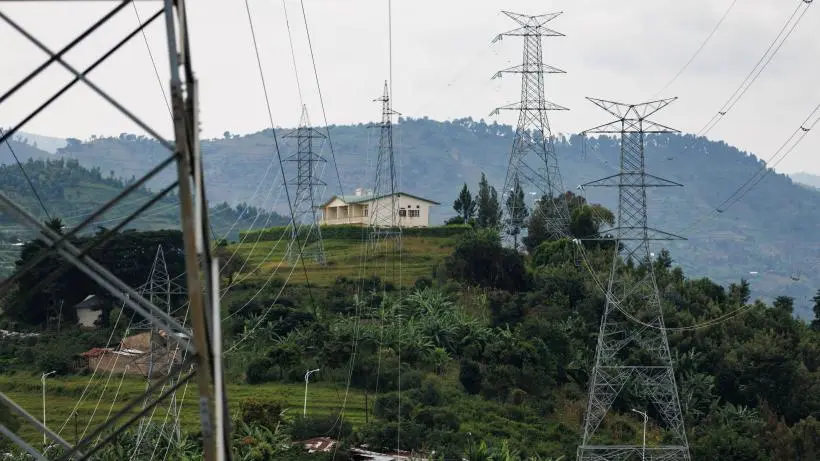
Rwanda has chosen to keep its electricity transmission and distribution networks under state control, even as Kenya and Uganda expand private-sector participation in grid infrastructure. Kigali will continue welcoming private investment in power generation, but argues that public ownership of networks is necessary to protect affordability and equitable access.
Key Overview
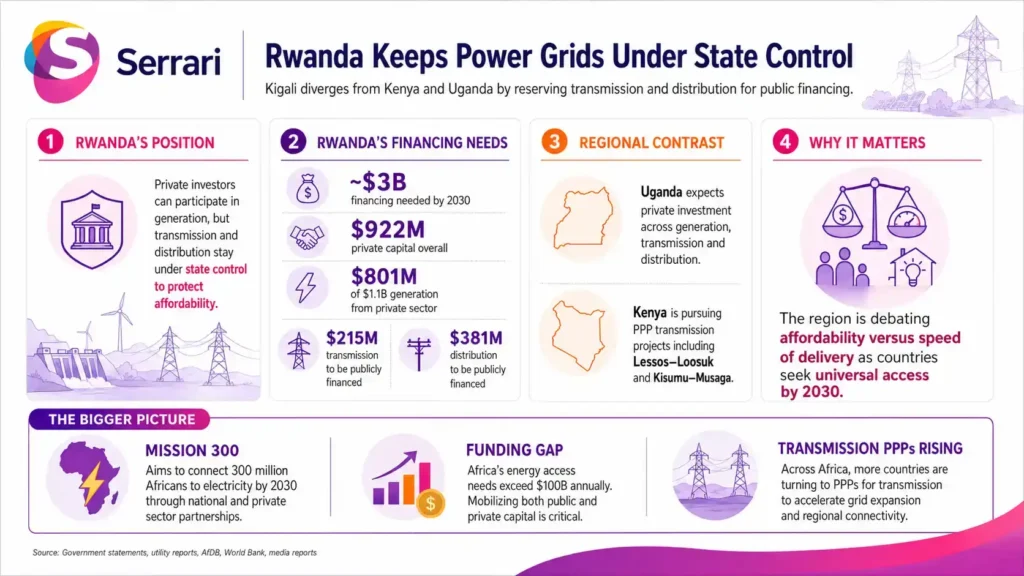
Rwanda estimates that achieving universal electricity access by 2030 will require close to $3 billion, including $922 million from private investors. That private capital will be directed mainly toward generation, while the government plans to fund transmission, distribution, regional interconnections and household connections. Uganda and Kenya are taking a different route by using public-private partnerships to mobilise capital for transmission projects.
Rwanda Draws a Line Around Grid Ownership
Rwanda’s energy strategy allows independent power producers and private partners to develop generation projects, but transmission and distribution will remain public responsibilities. The decision reflects concern that private investors seeking commercial returns could add pressure to already-sensitive electricity tariffs.
The country’s 2025 energy policy prioritises reliable, affordable and sustainable electricity while maintaining strong government coordination over critical infrastructure.
Rwanda needs about $1.1 billion for electricity generation, with private investors expected to provide roughly $801 million, equivalent to about 73% of that requirement. Transmission requires approximately $215 million, while distribution needs about $381 million. The government also expects to finance around $198 million for regional interconnections and $491 million for household grid connections.
This means private capital will remain important to Rwanda’s electricity expansion, but it will not own or operate the core networks that carry power from generators to consumers.
Uganda Uses Private Capital to Accelerate Expansion
Uganda has adopted a broader private-investment model as it seeks to increase electricity access from about 60% to 85% by 2030. Its national energy compact estimates total financing needs of approximately $17.7 billion.
Private players are expected to contribute across generation, transmission, distribution, off-grid electricity and clean cooking. The proposed private-sector share includes $6.5 billion of the $9.8 billion required for generation, $450 million toward transmission and $350 million for distribution.
Uganda’s shift is already visible in the Amari Power Transmission project. In March 2026, the project became the first independent transmission project in Africa to reach financial close.
Developed by Gridworks, the approximately $50 million project will upgrade four high-voltage substations at Tororo, Nkenda, Mbarara North and Kawaala. The upgrades are intended to improve system reliability, reduce technical losses and increase the grid’s capacity to absorb renewable electricity.
Kenya Advances Transmission Through PPPs
Kenya is also moving toward privately financed transmission infrastructure. Africa50 and Power Grid Corporation of India are developing the Kenya Transmission PPP Project, covering the 400kV Lessos–Loosuk and 220kV Kisumu–Musaga lines.
The consortium is responsible for developing, financing, constructing and operating the two lines under a public-private partnership framework. The projects are intended to strengthen power evacuation, improve regional reliability and support electricity access in western Kenya.
Kenya’s National Energy Compact also identifies private participation, stronger utilities and expanded transmission capacity as important to reaching universal electricity access.
Context is everything. Stay ahead of shifting trends with today’s market updates, and uncover emerging opportunities using the Serrari Group Market Index and Marketplace. Then, take control of your own financial future by exploring our Money & Life Reset Transformation Blueprint ™ to build stronger habits, create better systems, and design a path toward lasting wealth.
Affordability Versus Speed of Delivery
The differing strategies reflect a wider debate across Africa. State ownership can give governments greater control over tariffs, service obligations and network planning. It can also ensure that remote communities are not excluded because they offer weaker commercial returns.
However, public utilities often face debt constraints, limited capital budgets and competing national priorities. These pressures can delay transmission lines, substations and distribution upgrades even when demand is growing rapidly.
Private finance can speed up construction and introduce technical expertise, but projects require carefully designed contracts. Poorly structured guarantees, rigid availability payments or weak regulation can transfer excessive risk to governments and consumers.
The outcome therefore depends less on whether infrastructure is publicly or privately financed than on the quality of regulation, procurement, risk allocation and tariff design.
Africa’s Funding Gap Drives New Models
Mission 300 aims to connect 300 million Africans to electricity by 2030, combining national reforms, public investment, development finance and private capital.
The International Energy Agency estimates that private clean-energy spending in Africa must rise substantially this decade. Its analysis indicates that private investment needs to grow from roughly $75 billion to about $190 billion by 2030 under a pathway that meets the continent’s energy and climate goals.
The Central African Republic, for example, plans to attract up to $600 million in private energy investment by 2030, representing around 30% of its financing requirement.
These funding needs explain why transmission PPPs are receiving greater attention. Generation projects have attracted private investors for decades, but independent transmission remains relatively new in Africa because networks are natural monopolies and require long-term regulatory certainty.
Different Routes Toward the Same Goal
Rwanda, Uganda and Kenya are pursuing the same broad objective: wider, more reliable and affordable electricity access. Their disagreement is over how much of the network should be opened to private capital.
Rwanda is betting that public ownership will protect affordability and allow the state to direct investment according to national priorities. Uganda and Kenya believe regulated private participation can mobilise capital faster and reduce pressure on public budgets.
The performance of the Amari project and Kenya’s transmission PPPs will be closely watched. If they deliver infrastructure efficiently without creating unaffordable tariffs or heavy public liabilities, they could become templates for other African markets.
Rwanda’s model will face an equally important test: whether the state can mobilise enough public and concessional funding to build and maintain its networks while achieving universal access by 2030.
Sources: The EastAfrican / Ministry of Infrastructure Rwanda / World Bank / African Development Bank / Gridworks / Africa50 / International Energy Agency
Your financial future isn’t something you wait for—it’s something you build.
The real question is: when do you begin?
Move beyond simply staying informed.
Navigate the markets with clarity—track trends through the Serrari Group Market Index, uncover opportunities in the Serrari Marketplace, and build practical knowledge with our Curated Wealth Builder Platform.
Stay connected to what truly matters.
Get daily insights on macro trends and financial movements across Kenya, Africa, and global markets—delivered through the Serrari Newsletter.
Growth opens doors.
Advance your career through professional programs including ACCA, HESI A2, ATI TEAS 7 , HESI EXIT , NCLEX – RN and NCLEX – PN, Financial Literacy!🌟—designed to move you forward with confidence.
See where money is flowing—clearly and in real time.
Track Money Market Funds, Treasury Bills, Treasury Bonds, Green Bonds, and Fixed Deposits, alongside global and African indexes, key economic indicators, and the evolving Crypto and stablecoin landscape—all within Serrari’s Market Index.