














The Organization for Economic Cooperation and Development (OECD) has revised down its global economic growth projection for 2026 to 2.8%, down from its previous forecast of 2.9%. The 38-nation industrialized bloc warned that escalating conflict in the Middle East—ignited by military strikes involving the US, Israel, and Iran—has severely disrupted Gulf oil and gas exports. The resulting energy supply crunch is driving inflation higher, threatening to tip vulnerable economies into recession, and dampening capital investments across major commercial sectors worldwide.
Key Overview
- Slowing Momentum: Global GDP growth is projected to drop from 3.4% in 2025 down to 2.8% in 2026, assuming Gulf energy exports begin stabilizing by the third quarter.
- Worst-Case Outlook: A prolonged military conflict extending into next year could crater global expansion to 2.1% in 2026 and a stagnant 1.8% by 2027.
- Inflationary Pressures: Global inflation is forecasted to jump to 4.0% this year, up significantly from the 3.4% baseline recorded in 2025.
- Regional Slump: The Eurozone faces a sharp downturn, with GDP growth expected to plummet to 0.8% this year compared to 1.4% in the previous year.
Dual Trajectories and Macroeconomic Fallout
The sudden escalation of geopolitical hostilities in late February has introduced severe volatility into international commodities. In its June Economic Outlook report, the OECD outlined two distinct operational paths for the global economy depending entirely on the duration of the crisis. Under the baseline “time-limited disruption” model, supply chains and shipping corridors are expected to gradually recover over the next few months, containing the full-year global economic retreat to a moderate 2.8%.
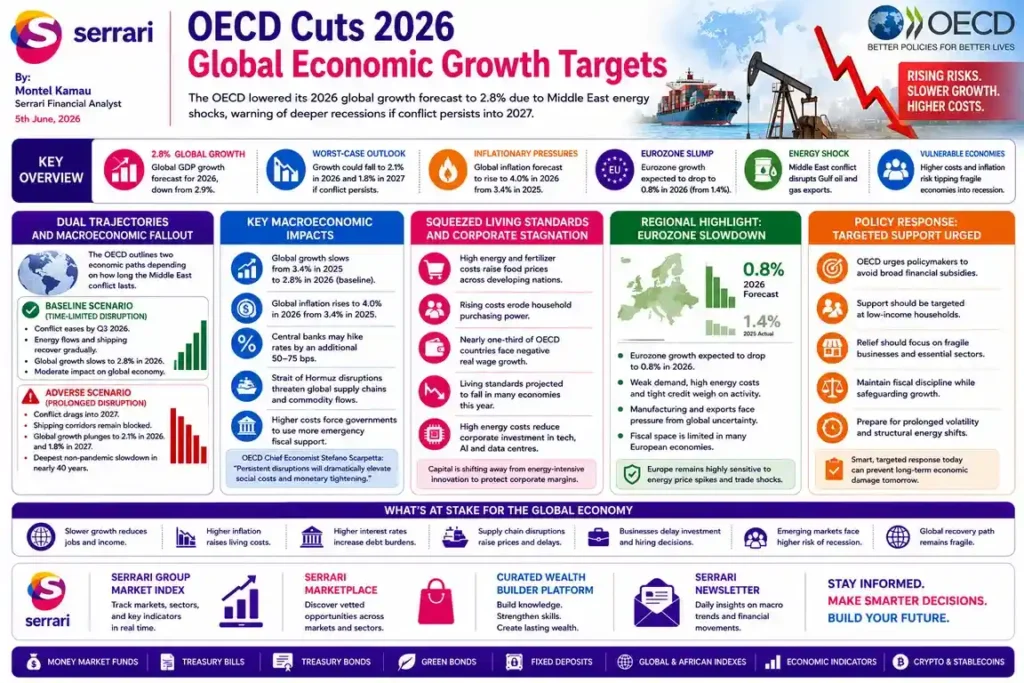
However, if an effective ceasefire is not reached before 2027, the “prolonged disruption” model points toward the deepest non-pandemic worldwide economic slowdown in nearly 40 years. Ongoing closures of critical maritime corridors like the Strait of Hormuz would cause severe shortages of industrial and agricultural inputs. OECD Chief Economist Stefano Scarpetta emphasized that persistent disruptions will dramatically elevate social costs, forcing central banks to hike interest rates by an extra 50 to 75 basis points to curb runaway energy markets.
Context is everything. Stay ahead of shifting trends with today’s market updates, and uncover emerging opportunities using the Serrari Group Market Index and Marketplace. Then, take control of your own financial future by exploring our Money & Life Reset Transformation Blueprint ™ to build stronger habits, create better systems, and design a path toward lasting wealth.
Squeezed Living Standards and Corporate Stagnation
The localized fallout from high hydrocarbon prices is hurting both household consumption and advanced technological investments. Developing nations are bearing the brunt of the shock due to the disproportionately high share of energy and fertilizer costs within their domestic food supplies. These compounding factors are directly eroding purchasing power, with nearly one-third of OECD nations now projected to experience negative real wage growth and a noticeable drop in overall living standards this year.
Simultaneously, the shock is shifting the allocation of corporate capital. High energy costs are reducing the massive funding pools previously dedicated to tech breakthroughs, specifically targeting energy-intensive AI development and data center infrastructure. In response to these vulnerabilities, the OECD has urged global policymakers to transition away from broad financial subsidies, recommending instead that state relief measures be strictly concentrated on low-income households and fragile businesses.
Sources: Anadolu Ajansı / Quartz / The Business Standard
Your financial future isn’t something you wait for—it’s something you build.
The real question is: when do you begin?
Move beyond simply staying informed.
Navigate the markets with clarity—track trends through the Serrari Group Market Index, uncover opportunities in the Serrari Marketplace, and build practical knowledge with our Curated Wealth Builder Platform.
Stay connected to what truly matters.
Get daily insights on macro trends and financial movements across Kenya, Africa, and global markets—delivered through the Serrari Newsletter.
Growth opens doors.
Advance your career through professional programs including ACCA, HESI A2, ATI TEAS 7 , HESI EXIT , NCLEX – RN and NCLEX – PN, Financial Literacy!🌟—designed to move you forward with confidence.
See where money is flowing—clearly and in real time.
Track Money Market Funds, Treasury Bills, Treasury Bonds, Green Bonds, and Fixed Deposits, alongside global and African indexes, key economic indicators, and the evolving Crypto and stablecoin landscape—all within Serrari’s Market Index.