South African motorists face historic financial strain as inland 95 unleaded petrol prices skyrocket to a record-high R28.06 per litre, driven by escalating geopolitical conflict between the United States, Israel, and Iran. To safeguard the domestic economy from intense inflationary pressures, the National Treasury and the Department of Mineral and Petroleum Resources implemented an extension of the general fuel levy reduction. This fiscal intervention significantly blunts the impact on consumer wallets, while a concurrent seasonal crash in international middle distillate costs delivers much-needed relief to diesel and illuminating paraffin users.
Key Overview
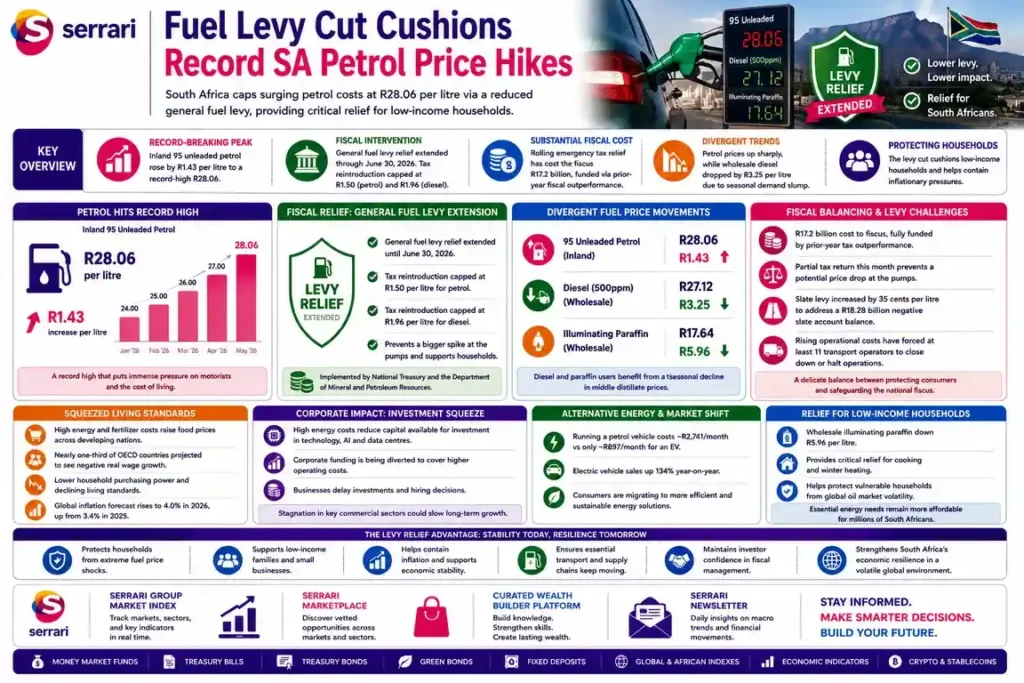
- Record-Breaking Peak: Inland 95 unleaded petrol increased by R1.43 per litre, hitting an unprecedented high of R28.06 at the pumps.
- Fiscal Intervention: National Treasury extended its general fuel levy relief, capping fuel tax reintroduction at R1.50 per litre for petrol and R1.96 per litre for diesel through June 30, 2026.
- Substantial Fiscal Cost: The ongoing rolling emergency tax relief has cost the national fiscus R17.2 billion, funded entirely via prior-year fiscal outperformance.
- Divergent Trends: While petrol costs advanced, wholesale 500ppm diesel plummeted by R3.25 per litre due to a seasonal demand slump in the Northern Hemisphere.
Fiscal Balancing and Sovereign Deficit Pressures
The implementation of the temporary General Fuel Levy (GFL) reduction represents a complex calculated risk for South Africa’s macro-fiscal health. Speaking at the CITI Emerging Markets Macro and Credit Conference, National Treasury Director-General Dr. Duncan Pieterse clarified that the R17.2 billion revenue shortfall will remain strictly fiscally neutral. Rather than expanding sovereign debt, the funding is pulled directly from previous tax collection windfalls.
However, the partial return of the tax burden this month—adding R1.50 back to petrol—prevented motorists from realizing a potential domestic price drop. The state is utilizing a controlled, phased rollback strategy to protect the fiscus while preventing massive price shocks. This structural transition occurs amid intensifying logistical friction, as the state-administered slate levy increased by 35 cents per litre to combat a staggering R18.28 billion negative balance in the cumulative slate account. The climbing operational overheads have put immense strain on transport companies, causing at least 11 transport operators to permanently halt operations or close down due to shrinking profit margins.
Context is everything. Stay ahead of shifting trends with today’s market updates, and uncover emerging opportunities using the Serrari Group Market Index and Marketplace. Then, take control of your own financial future by exploring our Money & Life Reset Transformation Blueprint ™ to build stronger habits, create better systems, and design a path toward lasting wealth.
Domestic Market Disruptions and Alternative Energy Migration
The retail reality of R28.06 per litre is reshaping consumer behavioral patterns across South Africa’s primary urban centers. The South African Petroleum Retailers Association warned that fuel station owners are experiencing a critical drop in total volumetric sales. Because fuel margins are legally fixed per litre rather than tied to percentage values, high prices compress dealer revenue by discouraging non-essential driving, forcing smaller regional sites to consider staff retrenchments or reduced operating hours.
Conversely, the persistent energy shock is rapidly accelerating the financial viability of alternative automotive technologies. Recent automotive market intelligence highlights that running a standard petrol vehicle now costs roughly R2,741 per month in fuel, compared to just R897 for an electric vehicle on identical distance distributions. This extreme operational cost gap has driven a massive 134% surge in local electric vehicle procurement over prior-year baselines. Meanwhile, vulnerable low-income households are finding temporary sanctuary in a massive R5.96 per litre drop in wholesale illuminating paraffin, insulating basic cooking and winter heating expenses from the global oil market volatility triggered by the partial closure of the strategic Strait of Hormuz shipping lanes.
Sources: Bizcommunity / SAnews / The Citizen / Daily Investor / MyBroadband / CAR Magazine
Your financial future isn’t something you wait for—it’s something you build.
The real question is: when do you begin?
Move beyond simply staying informed.
Navigate the markets with clarity—track trends through the Serrari Group Market Index, uncover opportunities in the Serrari Marketplace, and build practical knowledge with our Curated Wealth Builder Platform.
Stay connected to what truly matters.
Get daily insights on macro trends and financial movements across Kenya, Africa, and global markets—delivered through the Serrari Newsletter.
Growth opens doors.
Advance your career through professional programs including ACCA, HESI A2, ATI TEAS 7 , HESI EXIT , NCLEX – RN and NCLEX – PN, Financial Literacy!🌟—designed to move you forward with confidence.
See where money is flowing—clearly and in real time.
Track Money Market Funds, Treasury Bills, Treasury Bonds, Green Bonds, and Fixed Deposits, alongside global and African indexes, key economic indicators, and the evolving Crypto and stablecoin landscape—all within Serrari’s Market Index.