NCBA H1 results show a bank generating stronger income and rewarding shareholders more aggressively while also preparing for higher credit risk.
LIVENSE market summarySee NSE data →Profit after tax increased by 12.2% to KSh12.39 billion during the first half of 2026. Net interest income rose by 20.4% to KSh25.10 billion, supported by loan growth and lower funding costs.
The board increased the interim dividend by 50% to KSh3.75 per share from KSh2.50.
However, credit-loss provisions increased by approximately 60% to KSh5.17 billion, while gross non-performing loans reached KSh40.31 billion.
For investors, the central question is whether stronger margins, digital lending and regional diversification can continue supporting dividends while the bank absorbs higher provisions and completes its proposed ownership transaction with Nedbank.
Key Overview
- NCBA reported KSh12.39 billion in first-half profit after tax.
- Profit increased by 12.2% from the previous year.
- Net interest income increased by 20.4% to KSh25.10 billion.
- Operating income rose by 15.1% to KSh40.68 billion.
- The interim dividend increased by 50% to KSh3.75 per share.
- Credit-loss provisions rose by 60.3% to KSh5.17 billion.
- Gross non-performing loans increased to KSh40.31 billion.
- NCBA reported an NPL ratio of 10.5%.
- Customer deposits increased by 11% to KSh551.41 billion.
- Net loans increased to KSh345.88 billion.
- Digital-loan disbursements reached approximately KSh819 billion.
- Wealth assets under management increased to approximately KSh101 billion.
- The proposed Nedbank transaction remains subject to outstanding conditions and regulatory approvals.
NCBA H1 Results Lift Profit 12% as Dividend Jumps 50%
NCBA Group reported its highest first-half profit on record as stronger lending, lower funding costs and growing customer deposits supported another increase in earnings.
According to the current Kenyan Wall Street results report, profit after tax increased by 12.2% to KSh12.39 billion during the six months ended 30 June 2026.
Profit before tax rose by 14.3% to KSh15.49 billion, while earnings per share increased to KSh7.52 from KSh6.71.
However, the most significant shareholder development was the dividend.
NCBA increased its interim dividend from KSh2.50 to KSh3.75 per share, representing a 50% increase.
Dividend Growth Outpaced Earnings Growth
NCBA’s dividend increased considerably faster than its profit.
Profit after tax grew by 12.2%, while the interim dividend per share increased by 50%.
Comparing the KSh3.75 interim dividend with first-half earnings per share of KSh7.52 gives a simple payout comparison of approximately 49.9%.
A year earlier, the KSh2.50 interim dividend represented approximately 37.3% of the KSh6.71 half-year earnings per share.
This does not represent NCBA’s full-year dividend payout ratio because the bank still has another six months of earnings and may declare an additional final dividend.
However, it shows that the board is returning a larger proportion of first-half earnings to shareholders than it did at the same stage last year.
That makes the quality and sustainability of those earnings particularly important.
Net Interest Income Was the Main Driver
NCBA generated operating income of KSh40.68 billion, 15.1% higher than a year earlier.
Net interest income increased more rapidly, rising by 20.4% from KSh20.85 billion to KSh25.10 billion.
The detailed NCBA income statement analysis shows that total interest income increased by 7.6% to KSh36.54 billion while interest expense fell by 12.8% to KSh11.44 billion.
This combination helped widen the amount NCBA earned after paying depositors and other funding providers.
The improvement is particularly notable because customer deposits increased by 11% during the same period.
In simple terms, NCBA attracted more deposits while reducing the total interest cost associated with funding its balance sheet.
That supported margins and allowed net interest income to grow significantly faster than total interest income.
Why Funding Costs Matter
Banks earn part of their income from the difference between what they receive from loans and investments and what they pay for deposits and other funding.
When deposit costs rise sharply, that margin can become compressed even if lending volumes increase.
NCBA experienced the opposite effect during the first half.
Lower funding costs supported stronger net interest income while lending continued to expand.
Net loans and advances increased to KSh345.88 billion.
Customer deposits reached KSh551.41 billion, lifting the bank’s loan-to-deposit ratio to approximately 62.7% from 58% a year earlier.
The bank was therefore deploying a greater proportion of its deposit base into lending while retaining substantial liquidity.
Non-Interest Income Also Grew
NCBA’s non-interest income increased by 7.6% to KSh15.58 billion.
This includes income sources that are not directly generated from the spread between lending and deposit rates.
They can include:
- Transaction fees;
- Foreign-exchange income;
- Investment banking;
- Wealth management;
- Insurance;
- Asset finance;
- Digital banking; and
- Other financial services.
Diversification is useful because it reduces reliance on one source of bank earnings.
However, net interest income accounted for approximately 61.7% of NCBA’s operating income during the period, compared with 59% a year earlier.
The results therefore show that interest-generating banking activities became slightly more important to the group’s overall revenue mix.
Credit Provisions Rose Sharply
The strongest counterweight to NCBA’s earnings growth was the increase in credit provisions.
Provisions for credit losses rose by approximately 60.3% to KSh5.17 billion from KSh3.23 billion.
The Khusoko’s detailed half-year earnings analysis reports that the bank increased provisions to reflect potential economic risks while maintaining an NPL ratio of 10.5%.
A provision is an expense recognised by a bank to account for loans that may not be fully repaid.
Higher provisions therefore reduce reported profit.
They can rise because borrowers are already struggling, because the bank’s lending portfolio has expanded, or because management expects economic conditions to create additional credit risk.
The increase should not automatically be interpreted as KSh5.17 billion of loans that have already defaulted.
It is a risk allowance rather than the same thing as realised losses.
Provisions Absorbed a Larger Share of Earnings
The scale of the provision increase matters.
Before credit provisions, NCBA’s operating performance improved strongly because income increased faster than normal operating expenses.
Operating expenses excluding credit provisions increased by only 5.1% to KSh19.50 billion.
This helped improve operating efficiency.
However, the KSh5.17 billion provision represented approximately one-quarter of pre-provision operating profit.
The increase absorbed part of the benefit generated by stronger interest margins and loan growth.
That helps explain why operating income increased by 15.1% while profit after tax grew by a more modest 12.2%.
Non-Performing Loans Remain Material
Gross non-performing loans increased by approximately 5.7% to KSh40.31 billion.
However, net loans grew considerably faster, increasing by about 20.1%.
NCBA reported a non-performing-loan ratio of 10.5%.
The Soko Directory current NCBA results report compares this with a Kenyan banking-sector figure of approximately 15.3%.
A lower NPL ratio than the industry average is encouraging.
However, 10.5% still means that a meaningful portion of the loan portfolio is classified as non-performing.
Investors should therefore monitor whether the ratio continues declining, stabilises or begins to rise during the second half.
Higher Provisions Can Be Prudent
Rising provisions do not always indicate that a bank is becoming weaker.
A bank may deliberately recognise additional expected credit losses before problems fully materialise.
This can strengthen the balance sheet if the eventual losses occur because part of the financial impact has already been recognised.
NCBA reported a capital adequacy ratio of 21.7%, providing a buffer above minimum regulatory requirements.
Management also said the higher provisions were intended to position the group to absorb potential risks in the current operating environment.
For investors, the key question is whether the higher provisions are temporary caution or the beginning of a longer deterioration in asset quality.
That distinction will become clearer through future NPL movements and credit costs.
Context is everything. Stay ahead of shifting trends with today’s market updates, and uncover emerging opportunities using the Serrari Group Market Index and Marketplace. Then, take control of your own financial future by exploring our Money & Life Reset Transformation Blueprint ™ to build stronger habits, create better systems, and design a path toward lasting wealth.
Digital Lending Continues to Scale
NCBA remains one of Kenya’s largest digital lenders.
Digital-loan disbursements increased by 26.9% to approximately KSh819 billion during the first half.
Mobile banking accounted for 94% of transaction volumes.
The current NCBA digital-business performance figures also show that the group invested KSh2.4 billion in technology infrastructure, artificial intelligence and cybersecurity during the period.
The KSh819 billion figure requires careful interpretation.
It represents the total value of digital loans disbursed during the period.
It is not the amount of digital loans currently outstanding on the balance sheet, nor is it digital-loan revenue.
Short-term digital facilities can be issued, repaid and reissued several times during a year, creating very high cumulative disbursement volumes.
The real economics depend on interest and fee income, defaults, collection costs and the amount of capital required to support the portfolio.
Digital Credit Creates Both Opportunity and Risk
Digital lending gives NCBA access to millions of customers without requiring a traditional branch-based loan application.
Automated credit assessment can lower distribution costs and make small short-term loans commercially viable.
However, the business also requires strong risk controls.
High volumes mean even a small deterioration in repayment behaviour can affect credit costs.
Investors should therefore assess digital lending alongside:
- Default rates;
- Repeat borrowing;
- Collection performance;
- Credit-scoring quality;
- Consumer-protection rules; and
- Provisioning.
Growth in disbursements is useful, but sustainable profitability matters more than raw transaction volume.
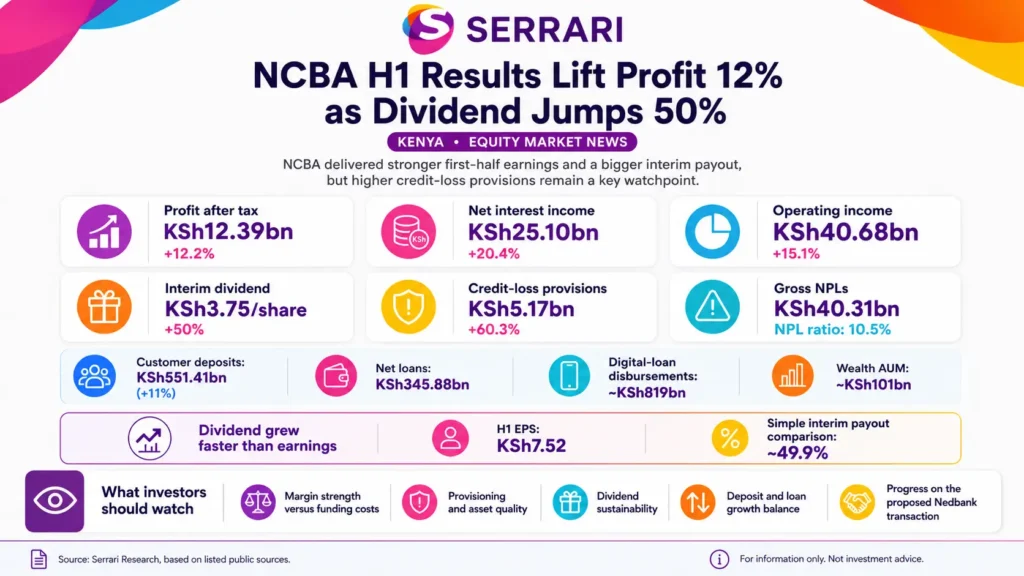
NCBA’s first-half 2026 results show profit after tax increasing by 12.2% to KSh12.39 billion while the interim dividend rises by 50% to KSh3.75 per share. Net interest income increased by 20.4% to KSh25.10 billion, customer deposits grew by 11% to KSh551.41 billion and digital-loan disbursements reached approximately KSh819 billion. The infographic contrasts these positive results with a 60.3% increase in credit-loss provisions to KSh5.17 billion, gross non-performing loans of KSh40.31 billion and an NPL ratio of 10.5%. It also highlights the pending Nedbank transaction, showing why investors must balance stronger shareholder returns against credit risk and ownership uncertainty.
Government Securities Remain Significant
NCBA also increased its holdings of government securities by approximately 22.5% to KSh220.64 billion.
LIVENSE market summarySee NSE data →That represents almost 30% of the group’s KSh739.40 billion total assets.
The current NCBA balance-sheet results breakdown shows that government securities remain an important part of the group’s earning assets alongside customer loans.
Government bonds and Treasury bills can provide interest income while giving banks an alternative place to deploy deposits.
They may also carry lower credit-risk treatment than private-sector loans.
However, substantial government-security holdings expose a bank to changes in market interest rates and sovereign borrowing conditions.
A fall in bond prices can affect valuation depending on how the securities are classified and held.
Kenya Remains the Main Earnings Engine
NCBA Bank Kenya remained the group’s largest profit contributor.
The Kenyan banking subsidiary increased profitability by 24.3% to approximately KSh13.7 billion.
Regional subsidiaries in Uganda, Tanzania and Rwanda generated approximately KSh1.6 billion in combined profitability.
Non-banking operations contributed approximately KSh1.1 billion, representing growth of about 40%.
The Khusoko’s detailed regional earnings breakdown shows that Kenya remains dominant, but regional and non-bank businesses are becoming increasingly meaningful contributors.
Regional diversification can reduce dependence on Kenya.
However, it also exposes NCBA to different interest-rate environments, currencies, credit cycles and regulatory systems.
Investors should therefore watch whether the regional subsidiaries continue increasing profit faster than the costs required to operate them.
Wealth Management Has Reached KSh101 Billion
NCBA’s wealth-management business increased assets under management to approximately KSh101 billion and exceeded 60,000 active wealth clients.
The SME loan book also increased by 12% to KSh44.7 billion.
These businesses support the group’s strategy of earning more revenue outside conventional corporate and retail lending.
Wealth management can produce management fees without requiring the bank to place the full value of client assets on its own balance sheet.
That can make fee-generating businesses attractive complements to traditional lending.
However, assets under management can fluctuate with market prices, client withdrawals and investment performance.
Dividend Increase Signals Board Confidence
The increase in NCBA’s interim dividend from KSh2.50 to KSh3.75 per share suggests that the board is comfortable returning more capital to shareholders despite the higher credit provisions.
Banks cannot distribute unlimited amounts of earnings.
They must retain sufficient capital to satisfy regulatory requirements, absorb potential credit losses and fund future growth.
NCBA’s reported 21.7% capital adequacy ratio provides useful context for the higher payout.
However, shareholders should not assume that a 50% interim dividend increase will translate into a similar increase in the full-year dividend.
Second-half earnings, asset quality, regulatory capital and the ownership transaction can all influence the final distribution.
Dividend Sustainability Depends on Credit Quality
For income investors, the central question is not whether NCBA can afford the KSh3.75 interim dividend today.
The more important question is whether earnings can continue supporting higher distributions over several years.
Strong net interest income helps.
Lower funding costs help.
Growing deposits, digital lending and regional profits also help.
But persistent increases in credit provisions could eventually reduce the cash and capital available for dividends.
If higher provisions prove temporary, the current dividend increase may be well supported by underlying growth.
If credit losses continue increasing, shareholders may need to reconsider how quickly distributions can expand.
Nedbank Adds an Ownership Catalyst
NCBA’s results are being released while Nedbank Group continues pursuing its proposed acquisition of approximately 66% of NCBA.
The Nedbank’s official NCBA transaction page states that the transaction would leave NCBA listed on the Nairobi Securities Exchange, with the remaining shares continuing to trade publicly.
The offer opened on 28 May and closed on 10 July 2026.
Current NCBA results reporting says shareholder acceptances exceeded the number of shares Nedbank sought to purchase, while completion remains subject to outstanding conditions and regulatory approvals.
The transaction should therefore not be described as completed.
What the Nedbank Deal Could Change
If completed, Nedbank would become NCBA’s controlling shareholder.
That could give NCBA access to a larger regional balance sheet, additional technology, institutional relationships and capital.
Nedbank has said the transaction is intended to strengthen its East African presence while allowing NCBA to retain its brand, local leadership and NSE listing.
The official Nedbank offer transaction overview says the proposed acquisition covers approximately 66% of NCBA and combines cash with newly issued Nedbank shares as consideration.
For existing shareholders, the deal introduces another layer to the investment case.
They are evaluating not only earnings and dividends but also the value, structure and future strategic consequences of the proposed ownership change.
The Deal Does Not Remove Banking Risk
A larger controlling shareholder would not eliminate NCBA’s normal business risks.
The bank would still face:
- Credit losses;
- Interest-rate changes;
- Competition;
- Deposit pricing;
- Technology risk;
- Regulatory requirements;
- Currency exposure; and
- Economic cycles.
A shareholder should therefore assess the Nedbank transaction separately from NCBA’s underlying financial performance.
A strong strategic shareholder can support growth, but lending quality and earnings remain essential.
Operating Efficiency Improved
NCBA’s normal operating expenses increased by only 5.1%, substantially slower than the 15.1% increase in operating income.
This reduced the cost-to-income ratio to approximately 47.9% from about 52.5%.
That is a positive sign because it means more of each shilling of income remained after paying ordinary operating expenses.
Digital adoption may support additional efficiency over time if more transactions move away from expensive manual or branch-based processes.
However, technology itself requires investment.
NCBA spent approximately KSh2.4 billion on technology, artificial intelligence and cybersecurity during the period.
Investors should therefore focus on whether these investments generate sustainable revenue growth or lower operating costs rather than viewing digital spending as automatically beneficial.
What Investors Should Monitor
The first number to monitor is credit provisions.
A further sharp increase during the second half could offset part of the benefit from stronger interest margins.
The NPL ratio is equally important.
Investors should establish whether it continues remaining below the wider banking-sector average and whether gross problem loans begin declining.
Other important indicators include:
- Net interest margin;
- Deposit costs;
- Loan growth;
- Government-security exposure;
- Digital-credit performance;
- Cost-to-income ratio;
- Capital adequacy;
- Regional subsidiary profitability;
- Wealth assets under management;
- Dividend coverage; and
- Progress on the Nedbank transaction.
The NCBA’s official investor-relations reporting archive provides the group’s filed financial statements and presentations for tracking these figures through future reporting periods.
Conclusion
NCBA delivered another strong first half, with profit after tax increasing by 12.2% to KSh12.39 billion and net interest income rising by more than 20%.
Lower funding costs, higher customer deposits and loan growth strengthened the core banking business.
The board responded by increasing the interim dividend by 50% to KSh3.75 per share.
However, the results also contain an important warning.
Credit-loss provisions increased by approximately 60% to KSh5.17 billion, while gross non-performing loans reached KSh40.31 billion.
NCBA’s 10.5% NPL ratio remains below the wider industry figure cited in current reporting, and its capital position remains strong.
The investor question is therefore not whether the first-half numbers were positive.
They were.
The question is whether strong margins and diversified growth can continue outweighing higher credit provisions.
If credit quality remains controlled, the larger dividend appears supported by stronger earnings and capital.
If provisions continue rising substantially, shareholders may need to reassess how quickly dividends can continue growing.
The pending Nedbank transaction adds an additional catalyst, but NCBA’s long-term investment case will still depend on the quality of its loans, the durability of its margins and the cash earnings available to shareholders.
FAQs
1. How much did NCBA earn in H1 2026?
NCBA Group reported profit after tax of KSh12.39 billion for the six months ended 30 June 2026, representing growth of approximately 12.2% from the previous year. Operating income increased by 15.1% to KSh40.68 billion, while net interest income grew even faster at 20.4% to KSh25.10 billion.
2. How much is NCBA’s interim dividend?
NCBA declared an interim dividend of KSh3.75 per share, compared with KSh2.50 during the previous first half. This represents a 50% increase. The dividend rose considerably faster than first-half profit, making future earnings growth, credit quality and capital adequacy important when assessing whether higher distributions can be maintained.
3. Why did NCBA’s credit provisions increase?
NCBA increased provisions for credit losses to approximately KSh5.17 billion from KSh3.23 billion a year earlier. Provisions represent money recognised against loans that may not be fully repaid. They can increase because the loan portfolio is growing, economic risks have increased or management is taking a more cautious view of future repayments. Higher provisions do not mean the entire amount has already been lost.
4. What does the Nedbank transaction mean for NCBA shareholders?
Nedbank is seeking to acquire approximately 66% of NCBA, which would make it the controlling shareholder if all outstanding conditions and regulatory approvals are satisfied. NCBA is expected to remain listed on the Nairobi Securities Exchange. The transaction could provide additional capital and regional strategic support, but it does not remove the bank’s ordinary credit, interest-rate, operational or market risks.
Sources: NCBA official investor-relations reporting archive, current Kenyan Wall Street results report, Khusoko detailed half-year earnings analysis, Soko Directory current NCBA results report, Nedbank official NCBA transaction page, official Nedbank acquisition announcement.
Your financial future isn’t something you wait for—it’s something you build.
The real question is: when do you begin?
Move beyond simply staying informed.
Navigate the markets with clarity—track trends through the Serrari Group Market Index, uncover opportunities in the Serrari Marketplace, and build practical knowledge with our Curated Wealth Builder Platform.
Stay connected to what truly matters.
Get daily insights on macro trends and financial movements across Kenya, Africa, and global markets—delivered through the Serrari Newsletter.
Growth opens doors.
Advance your career through professional programs including ACCA, HESI A2, ATI TEAS 7 , HESI EXIT , NCLEX – RN and NCLEX – PN, Financial Literacy!🌟—designed to move you forward with confidence.
See where money is flowing—clearly and in real time.
Track Money Market Funds, Treasury Bills, Treasury Bonds, Green Bonds, and Fixed Deposits, alongside global and African indexes, key economic indicators, and the evolving Crypto and stablecoin landscape—all within Serrari’s Market Index