Nairobi satellite land has emerged as Kenya’s best-performing long-term investment, turning an initial KSh1 million invested in 2007 into KSh13.71 million by the second quarter of 2026. The impressive growth surpassed returns from bonds, stocks, savings, and even land within Nairobi’s suburbs, highlighting the growing appeal of real estate investment in the capital’s expanding satellite towns.
Key Overview
Land in Nairobi’s satellite towns has significantly outperformed other major investment classes over the past 18 years. Strong population growth, expanding infrastructure, and rising demand for affordable property have driven substantial capital appreciation, although recent performance shows gains becoming increasingly concentrated in selected locations.
Nairobi Satellite Land Delivers Kenya’s Strongest Investment Returns
Nairobi satellite land has become one of Kenya’s most rewarding long-term investment opportunities, according to the latest HassConsult Land Price Index.
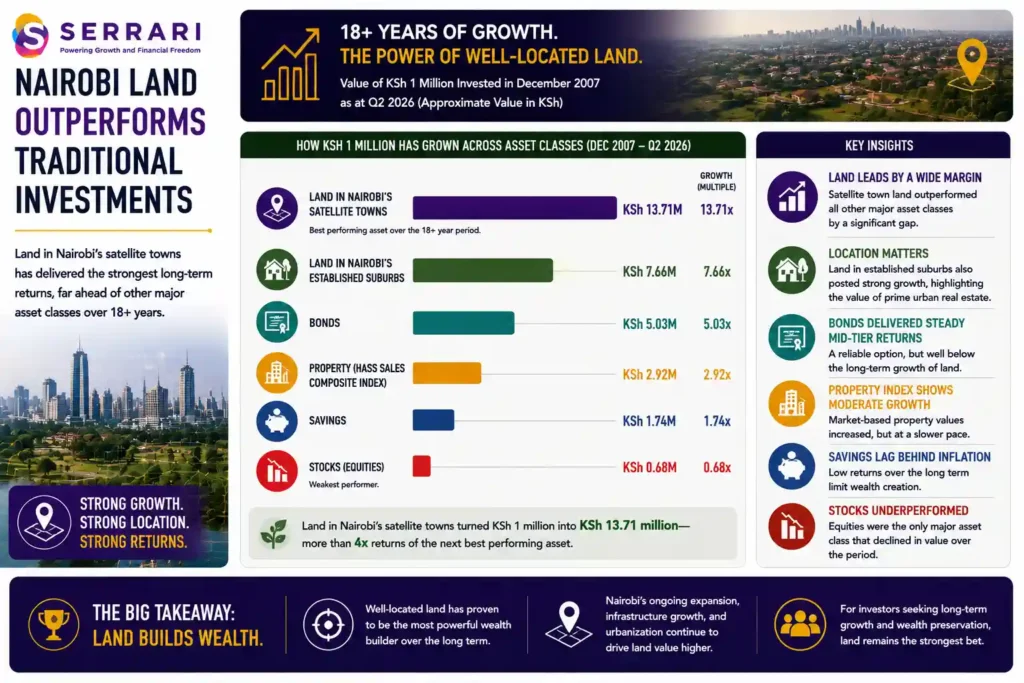
An investment of KSh1 million made in December 2007 would have grown to approximately KSh13.71 million by the second quarter of 2026, making land in Nairobi’s satellite towns the strongest-performing asset class tracked over the period.
The remarkable appreciation reflects nearly two decades of urban expansion as residential and commercial developments continued spreading beyond Nairobi’s traditional boundaries into surrounding towns.
Satellite Towns Outperform Stocks, Bonds and Savings
The long-term performance of property investment has comfortably surpassed several traditional investment options.
During the same period, KSh1 million invested in land within Nairobi’s established suburbs would have increased to approximately KSh7.66 million, while investment in bonds would have reached around KSh5.03 million.
Property measured through the Hass Sales Composite Index grew to KSh2.92 million, while savings increased to KSh1.74 million.
By contrast, stocks delivered the weakest performance among the major asset classes tracked, with the original KSh1 million declining to approximately KSh680,000 over the same period.
These figures underscore the significant investment returns generated by well-located land as Nairobi’s metropolitan area expanded.
Ruiru Leads Growth Among Satellite Towns
Performance across Nairobi’s satellite towns was not uniform, although several locations continued posting strong gains during the second quarter of 2026.
Ruiru recorded the strongest quarterly performance, with land prices rising 4.1% to reach KSh42.2 million per acre.
Thika followed closely with a 3.8% increase, pushing average prices to KSh32.4 million per acre, while Ruaka gained 2.8%, taking average land values to KSh115.7 million per acre.
These locations continue benefiting from expanding transport infrastructure, commercial activity, and growing residential demand.
Some Satellite Markets Experience Price Declines
Despite the broader recovery, not every satellite town experienced positive growth.
Seven of the fourteen towns tracked by HassConsult registered declining prices during the quarter.
Ngong recorded the largest decline, with prices falling 2.5%, while Limuru posted a more modest 0.8% decrease.
The divergence suggests investors are becoming increasingly selective, favoring areas supported by stronger economic activity, infrastructure development, and population growth.
Context is everything. Stay ahead of shifting trends with today’s market updates, and uncover emerging opportunities using the Serrari Group Market Index and Marketplace. Then, take control of your own financial future by exploring our Money & Life Reset Transformation Blueprint ™ to build stronger habits, create better systems, and design a path toward lasting wealth.
Nairobi Suburbs Also Continue Recovering
Within Nairobi itself, the Nairobi property market also showed renewed momentum.
Land prices across Nairobi suburbs increased 1.4% during the second quarter, accelerating from 0.8% growth recorded during the previous quarter.
Among individual suburbs, Langata delivered the strongest quarterly performance, with prices rising 4.1% to an average of KSh94.7 million per acre.
Karen followed with a 3.2% increase to KSh79.5 million per acre, while Runda gained 2.9% to KSh105.6 million per acre.
Nyari also posted healthy growth of 2.5%, lifting average prices to KSh128.2 million per acre.
Development Policy Supports Property Market Recovery
HassConsult attributed part of the market’s recovery to improved certainty surrounding development approvals.
The publication of Nairobi County’s updated property development policy has increased confidence among developers and investors, supporting both suburban and satellite town markets.
Satellite towns matched suburban growth during the quarter, recording a 1.4% increase compared with 0.5% during the previous quarter.
The improvement suggests that clearer planning regulations are encouraging renewed activity across Kenya’s broader real estate investment market.
Demand Shifts Toward More Affordable Locations
According to HassConsult Co-Chief Executive Officer and Creative Director Sakina Hassanali, changing buyer preferences are increasingly shaping the market.
She noted that Karen and Langata recorded their strongest quarterly growth in a decade as developers and individual home builders shifted toward areas offering relatively lower land acquisition costs compared with Nairobi’s premium suburbs.
The trend reflects continued demand for affordable development opportunities as construction costs and urban expansion reshape buyer preferences across the metropolitan region.
Outlook for Nairobi Satellite Land
The long-term outlook for Nairobi satellite land remains positive, although future growth is likely to become increasingly location-specific.
Areas benefiting from improved transport infrastructure, employment opportunities, commercial expansion, and supportive planning policies are expected to continue attracting investor interest.
While the sector has consistently delivered superior capital appreciation over the past 18 years, investors are likely to focus more carefully on towns demonstrating sustainable economic fundamentals rather than broad market growth.
FAQs
Why has Nairobi satellite land outperformed other investments?
Nairobi satellite land has benefited from sustained urban expansion, infrastructure improvements, rising housing demand, and strong capital appreciation, allowing it to outperform stocks, bonds, and savings over the long term.
Which satellite town recorded the strongest growth?
Ruiru posted the highest quarterly increase, with land prices rising 4.1% to approximately KSh42.2 million per acre during the second quarter of 2026.
Did every satellite town record higher land prices?
No. Seven of the fourteen towns tracked experienced declining prices, with Ngong and Limuru posting the largest quarterly declines.
What supported the recent recovery in Kenya’s property market?
Improved certainty around development approvals following Nairobi County’s updated property development policy, combined with continued demand for affordable residential developments, helped support the recovery in both suburban and satellite towns markets.
Your financial future isn’t something you wait for—it’s something you build.
The real question is: when do you begin?
Move beyond simply staying informed.
Navigate the markets with clarity—track trends through the Serrari Group Market Index, uncover opportunities in the Serrari Marketplace, and build practical knowledge with our Curated Wealth Builder Platform.
Stay connected to what truly matters.
Get daily insights on macro trends and financial movements across Kenya, Africa, and global markets—delivered through the Serrari Newsletter.
Growth opens doors.
Advance your career through professional programs including ACCA, HESI A2, ATI TEAS 7 , HESI EXIT , NCLEX – RN and NCLEX – PN, Financial Literacy!🌟—designed to move you forward with confidence.
See where money is flowing—clearly and in real time.
Track Money Market Funds, Treasury Bills, Treasury Bonds, Green Bonds, and Fixed Deposits, alongside global and African indexes, key economic indicators, and the evolving Crypto and stablecoin landscape—all within Serrari’s Market Index.