The proposed Kenya Islamic finance initiative could introduce Sharia-compliant Sukuk securities to the country’s capital markets for the first time. The government believes the move could diversify funding sources, attract new investors, and provide access to the rapidly expanding global Islamic finance market while helping finance future budget deficits.
LIVEKenya bond yields: Average yield 11.93% across 58 bonds · 16 OctSee yields →Key Overview
- Kenya is considering introducing Sukuk securities as a new funding instrument.
- Treasury Cabinet Secretary John Mbadi announced the proposal during the 2026/27 Budget presentation.
- Sukuk instruments are structured according to Sharia-compliant financing principles.
- The government aims to diversify its funding sources and investor base.
- Kenya plans to spend approximately Sh4.8 trillion in the 2026/27 fiscal year.
- Projected government revenue is estimated at Sh3.6 trillion.
- The resulting budget deficit is approximately Sh1.2 trillion.
- Sukuk securities could provide access to global Islamic finance markets.
- The initiative is intended to deepen Kenya’s capital markets.
- The proposal complements existing financing through taxes, Treasury securities, loans, and grants.
Kenya Sukuk Bonds Could Transform Government Financing Strategy
The proposal to introduce Kenya sukuk bonds marks a potentially significant development in the country’s efforts to diversify government financing and strengthen capital markets.
Treasury Cabinet Secretary John Mbadi announced that the government is considering issuing Sukuk securities as part of broader efforts to access new pools of capital and expand Kenya’s investor base.
The move comes as the government seeks innovative funding solutions to support growing expenditure needs while reducing dependence on traditional borrowing channels.
If implemented, Sukuk securities would provide Kenya with access to the rapidly expanding global Islamic finance industry, which has become an increasingly important source of capital for governments and corporations worldwide.
The proposal also reflects growing interest in ethical and faith-based investment products across international financial markets.
Kenya Islamic Finance Market Could Expand Significantly
The introduction of Sukuk instruments could accelerate the growth of Kenya Islamic finance.
Islamic finance operates under Sharia principles, which prohibit interest-based transactions and emphasize asset-backed financing structures. As a result, Sukuk securities differ from conventional bonds because investors receive returns linked to underlying assets rather than interest payments.
Global demand for Islamic financial products has grown substantially over the past two decades, with governments and institutions across the Middle East, Asia, and Africa increasingly utilizing Sukuk markets to raise capital.
Kenya’s entry into this market could open access to a broader group of international and domestic investors seeking Sharia-compliant investment opportunities.
The government believes such diversification could strengthen the country’s financial ecosystem while enhancing funding flexibility.
Sukuk Bonds Kenya Offer Alternative Funding Source
The proposed sukuk bonds Kenya framework would provide an alternative to conventional government borrowing instruments.
Currently, Kenya finances public spending through a combination of tax revenues, Treasury bills, Treasury bonds, external loans, grants, and donor support.
However, rising financing needs have encouraged policymakers to explore additional funding channels.
Sukuk securities are typically structured around tangible assets or projects, allowing investors to participate in returns generated by those assets while complying with Islamic finance principles.
Many governments use Sukuk to finance infrastructure projects, public investments, and budgetary requirements.
By adding Sukuk to its financing toolkit, Kenya could broaden its options for raising capital while reducing reliance on traditional debt markets.
The move may also increase investor participation by appealing to previously underserved segments of the market.
Context is everything. Stay ahead of shifting trends with today’s market updates, and uncover emerging opportunities using the Serrari Group Market Index and Marketplace. Then, take control of your own financial future by exploring our Money & Life Reset Transformation Blueprint ™ to build stronger habits, create better systems, and design a path toward lasting wealth.
Islamic Bonds Kenya Could Deepen Capital Markets
The introduction of Islamic bonds Kenya could contribute to the continued development of local capital markets.
One of the government’s objectives is to expand the range of investment products available to both institutional and retail investors.
A more diverse financial market can improve liquidity, attract international capital, and create additional investment opportunities.
Sukuk securities have been successfully introduced in several African countries, including South Africa and Nigeria, where they have attracted strong investor demand.
Kenya hopes to replicate similar success by creating products that appeal to investors seeking ethical, faith-based, and asset-backed investment structures.
The initiative may also encourage greater participation from Islamic financial institutions operating within the region.
Sovereign Sukuk Issuance Supports Fiscal Planning
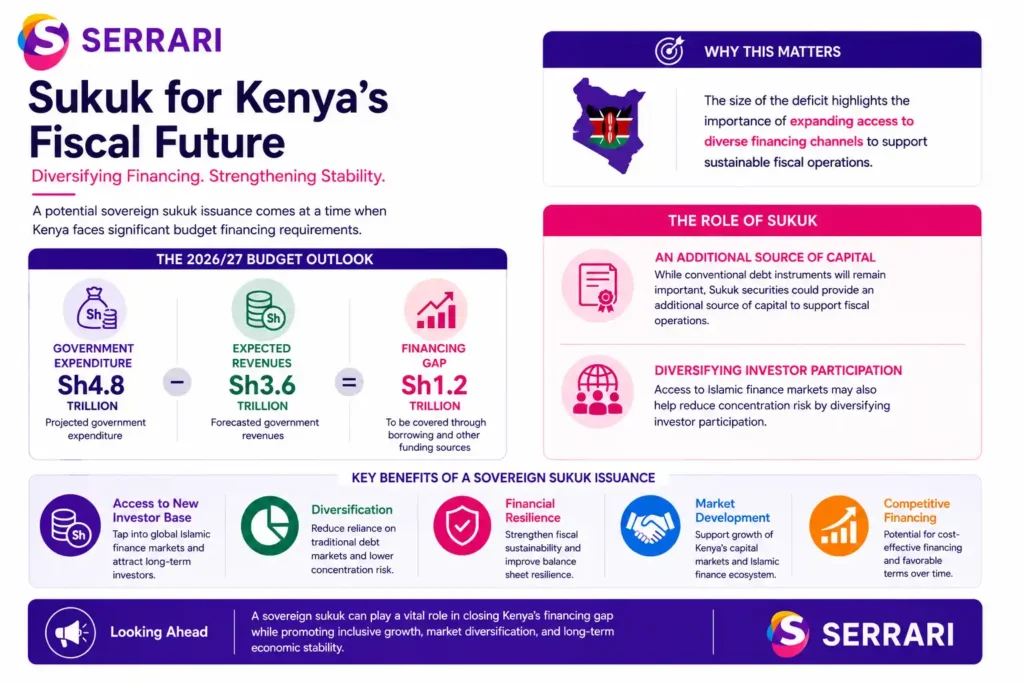
A potential sovereign sukuk issuance comes at a time when Kenya faces significant budget financing requirements.
According to the 2026/27 budget estimates, government expenditure is projected to reach approximately Sh4.8 trillion.
At the same time, expected revenues are forecast at around Sh3.6 trillion.
This leaves a financing gap of roughly Sh1.2 trillion that must be covered through borrowing and other funding sources.
The size of the deficit highlights the importance of expanding access to diverse financing channels.
While conventional debt instruments will remain important, Sukuk securities could provide an additional source of capital to support fiscal operations.
LIVEKenya bond yields: Average yield 11.93% across 58 bonds · 16 OctSee yields →Access to Islamic finance markets may also help reduce concentration risk by diversifying investor participation.
Government Deficit Financing Requires New Solutions
The challenge of government deficit financing continues to shape fiscal policy decisions.
Budget deficits occur when government spending exceeds revenue collections, requiring additional funding to cover the shortfall.
Traditionally, governments rely on domestic borrowing, external debt, and grants to bridge these gaps.
However, increasing competition for capital and rising global borrowing costs have encouraged many countries to seek alternative financing mechanisms.
Sukuk markets have emerged as one such solution because they provide access to investors who specifically seek Sharia-compliant products.
By entering this market, Kenya could potentially attract capital that may not otherwise participate in conventional government bond offerings.
This diversification could strengthen financing resilience over the long term.
Sharia-Compliant Investments Attract Global Demand
The growing popularity of Sharia-compliant investments is one of the main factors supporting the proposal.
Islamic finance assets globally are measured in trillions of dollars and continue expanding as demand increases among institutional and individual investors.
Many investors are attracted not only by religious considerations but also by the asset-backed nature of Sukuk structures and their emphasis on ethical financing principles.
These characteristics have helped Sukuk evolve into a mainstream financing tool used by governments, banks, and corporations worldwide.
For Kenya, participation in this market could improve visibility among international investors while strengthening ties with Islamic financial institutions and investment funds.
The proposal reflects recognition of these emerging opportunities.
Kenya Public Debt Strategy Continues to Evolve
The potential introduction of Sukuk also forms part of the broader evolution of Kenya public debt management.
Governments increasingly seek to balance borrowing costs, investor diversification, and financial sustainability when designing funding strategies.
Adding Sukuk to Kenya’s borrowing framework would not eliminate the need for traditional financing sources. Instead, it would complement existing Treasury securities and external borrowing programs.
A more diversified debt portfolio can improve resilience and provide greater flexibility when responding to changing market conditions.
As policymakers evaluate the proposal, they will likely consider factors such as investor demand, regulatory requirements, issuance costs, and market readiness.
If successfully implemented, Sukuk could become an important component of Kenya’s future financing strategy.
Conclusion
The proposal to introduce Kenya sukuk bonds represents a potentially transformative step in the country’s public financing strategy. By accessing global Islamic finance markets, Kenya could diversify its investor base, deepen capital markets, and create new funding channels to support development priorities.
With a projected budget deficit of approximately Sh1.2 trillion in the 2026/27 fiscal year, alternative financing solutions are becoming increasingly important. If adopted, Sukuk securities could provide Kenya with greater funding flexibility while strengthening its position within the growing global Islamic finance ecosystem.
FAQs
1. What are Sukuk bonds?
Sukuk are Sharia-compliant financial instruments often referred to as Islamic bonds. Unlike conventional bonds that pay interest, Sukuk are structured around ownership or participation in underlying assets and generate returns through asset-backed arrangements that comply with Islamic finance principles.
2. Why is Kenya considering Sukuk securities?
Kenya is exploring Sukuk securities to diversify its funding sources, attract new investors, and access liquidity from global Islamic finance markets. The government believes the instruments could help broaden the investor base while supporting long-term capital market development.
3. How much is Kenya’s projected budget deficit?
For the 2026/27 fiscal year, Kenya plans to spend approximately Sh4.8 trillion while expecting revenues of about Sh3.6 trillion. This creates a financing gap of roughly Sh1.2 trillion that will require borrowing and other funding sources to bridge.
4. How could Sukuk benefit investors?
Sukuk provides investors with access to asset-backed, Sharia-compliant investment opportunities. They may appeal to both faith-based and conventional investors seeking diversified portfolios, ethical investment structures, and exposure to government-backed financing instruments.
Sources: Capital Business, Dawan Africa
Your financial future isn’t something you wait for—it’s something you build.
The real question is: when do you begin?
Move beyond simply staying informed.
Navigate the markets with clarity—track trends through the Serrari Group Market Index, uncover opportunities in the Serrari Marketplace, and build practical knowledge with our Curated Wealth Builder Platform.
Stay connected to what truly matters.
Get daily insights on macro trends and financial movements across Kenya, Africa, and global markets—delivered through the Serrari Newsletter.
Growth opens doors.
Advance your career through professional programs including ACCA, HESI A2, ATI TEAS 7 , HESI EXIT , NCLEX – RN and NCLEX – PN, Financial Literacy!🌟—designed to move you forward with confidence.
See where money is flowing—clearly and in real time.
Track Money Market Funds, Treasury Bills, Treasury Bonds, Green Bonds, and Fixed Deposits, alongside global and African indexes, key economic indicators, and the evolving Crypto and stablecoin landscape—all within Serrari’s Market Index.