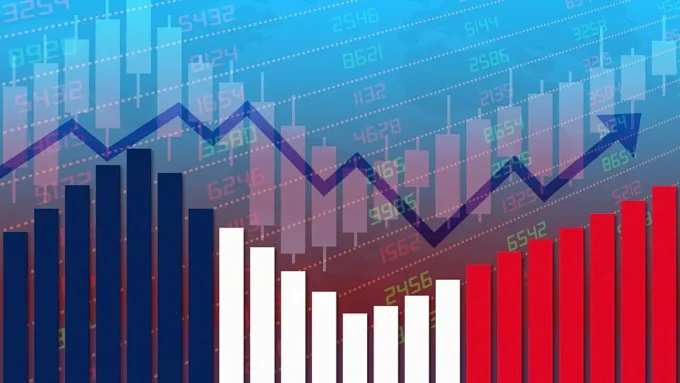
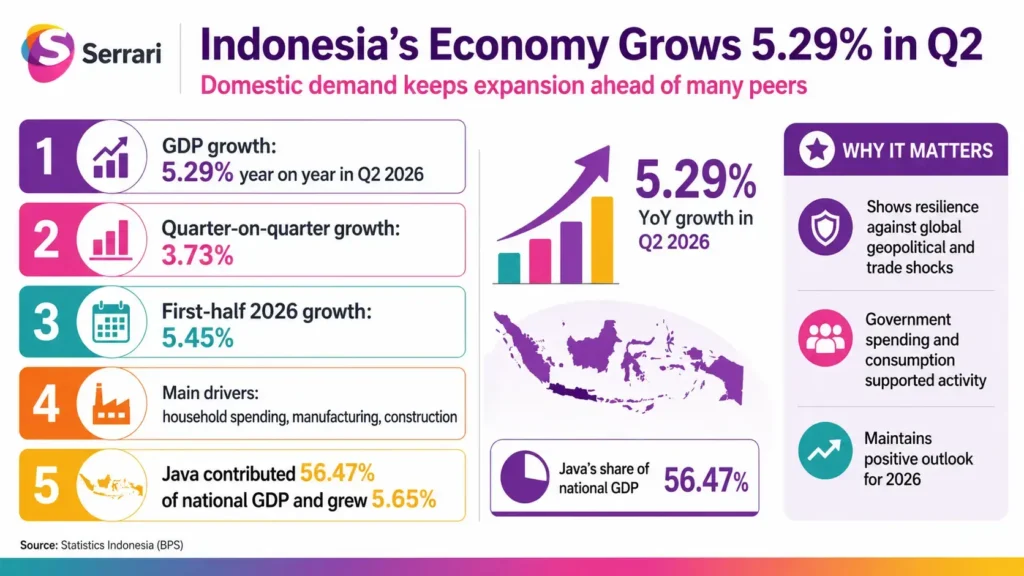
Indonesia’s economy expanded by 5.29% year on year in the second quarter of 2026, supported by household consumption, manufacturing, construction and a sharp increase in government spending. The result was stronger than the 5.12% recorded in the same quarter of 2025, although it moderated from 5.61% in the first quarter of 2026.
Official figures showed gross domestic product reached Rp6,552.1 trillion at current prices and Rp3,576.2 trillion at constant 2010 prices. The economy also grew by 3.73% from the previous quarter, while first-half growth reached 5.45% compared with the first six months of 2025.
Key Overview
- Second-quarter growth: 5.29% year on year.
- Quarter-on-quarter growth: 3.73%.
- First-half growth: 5.45% year on year.
- Largest production contributor: Manufacturing, adding 0.90 percentage points.
- Main expenditure driver: Household consumption, contributing 2.67 percentage points.
- Regional centre: Java generated 56.47% of national GDP and grew by 5.65%.
- Full-year outlook: Bank Indonesia projects growth of between 4.9% and 5.7% in 2026.
Consumption and Manufacturing Drive Expansion
The official second-quarter GDP release showed that household consumption remained the economy’s largest demand component. Spending rose by 5.06% year on year, accounted for 53.32% of GDP and contributed 2.67 percentage points to headline growth.
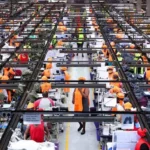
Manufacturing was the largest production-side contributor, adding 0.90 percentage points after expanding by 4.52%. The sector represented 18.50% of the economy, reinforcing its central role in employment, exports and domestic supply chains.
Wholesale and retail trade contributed 0.83 percentage points, construction added 0.62 points and information and communications contributed 0.48 points. Construction grew by 6.68%, with the government linking part of the expansion to activity under its three-million-homes programme.
The strongest year-on-year production growth was recorded in electricity and gas at 10.81%. Accommodation and food services also expanded strongly as domestic travel and tourism activity continued to recover.
Context is everything. Stay ahead of shifting trends with today’s market updates, and uncover emerging opportunities using the Serrari Group Market Index and Marketplace. Then, take control of your own financial future by exploring our Money & Life Reset Transformation Blueprint ™ to build stronger habits, create better systems, and design a path toward lasting wealth.
Government Spending Adds Momentum
Government consumption recorded the fastest expenditure-side increase, rising by 15.97% year on year. The expansion reflected stronger public spending and the continued implementation of social and development programmes.
Coordinating Minister for Economic Affairs Airlangga Hartarto said initiatives including the Free Nutritious Meals programme helped support household activity. However, household consumption remained the larger direct contributor to overall GDP growth.
The government plans to maintain momentum by accelerating capital expenditure, strengthening industrial zones and expanding the Red and White Cooperatives programme. Deputy Finance Minister Juda Agung also pointed to an expanding Manufacturing Purchasing Managers’ Index and stronger imports of capital goods and raw materials as signs of continued production and investment activity.
Java Retains Its Dominant Economic Position
Java remained the centre of Indonesia’s economic activity, accounting for 56.47% of national output and recording growth of 5.65%. This means national performance remains highly dependent on consumption, manufacturing, trade and services activity across the island’s major urban and industrial centres.
Bali and Nusa Tenggara recorded growth of about 6.1%, supported by tourism and related services. The regional figures indicate that the recovery is not confined to the country’s main manufacturing base, although economic activity remains unevenly distributed.
Greater investment outside Java could improve resilience by broadening the country’s production base. Industrial estates, transport connections, tourism infrastructure and local processing projects will be important in determining whether faster-growing regions can increase their share of national output.
Outlook Remains Positive but External Risks Persist
The second-quarter result remained within Bank Indonesia’s 2026 growth forecast of 4.9% to 5.7%. Domestic consumption, investment and government programmes are expected to remain the principal supports for growth during the rest of the year.
However, Indonesia continues to face risks from trade friction, geopolitical conflict, commodity-price volatility and shifts in global financial conditions. These pressures could affect exports, investment flows, inflation and the rupiah.
The 5.29% expansion demonstrates that domestic demand is helping the economy absorb external shocks. Sustaining that performance will depend on productive public spending, stronger private investment and continued manufacturing growth rather than short-term stimulus alone.
Sources: Statistics Indonesia / ANTARA News / Bank Indonesia
Your financial future isn’t something you wait for—it’s something you build.
The real question is: when do you begin?
Move beyond simply staying informed.
Navigate the markets with clarity—track trends through the Serrari Group Market Index, uncover opportunities in the Serrari Marketplace, and build practical knowledge with our Curated Wealth Builder Platform.
Stay connected to what truly matters.
Get daily insights on macro trends and financial movements across Kenya, Africa, and global markets—delivered through the Serrari Newsletter.
Growth opens doors.
Advance your career through professional programs including ACCA, HESI A2, ATI TEAS 7 , HESI EXIT , NCLEX – RN and NCLEX – PN, Financial Literacy!🌟—designed to move you forward with confidence.
See where money is flowing—clearly and in real time.
Track Money Market Funds, Treasury Bills, Treasury Bonds, Green Bonds, and Fixed Deposits, alongside global and African indexes, key economic indicators, and the evolving Crypto and stablecoin landscape—all within Serrari’s Market Index.