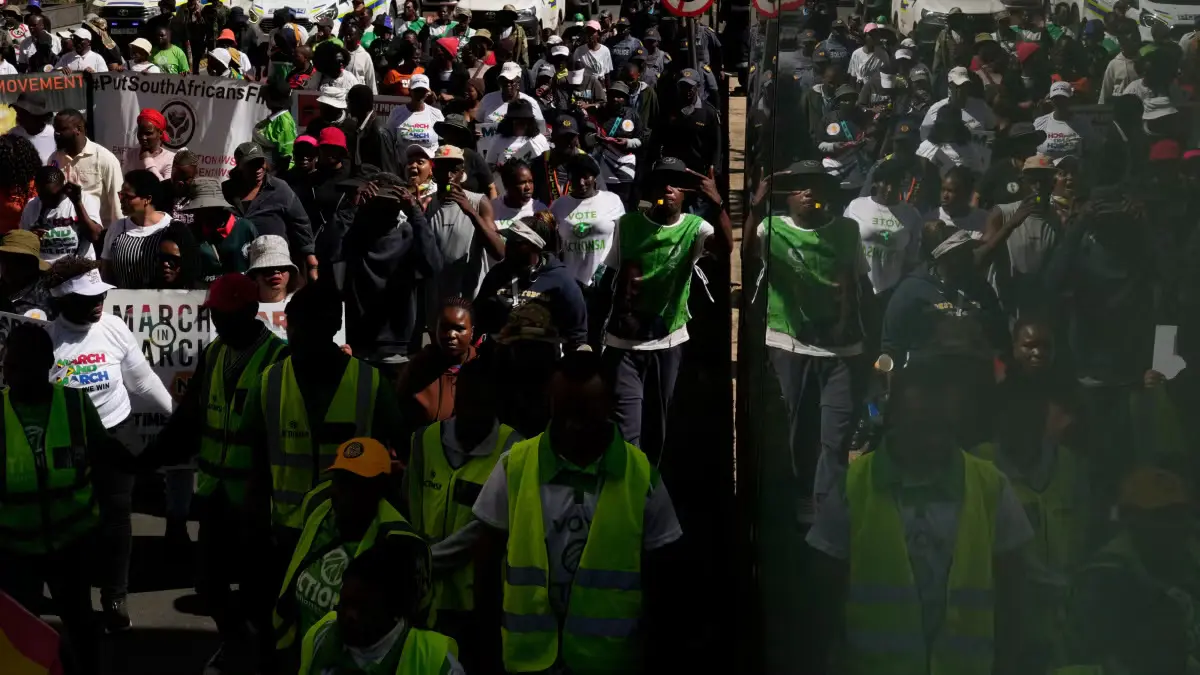
South Africa’s escalating anti-migrant campaign is creating economic disruption across township retail, wholesale distribution, agriculture and cross-border commerce. Migrant-owned shops have closed following threats, looting and violence, while some employers report losing skilled or seasonal workers.
The movement is gaining political visibility ahead of local government elections scheduled for November 4, 2026. However, official data show that international migrants form a relatively small share of South Africa’s population, while unemployment, weak education outcomes and slow economic growth remain far larger structural challenges.
Key Overview
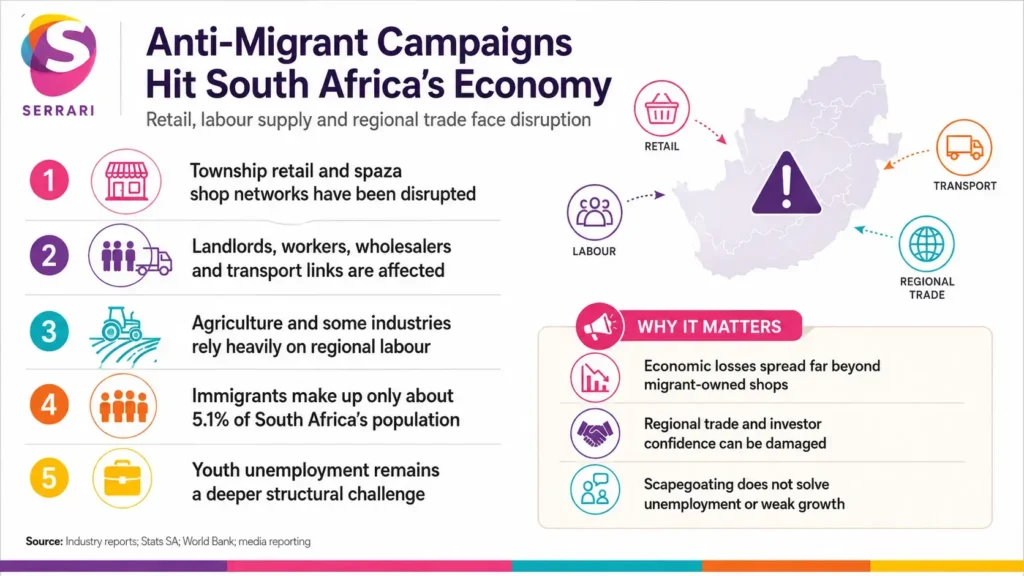
- Economic impact: Shop closures are disrupting landlords, workers, wholesalers and local supply chains.
- Migration scale: Official estimates place South Africa’s immigrant population at just over three million, or about 5.1% of the population.
- Labour pressure: Unemployment among people aged 15–24 reached 60.9% in the first quarter of 2026.
- Trade exposure: Africa remains a major destination for South African goods and informal cross-border commerce.
- Political backdrop: Anti-migrant mobilisation is intensifying before the November 2026 municipal elections.
- Core risk: Scapegoating migrants may deepen economic damage without resolving unemployment, crime or service-delivery failures.
Township Retail Faces Wider Supply-Chain Damage
The anti-migrant March and March movement has demanded the removal of undocumented migrants and organised protests in Johannesburg. However, field reporting from affected communities found that legally documented African migrants and asylum seekers were also targeted.
Spaza shops are deeply integrated into township economies. They provide household essentials, sell goods in small affordable quantities, extend informal credit and create rental income for property owners. When stores are looted, burned or forced to close, the damage extends beyond the owner to local employees, landlords, wholesalers, manufacturers and transport operators.
South Africa’s government has recognised the sector’s importance through a R500 million support fund intended to improve compliance, formalisation and access to finance. Violence and forced closures undermine those objectives by removing operating businesses rather than helping them meet regulatory standards.
The disruption is also affecting central Johannesburg’s cross-border retail economy. Traders from neighbouring countries travel to the city to buy clothing, cosmetics and household goods for resale, supporting transport services, accommodation and wholesale activity. Fear of harassment reduces this spending and weakens Johannesburg’s role as a regional commercial hub.
Context is everything. Stay ahead of shifting trends with today’s market updates, and uncover emerging opportunities using the Serrari Group Market Index and Marketplace. Then, take control of your own financial future by exploring our Money & Life Reset Transformation Blueprint ™ to build stronger habits, create better systems, and design a path toward lasting wealth.
Agriculture and Manufacturing Depend on Regional Labour
The economic impact extends beyond informal retail. Farmers in parts of KwaZulu-Natal have reported sudden shortages of cane cutters, while horticulture and other labour-intensive industries depend heavily on workers from Zimbabwe, Mozambique and Lesotho.
Seasonal agricultural work is physically demanding, often located in remote areas and increasingly requires specialised skills. Removing experienced workers without a ready replacement pool can delay harvesting, reduce output and increase production costs.
Manufacturers face similar concerns in technical occupations. Employers interviewed in the original report said they recruit locally where possible but sometimes rely on regional workers for machinist and specialist positions. A disorderly exodus could therefore weaken businesses already facing imported competition, low domestic demand and narrow margins.
This does not remove the need to enforce labour and immigration laws. Employers who underpay or exploit undocumented workers should face lawful sanctions. The economic distinction is between targeted enforcement against violations and collective punishment based on nationality.
Official Data Challenge the Scale of Anti-Migrant Claims
Public debate frequently exaggerates the number of migrants in South Africa. The latest official migration analysis estimates that the country hosts just over three million immigrants, representing approximately 5.1% of the population. Earlier Census 2022 data placed the figure below 4%, reflecting differences in datasets and measurement periods.
By contrast, South Africa’s employment crisis is exceptionally large. In the first quarter of 2026, youth unemployment reached 45.8% among people aged 15–34, while the rate for those aged 15–24 was 60.9%.
These figures point to structural problems that cannot be solved by removing migrants. Weak job creation, inadequate education, infrastructure constraints, low investment and slow growth affect millions more people than the migrant population.
The economic backdrop remains fragile. The World Bank’s outlook projected South African growth of about 1.4% in 2026, a pace insufficient to materially reduce unemployment or poverty.
Regional Trade and Political Relations Are at Risk
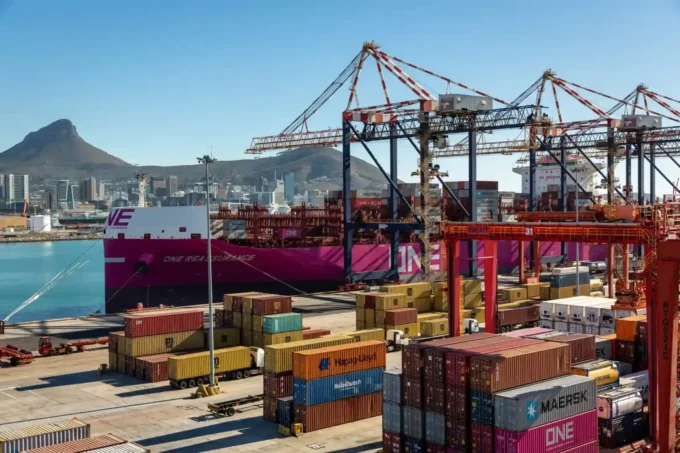
South Africa’s economy is closely connected to the continent. A June 2025 merchandise trade snapshot showed that African markets accounted for approximately 32% of the country’s exports during the month.
Persistent hostility toward African nationals could therefore damage consumer sentiment, diplomatic relationships and demand for South African products. It may also encourage retaliation against South African companies operating across the continent.
The political stakes are increasing ahead of the November 4 municipal elections. Migration is becoming a campaign issue as parties and civic movements compete for voters frustrated by unemployment, crime and failing public services.
The government has said immigration laws must be enforced while rejecting vigilantism, intimidation and discrimination. Its national migration report states that unlawful exclusion and violence should not replace evidence-based migration management.
South Africa’s challenge is therefore to improve border governance and workplace compliance without destroying businesses, jobs and regional relationships. Anti-migrant mobilisation may offer a simple political target, but it risks weakening the same economy it claims to protect.
Sources: The New Humanitarian / Statistics South Africa / South African Government / South African Revenue Service / World Bank
Your financial future isn’t something you wait for—it’s something you build.
The real question is: when do you begin?
Move beyond simply staying informed.
Navigate the markets with clarity—track trends through the Serrari Group Market Index, uncover opportunities in the Serrari Marketplace, and build practical knowledge with our Curated Wealth Builder Platform.
Stay connected to what truly matters.
Get daily insights on macro trends and financial movements across Kenya, Africa, and global markets—delivered through the Serrari Newsletter.
Growth opens doors.
Advance your career through professional programs including ACCA, HESI A2, ATI TEAS 7 , HESI EXIT , NCLEX – RN and NCLEX – PN, Financial Literacy!🌟—designed to move you forward with confidence.
See where money is flowing—clearly and in real time.
Track Money Market Funds, Treasury Bills, Treasury Bonds, Green Bonds, and Fixed Deposits, alongside global and African indexes, key economic indicators, and the evolving Crypto and stablecoin landscape—all within Serrari’s Market Index.