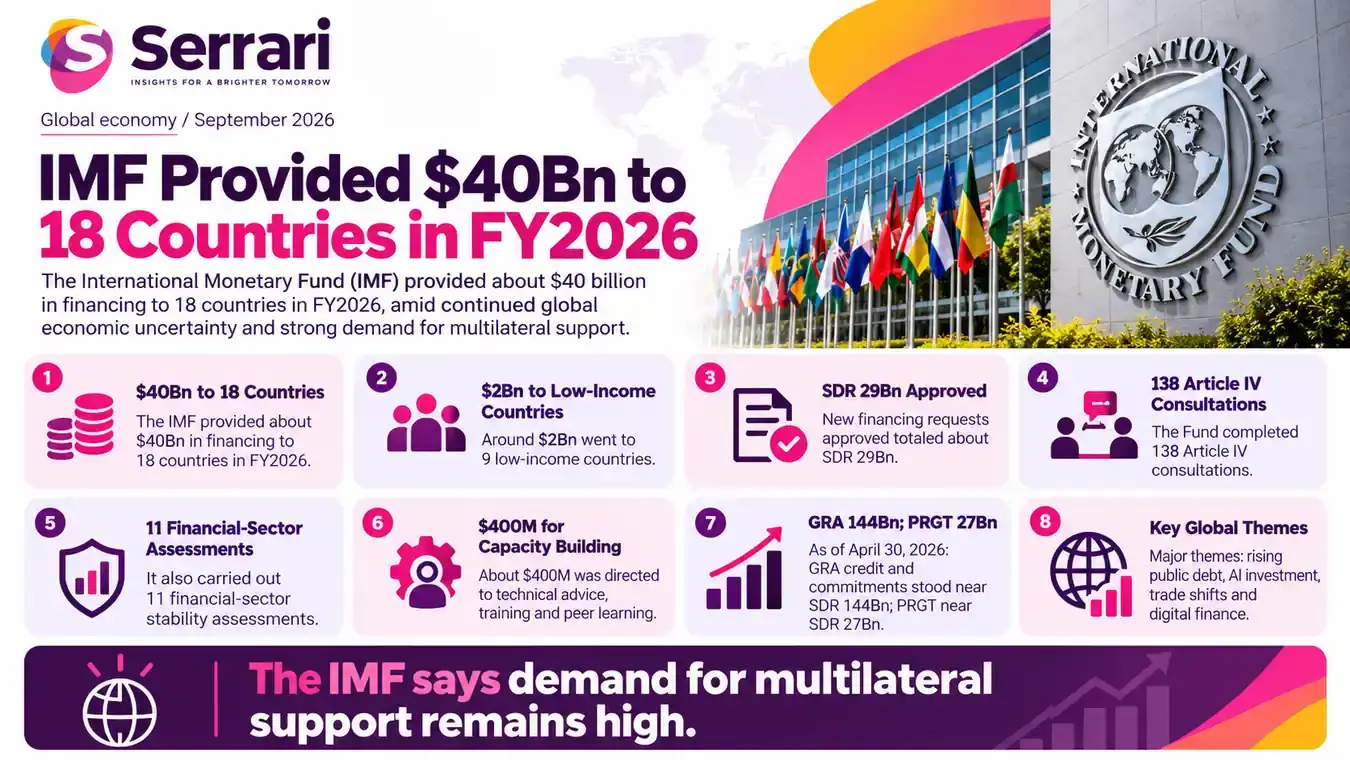
The International Monetary Fund provided about $40 billion in financing to 18 countries during fiscal year 2026 as governments continued to face debt pressures, geopolitical shocks, higher financing needs and uneven economic growth.
The Fund’s fiscal year ran from May 1, 2025 to April 30, 2026. Roughly $2 billion of the financing went to nine low-income countries, while new requests approved across IMF facilities totalled about SDR 29 billion.
The figures form part of the IMF’s 2026 Annual Report, Navigating a Precarious World, which also highlights growing public debt, artificial intelligence investment, shifts in global trade and the rapid development of digital finance as major forces reshaping the world economy.
Key Overview
- The IMF provided about $40 billion in financing to 18 countries during FY2026.
- Around $2 billion went to nine low-income countries.
- New financing requests approved during the year totalled approximately SDR 29 billion.
- The Fund completed 138 Article IV consultations and 11 financial-sector stability assessments.
- About $400 million was directed to technical assistance, policy training and peer learning.
- As of April 30, 2026, GRA credit and undisbursed commitments stood at about SDR 144 billion, while the comparable PRGT total was around SDR 27 billion.
- The report identifies public debt, AI, trade disruption and digital finance as major policy challenges.
IMF Lending Remains Elevated After Repeated Global Shocks
Demand for IMF support remained high during FY2026 as countries continued dealing with the effects of the pandemic era and subsequent economic disruptions.
The Fund reported that new financing requests worth about SDR 29 billion were approved between May 1, 2025 and April 30, 2026. Using the IMF’s April 30 exchange rate of SDR 1 = $1.372020, that is equivalent to almost $40 billion.
The approvals covered several financing channels. They included new arrangements under the General Resources Account and Poverty Reduction and Growth Trust, precautionary credit lines, emergency financing and additional funding under existing programmes.
The IMF also approved Resilience and Sustainability Facility arrangements for Burkina Faso, The Gambia, Jordan, Liberia and Pakistan worth roughly SDR 1.8 billion in total. This facility is designed to help eligible countries address longer-term structural risks such as climate change and pandemic preparedness.
Low-Income Countries Received About $2 Billion
Of the total financing provided during the year, approximately $2 billion went to nine low-income countries.
The Fund continues to provide concessional financing through the Poverty Reduction and Growth Trust, with the poorest eligible countries benefiting from zero-interest financing while better-off low-income economies face positive but still concessional rates.
Beyond the new FY2026 financing, the IMF’s overall exposure remains considerably larger. As of April 30, total credit outstanding and undisbursed commitments under the General Resources Account stood at about SDR 144 billion, equivalent to roughly $198 billion at the period-end exchange rate.
The corresponding amount under the Poverty Reduction and Growth Trust was approximately SDR 27 billion, or about $37 billion.
These figures should not be confused with the $40 billion provided during FY2026 because they include both outstanding credit from previous periods and financing already committed but not yet disbursed.
Context is everything. Stay ahead of shifting trends with today’s market updates, and uncover emerging opportunities using the Serrari Group Market Index and Marketplace. Then, take control of your own financial future by exploring our Money & Life Reset Transformation Blueprint ™ to build stronger habits, create better systems, and design a path toward lasting wealth.
IMF Conducted 138 Country Economic Reviews
Lending represents only one part of the Fund’s work. During FY2026, it completed 138 Article IV consultations, the regular economic assessments used to examine member countries’ fiscal, monetary, financial and structural policies.
It also carried out 11 financial-system stability assessments under its Financial Sector Assessment Program. The country surveillance process is intended to identify risks to economic and financial stability and recommend possible policy adjustments.
The Fund additionally published 45 policy papers during the year and began reviews of its surveillance framework and financial-sector assessment programme.
$400 Million Directed to Technical Support
The IMF also allocated about $400 million to capacity development, covering hands-on technical advice, policy-oriented training and peer learning for member countries.
This work supports institutions such as central banks, finance ministries, revenue authorities, statistics agencies and financial-sector regulators. The capacity-development programme reached countries across all major regions, with sub-Saharan Africa accounting for 36% of total delivery, the largest regional share.
Ukraine, Sri Lanka and the Democratic Republic of the Congo ranked among the largest recipients by value of capacity-development work, while Kenya was among the top 10 recipients and also among the leading countries by training participation.
Debt, AI and Digital Finance Shape the Next Policy Cycle
The annual report places the IMF’s FY2026 activities against an increasingly complicated global backdrop.
Public debt is rising toward historically high levels, forcing governments to balance higher spending demands against fiscal sustainability. At the same time, AI-related investment has become a significant economic force, with some external estimates cited by the Fund suggesting global private investment could exceed $2 trillion in 2026.
Trade patterns are also shifting as geopolitical tensions and supply-chain disruptions alter established commercial relationships. Meanwhile, stablecoins, central bank digital currencies, digital payments and tokenisation are creating new opportunities while adding regulatory and financial-stability questions.
Against that backdrop, the IMF’s $40 billion in FY2026 financing shows that demand for multilateral financial support remains substantial even as the institution increasingly focuses on longer-term resilience, institutional capacity and emerging technological risks.
Sources
International Monetary Fund / Emirates News Agency
Your financial future isn’t something you wait for—it’s something you build.
The real question is: when do you begin?
Move beyond simply staying informed.
Navigate the markets with clarity—track trends through the Serrari Group Market Index, uncover opportunities in the Serrari Marketplace, and build practical knowledge with our Curated Wealth Builder Platform.
Stay connected to what truly matters.
Get daily insights on macro trends and financial movements across Kenya, Africa, and global markets—delivered through the Serrari Newsletter.
Growth opens doors.
Advance your career through professional programs including ACCA, HESI A2, ATI TEAS 7 , HESI EXIT , NCLEX – RN and NCLEX – PN, Financial Literacy!🌟—designed to move you forward with confidence.
See where money is flowing—clearly and in real time.
Track Money Market Funds, Treasury Bills, Treasury Bonds, Green Bonds, and Fixed Deposits, alongside global and African indexes, key economic indicators, and the evolving Crypto and stablecoin landscape—all within Serrari’s Market Index.