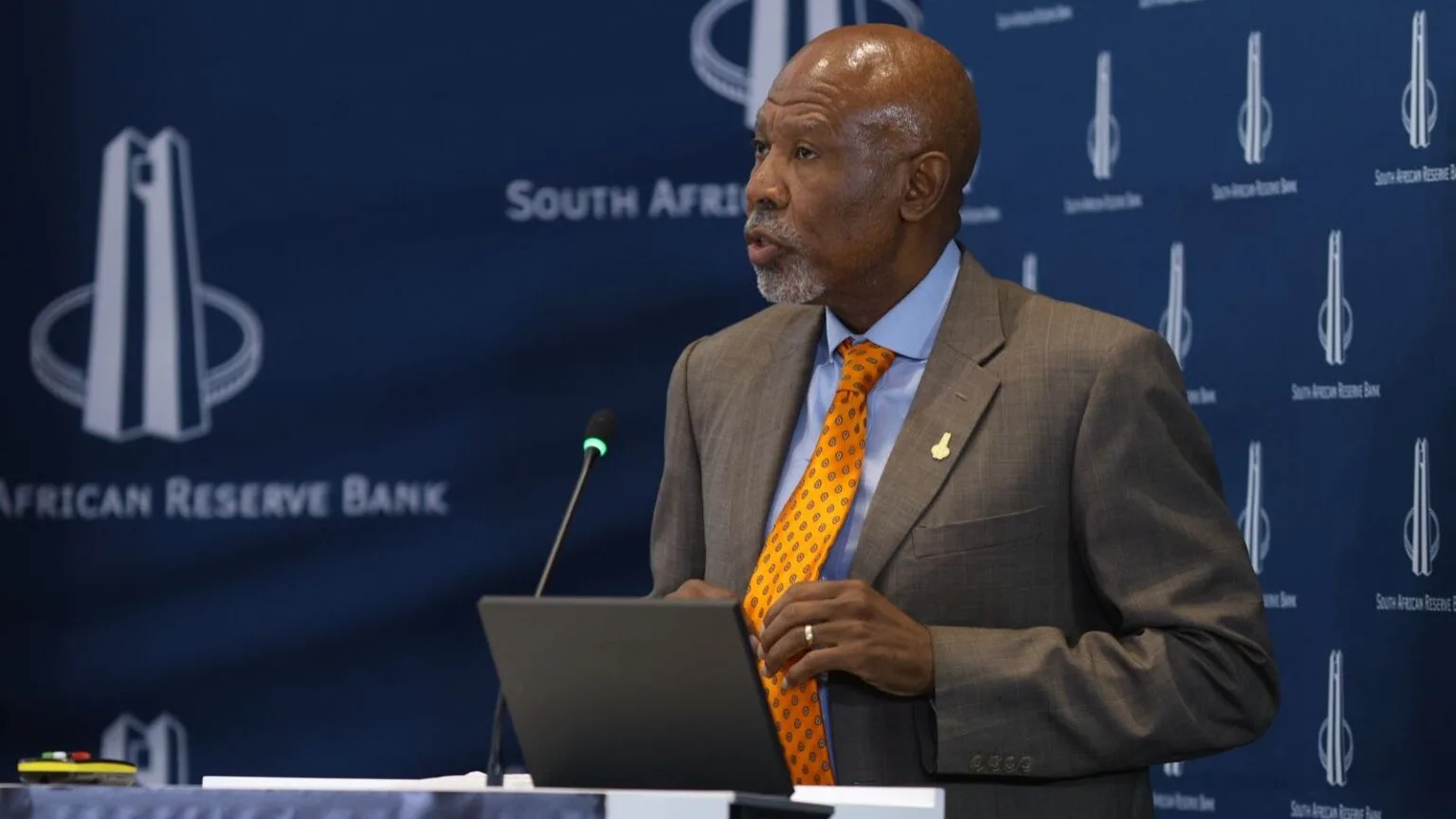
The South African Reserve Bank has raised its policy rate by 25 basis points to 7.25%, tightening monetary conditions as policymakers respond to renewed inflation pressure from fuel costs, services prices and a difficult global environment.
The decision was announced on September 23, 2026 and takes effect on September 25. All members of the Monetary Policy Committee supported the increase, making the decision unanimous.
The move follows a rise in annual consumer inflation to 4.4% in August from 4.3% in July. Under South Africa’s current framework, the inflation target is 3% with a tolerance band of one percentage point either side, placing the latest inflation reading above the upper end of that band.
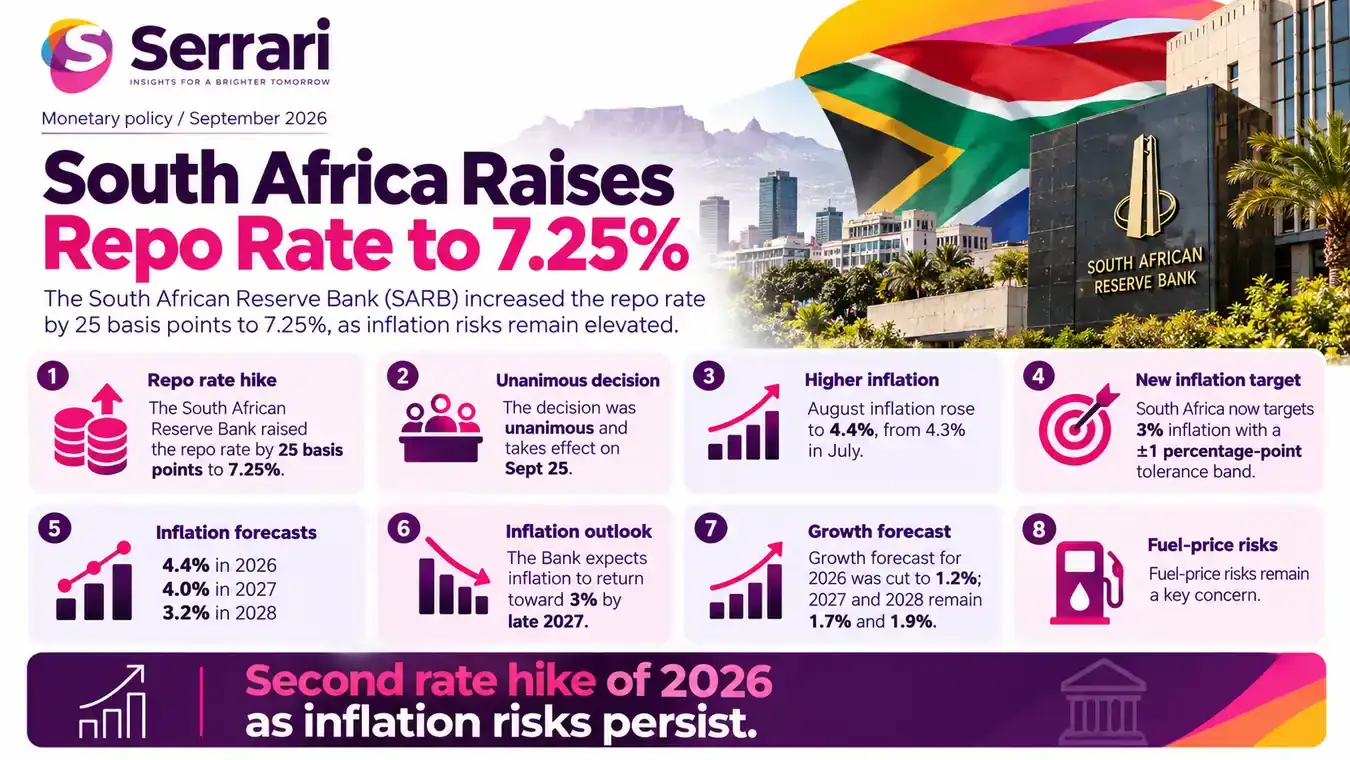
Key Overview
- The policy rate rises 25 basis points from 7.00% to 7.25%, effective September 25.
- The Monetary Policy Committee’s decision was unanimous.
- Annual inflation increased to 4.4% in August, from 4.3% in July.
- South Africa now targets 3% inflation with a ±1 percentage-point tolerance band.
- Inflation is forecast at 4.4% in 2026, 4.0% in 2027 and 3.2% in 2028.
- The central bank expects inflation to return to around 3% toward the end of 2027.
- GDP growth for 2026 is forecast at 1.2%, with 1.7% projected for 2027 and 1.9% for 2028.
Why the Reserve Bank Raised Rates
The September policy decision reflects renewed concern that external price shocks could keep inflation elevated for longer than previously expected.
Fuel prices have become a central risk. Global supply disruptions linked to escalating conflict in the Middle East, interruptions to energy flows and continued damage to refining infrastructure have pushed energy costs higher. South Africa is a net fuel importer, making domestic prices particularly sensitive to international oil markets and exchange-rate movements.
Services inflation also remains elevated, while longer-term inflation expectations are still running at about 4%, above the central bank’s 3% objective. Policymakers therefore want to prevent temporary fuel-price shocks from becoming embedded in wages, services prices and broader inflation expectations.
The September increase is the second rate hike of 2026, following a 25-basis-point increase to 7% in May. Policymakers then held the rate unchanged in July before tightening again in September.
Inflation Rises Above the Current Target Band
Official August inflation data showed headline consumer inflation rising to 4.4% year on year, compared with 4.3% in July. Prices were unchanged on a month-to-month basis.
Housing and utilities rose 5.2% annually and contributed 1.3 percentage points to headline inflation, while transport prices increased 8.8% and contributed another 1.2 percentage points. Services inflation reached 5.1%, compared with 3.3% for goods.
The latest reading needs to be assessed against South Africa’s revised monetary-policy framework. The country now has a 3% inflation target with a one-percentage-point tolerance band, meaning the operating range is effectively 2% to 4% rather than the former 3% to 6% framework.
That makes August’s 4.4% inflation rate more significant: inflation is not merely above the target itself, but also above the upper end of the tolerance band.
Context is everything. Stay ahead of shifting trends with today’s market updates, and uncover emerging opportunities using the Serrari Group Market Index and Marketplace. Then, take control of your own financial future by exploring our Money & Life Reset Transformation Blueprint ™ to build stronger habits, create better systems, and design a path toward lasting wealth.
Fuel Shock Pushes Inflation Forecasts Higher
Policymakers expect inflation pressure to remain elevated into 2027. Headline inflation is projected to move above 5% later in 2026 and early in 2027, largely because of fuel and services prices, before slowing as the energy shock fades.
The latest projections put average inflation at 4.4% in 2026, 4.0% in 2027 and 3.2% in 2028. The Reserve Bank expects inflation to move back toward the 3% target around the end of 2027.
There are some offsets to the inflation pressure. Food inflation has fallen to its lowest level since 2010, helped by strong harvests and stabilising meat prices following the foot-and-mouth disease outbreak. The rand has also remained comparatively resilient, helping contain imported goods prices.
However, the Bank continues to see upside risks to inflation, particularly if global energy disruptions persist or inflation expectations rise further.
Growth Outlook Weakens as Rates Stay Restrictive
The rate increase comes despite weak economic momentum.
The South African economy contracted by 0.2% in the second quarter, and the Reserve Bank has lowered its 2026 growth projection to 1.2% from 1.4%. It still expects activity to recover during the second half of the year.
Growth forecasts for 2027 and 2028 remain at 1.7% and 1.9%, respectively, with the medium-term outlook dependent on improved global conditions and domestic reforms in areas such as energy, logistics and the broader business environment.
This leaves policymakers balancing two competing pressures: inflation risks argue for tighter monetary policy, while weak growth increases the economic cost of higher borrowing rates.
For households and businesses, the 7.25% policy rate means financing conditions remain restrictive. For the Reserve Bank, however, the immediate priority is clear: prevent the current fuel-driven inflation shock from becoming persistent and guide inflation back toward 3% over time.
Sources
South African Reserve Bank / Statistics South Africa / Reuters / Trading Economics / SAnews
Your financial future isn’t something you wait for—it’s something you build.
The real question is: when do you begin?
Move beyond simply staying informed.
Navigate the markets with clarity—track trends through the Serrari Group Market Index, uncover opportunities in the Serrari Marketplace, and build practical knowledge with our Curated Wealth Builder Platform.
Stay connected to what truly matters.
Get daily insights on macro trends and financial movements across Kenya, Africa, and global markets—delivered through the Serrari Newsletter.
Growth opens doors.
Advance your career through professional programs including ACCA, HESI A2, ATI TEAS 7 , HESI EXIT , NCLEX – RN and NCLEX – PN, Financial Literacy!🌟—designed to move you forward with confidence.
See where money is flowing—clearly and in real time.
Track Money Market Funds, Treasury Bills, Treasury Bonds, Green Bonds, and Fixed Deposits, alongside global and African indexes, key economic indicators, and the evolving Crypto and stablecoin landscape—all within Serrari’s Market Index.