














Higher crude oil prices are becoming a renewed threat to global growth as Middle East supply disruptions, shipping delays and elevated insurance costs keep pressure on energy markets. A recent market-risk analysis warned that every sustained $10 per barrel increase in crude prices could reduce annual GDP growth by about 0.1 to 0.5 percentage points in major net energy-importing economies. The impact is expected to be most severe in countries that rely heavily on imported fuel, where higher oil prices quickly feed into inflation, trade deficits, household costs and corporate margins.
Key Overview
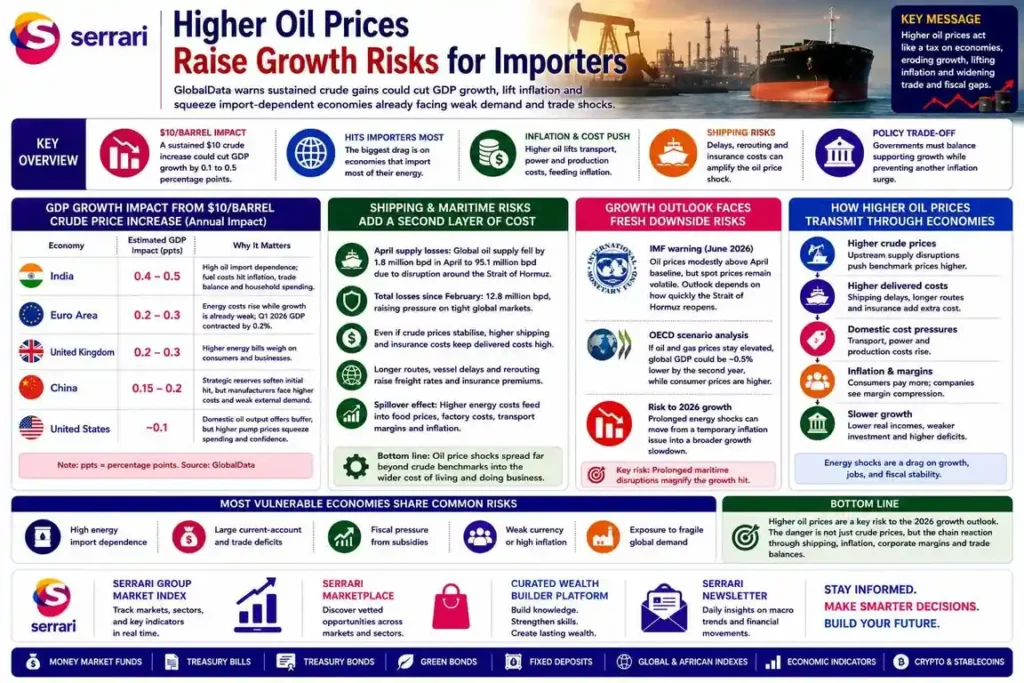
- A sustained $10 per barrel crude increase could cut GDP growth by 0.1 to 0.5 percentage points in major importing economies.
- India faces the biggest estimated hit, at 0.4 to 0.5 percentage points, due to high import dependence.
- The euro area and UK face a 0.2 to 0.3 percentage-point growth risk from higher energy costs.
- China’s impact is estimated at 0.15 to 0.2 percentage points, while the US faces a smaller 0.1 percentage-point drag.
- Shipping delays, rerouting and freight insurance costs could amplify the shock beyond crude prices alone.
Energy Importers Face the Sharpest Pressure
For net energy importers, higher oil prices work like an external tax on households, companies and governments. Consumers pay more for transport and power-related costs, manufacturers absorb higher input prices, and governments face pressure to cushion fuel bills through subsidies or tax relief.
The impact differs sharply by economy. India is most exposed in GlobalData’s estimates, with a $10 per barrel price increase potentially cutting annual GDP growth by 0.4 to 0.5 percentage points. That reflects the country’s high oil import dependence and the direct effect of fuel costs on inflation, current-account balances and household spending.
The eurozone and the UK face a smaller but still material hit of 0.2 to 0.3 percentage points. Europe’s challenge is that higher energy costs arrive while growth is already weak. Eurostat’s latest estimate shows euro-area GDP contracted by 0.2% in the first quarter of 2026, reversing the earlier flash estimate of modest growth.
Context is everything. Stay ahead of shifting trends with today’s market updates, and uncover emerging opportunities using the Serrari Group Market Index and Marketplace. Then, take control of your own financial future by exploring our Money & Life Reset Transformation Blueprint ™ to build stronger habits, create better systems, and design a path toward lasting wealth.
Shipping Risks Add a Second Layer of Cost
The oil-price shock is not only about crude benchmarks. Disruptions in key maritime routes can raise the delivered cost of energy and goods through longer voyages, vessel delays, higher freight rates and more expensive insurance.
The International Energy Agency reported that global oil supply declined further in April, with losses linked to disruption around the Strait of Hormuz. The agency said global supply fell by 1.8 million barrels per day in April to 95.1 million barrels per day, taking total losses since February to 12.8 million barrels per day.
That matters because even if headline crude prices stabilise, delivered fuel and imported goods can remain expensive when shipping and insurance costs stay elevated. This is why the macroeconomic hit can spread from energy bills into food prices, factory costs, transport margins and consumer inflation.
Growth Forecasts Face Fresh Downside Risks
The International Monetary Fund has also warned that oil-market volatility could affect its global outlook. In June, the IMF said oil prices were only modestly above levels used in its April baseline, but noted that physical spot prices remained volatile and that the path of oil would depend heavily on how quickly the Strait of Hormuz reopens.
The OECD has modelled a wider energy-price shock in which oil and gas prices remain elevated. Under that scenario, global GDP could be around 0.5% lower by the second year, while consumer prices would be higher. That reinforces the concern that a prolonged energy shock can move from a temporary inflation issue into a broader growth slowdown.
For the US, domestic oil output provides a partial buffer, limiting the estimated GDP hit to around 0.1 percentage points. However, higher pump prices still squeeze discretionary spending and can weaken consumer confidence. In China, strategic reserves can soften the first impact, but manufacturers remain exposed to energy-intensive production and weaker external demand.
Bottom Line
Higher oil prices are emerging as a key risk to the 2026 growth outlook, especially for economies that depend heavily on imported energy. The danger is not only a higher crude price, but the wider chain reaction through freight, insurance, inflation, corporate margins and trade balances. If maritime disruptions persist, the world’s major importers could face a more difficult policy trade-off: protecting growth while preventing another energy-led inflation shock.
Sources used: TradeArabia / Eurostat / International Energy Agency / Reuters / OECD
Your financial future isn’t something you wait for—it’s something you build.
The real question is: when do you begin?
Move beyond simply staying informed.
Navigate the markets with clarity—track trends through the Serrari Group Market Index, uncover opportunities in the Serrari Marketplace, and build practical knowledge with our Curated Wealth Builder Platform.
Stay connected to what truly matters.
Get daily insights on macro trends and financial movements across Kenya, Africa, and global markets—delivered through the Serrari Newsletter.
Growth opens doors.
Advance your career through professional programs including ACCA, HESI A2, ATI TEAS 7 , HESI EXIT , NCLEX – RN and NCLEX – PN, Financial Literacy!🌟—designed to move you forward with confidence.
See where money is flowing—clearly and in real time.
Track Money Market Funds, Treasury Bills, Treasury Bonds, Green Bonds, and Fixed Deposits, alongside global and African indexes, key economic indicators, and the evolving Crypto and stablecoin landscape—all within Serrari’s Market Index.