

















Recent corporate bond investing activity suggests investors are increasingly favoring high-quality credit amid a higher interest rate environment. Market performance during May highlighted strong demand for longer-duration, investment-grade corporate bonds, while lower-rated debt underperformed as investors became more selective about credit risk and balance sheet quality.
Key Overview
- Longer-duration corporate bonds outperformed shorter-duration bonds during May.
- Investor demand increased for high-quality, investment-grade corporate debt.
- Single-A and AA-rated 30-year bonds were identified as attractive opportunities.
- Lower-rated corporate bonds, including BB, B, and CCC debt, underperformed.
- Higher interest rates are creating greater pressure on weaker borrowers.
- Investors are becoming increasingly selective about credit quality.
- American Century Investments highlighted opportunities in dislocated segments of the corporate bond market.
- Duration demand contributed to stronger performance in longer-maturity bonds.
- The American Century Diversified Corporate Bond ETF (KORP) returned approximately 5.5% over the last 12 months.
- The ETF carries an expense ratio of 29 basis points.
Corporate Bond Market Trends Favor High-Quality Credit
The latest corporate bond market trends indicate a growing preference among investors for high-quality debt as interest rates remain elevated and economic uncertainty persists.
Recent market activity has demonstrated a clear divide between investment-grade bonds and lower-rated corporate debt. Investors are increasingly rewarding issuers with stronger balance sheets, healthier cash flows, and greater financial flexibility while becoming more cautious toward companies with weaker credit profiles.
According to insights shared by American Century Investments executive Jason Greenblath, May delivered a notable shift within corporate bond markets, with longer-duration bonds outperforming shorter-maturity debt.
The trend reflects changing investor preferences and highlights how credit quality continues to influence performance across fixed income markets.
Bond Market Outlook Improves for Longer-Duration Bonds
The latest bond market outlook suggests investors are becoming more comfortable extending duration in pursuit of higher-quality opportunities.
While April saw strength across multiple segments of the corporate bond curve, May produced a stronger performance from longer-maturity bonds. These securities benefited from increased demand among investors seeking duration exposure and high-quality credit characteristics.
Greenblath noted that the longer end of the corporate bond curve significantly outperformed during the month.
The preference for longer-duration bonds reflects growing confidence in investment-grade issuers and the belief that these companies are better positioned to navigate a prolonged period of elevated interest rates.
As market participants continue evaluating economic conditions and monetary policy expectations, duration remains a key factor influencing portfolio construction decisions.
Investment-Grade Bonds Attract Investor Interest
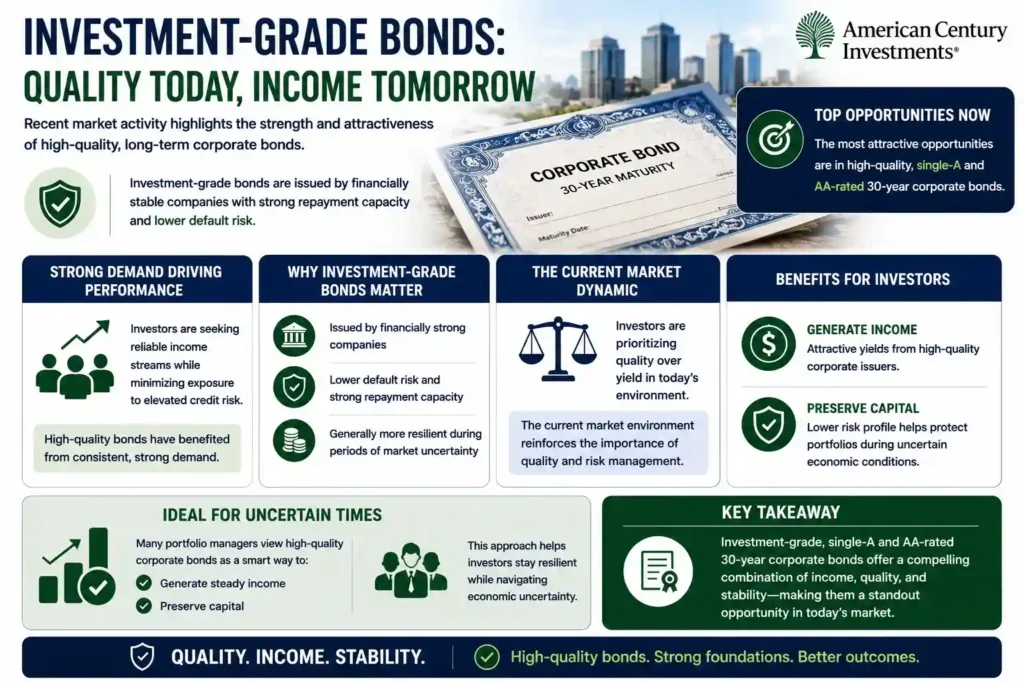
One of the clearest themes emerging from recent market activity is the strong performance of investment-grade bonds.
According to American Century Investments, some of the most attractive opportunities currently exist within high-quality single-A and AA-rated 30-year corporate bonds.
These securities have benefited from strong demand as investors seek reliable income streams while minimizing exposure to elevated credit risk.
Investment-grade bonds are generally issued by financially stable companies with strong repayment capacity and lower default risk. As a result, they often perform relatively well during periods when investors become more risk-conscious.
The current market environment appears to be reinforcing this dynamic, with investors prioritizing quality over yield.
Many portfolio managers view high-quality corporate bonds as an attractive way to generate income while preserving capital in uncertain economic conditions.
Context is everything. Stay ahead of shifting trends with today’s market updates, and uncover emerging opportunities using the Serrari Group Market Index and Marketplace. Then, take control of your own financial future by exploring our Money & Life Reset Transformation Blueprint ™ to build stronger habits, create better systems, and design a path toward lasting wealth.
Fixed Income Markets Show Clear Quality Preference
Recent developments across fixed income markets reveal a growing distinction between stronger and weaker borrowers.
While investment-grade debt performed well, lower-rated corporate bonds experienced significant underperformance. Securities rated below investment grade faced increasing pressure as investors reassessed risk exposure in light of higher financing costs.
According to Greenblath, lower-credit-quality bonds performed dramatically worse as ratings declined from BB to single-B and CCC categories.
The divergence highlights how elevated interest rates can disproportionately affect companies with weaker financial positions.
Businesses carrying higher debt burdens or generating less predictable cash flows often face greater refinancing challenges when borrowing costs remain elevated.
As a result, investors are increasingly scrutinizing balance sheets and credit metrics when allocating capital within fixed income portfolios.
Corporate Bond Investing Requires Greater Selectivity
The current environment suggests that corporate bond investing is becoming increasingly dependent on careful credit selection.
During periods of abundant liquidity and low interest rates, investors often accepted greater risk in pursuit of higher yields. Today’s market conditions are different.
Higher rates have increased the importance of identifying issuers capable of maintaining financial stability despite rising borrowing costs.
Greenblath emphasized that investors should focus on bonds offering positive optionality while avoiding securities that appear expensive relative to their risk profile.
This approach reflects a broader trend toward active credit analysis and disciplined portfolio construction.
Rather than chasing yield alone, investors are prioritizing risk-adjusted returns and long-term credit quality.
The result is a market that increasingly rewards companies with strong fundamentals while penalizing weaker issuers.
Bond Portfolio Strategy Shifts Toward Quality
The evolving market landscape is also influencing bond portfolio strategy decisions.
Portfolio managers are adjusting allocations to emphasize quality, duration management, and resilience.
For many investors, this means increasing exposure to highly rated corporate issuers while reducing positions in speculative-grade debt.
The strategy aims to balance income generation with risk management as economic conditions remain uncertain.
Longer-duration investment-grade bonds have emerged as a particularly attractive segment because they offer both income potential and exposure to high-quality issuers.
This combination has helped support demand despite broader market volatility.
Investors seeking diversified exposure to corporate bonds are increasingly evaluating funds and exchange-traded products focused on investment-grade securities.
American Century Investments Highlights Market Opportunities
The views presented by American Century Investments reflect a broader industry discussion about where value exists within corporate bond markets.
The firm’s research has identified high-quality, long-duration bonds as one of the most attractive areas within the corporate credit universe.
Investors seeking exposure to this theme can access the market through the American Century Diversified Corporate Bond ETF (KORP).
The ETF charges a management fee of 29 basis points and delivered a return of approximately 5.5% over the past twelve months, according to ETF Database data.
The strategy provides diversified exposure to corporate bonds while incorporating the firm’s research-driven approach to credit selection and portfolio construction.
As market conditions evolve, such strategies may continue benefiting from investor demand for quality-focused fixed income solutions.
Conclusion
Current corporate bond market trends reveal a strong preference for quality as investors navigate a higher-rate environment. Longer-duration investment-grade bonds have outperformed, while lower-rated debt has faced significant pressure due to concerns about refinancing risk and financial resilience.
The divergence between high-quality and speculative-grade bonds highlights the importance of careful credit analysis and disciplined portfolio management. As fixed income markets continue adapting to elevated interest rates, investors appear increasingly focused on identifying strong issuers capable of delivering stable returns while managing risk effectively.
FAQs
1. Why are high-quality corporate bonds outperforming lower-rated bonds?
High-quality corporate bonds are benefiting from increased investor demand because they are issued by companies with stronger financial positions and lower default risk. In a higher interest rate environment, investors are becoming more selective and favoring issuers that have strong balance sheets, reliable cash flows, and greater ability to manage borrowing costs.
2. What are investment-grade bonds?
Investment-grade bonds are debt securities issued by companies that have relatively strong credit ratings and a lower likelihood of default. Ratings agencies typically classify bonds rated BBB- or higher as investment grade. These bonds often offer lower yields than speculative-grade debt but are generally considered safer investments.
3. Why are lower-rated corporate bonds struggling?
Lower-rated bonds are underperforming because higher interest rates place greater financial pressure on companies with weaker credit profiles. Borrowers with significant debt obligations or lower cash flow generation may face higher refinancing costs and increased repayment risks, making investors more cautious about holding their bonds.
4. How can investors gain exposure to corporate bonds?
Investors can access corporate bonds through individual bond purchases, mutual funds, or exchange-traded funds. Products such as the American Century Diversified Corporate Bond ETF (KORP) provide diversified exposure to corporate credit markets while helping investors spread risk across multiple issuers and sectors.
Your financial future isn’t something you wait for—it’s something you build.
The real question is: when do you begin?
Move beyond simply staying informed.
Navigate the markets with clarity—track trends through the Serrari Group Market Index, uncover opportunities in the Serrari Marketplace, and build practical knowledge with our Curated Wealth Builder Platform.
Stay connected to what truly matters.
Get daily insights on macro trends and financial movements across Kenya, Africa, and global markets—delivered through the Serrari Newsletter.
Growth opens doors.
Advance your career through professional programs including ACCA, HESI A2, ATI TEAS 7 , HESI EXIT , NCLEX – RN and NCLEX – PN, Financial Literacy!🌟—designed to move you forward with confidence.
See where money is flowing—clearly and in real time.
Track Money Market Funds, Treasury Bills, Treasury Bonds, Green Bonds, and Fixed Deposits, alongside global and African indexes, key economic indicators, and the evolving Crypto and stablecoin landscape—all within Serrari’s Market Index.