The first leg of the U.S. Treasury’s $125 billion August refunding is complete. The $58 billion three-year note auction cleared at 4.291%, up from 4.179% in July.
That is 11.2 basis points higher, although the increase alone does not prove weak demand because market yields have also risen.
Attention now shifts to $42 billion of 10-year notes on August 12 and $25 billion of 30-year bonds on August 13. July CPI arrives before Wednesday’s 10-year auction.
Key Overview
- Three-year auction: $58 billion at 4.291%
- July three-year auction: 4.179%
- Remaining refunding supply: $67 billion
- 10-year auction: $42 billion on August 12
- 30-year auction: $25 billion on August 13
- 10-year market yield: approximately 4.69%
- 30-year market yield: approximately 5.24%
- July CPI: August 12 at 8:30 a.m. ET
US Treasury Bonds Clear First $58B Test at 4.291%
The U.S. Treasury has completed the first auction in its $125 billion August quarterly refunding programme, selling $58 billion of three-year notes at a high yield of 4.291%.
The Trading Economics current auction record shows the result above July’s 4.179% auction yield, an increase of 11.2 basis points.
A higher yield gives new buyers more income but means a lower bond price. The increase should not automatically be labelled weak demand because the wider Treasury market has also repriced.
$67 Billion of Supply Remains
The official Treasury August refunding statement sets out $125 billion across three maturities. About $96.3 billion will refinance maturing privately held debt, while approximately $28.7 billion represents new cash.
After today’s sale, Treasury still has:
- $42 billion of 10-year notes on August 12; and
- $25 billion of 30-year bonds on August 13.
Longer maturities generally carry greater duration risk, so their prices are more sensitive to changes in yields.
CPI Arrives Before the 10-Year Auction
The official BLS July CPI schedule confirms that July inflation data will be released at 8:30 a.m. Eastern Time on Wednesday, several hours before the 10-year auction.
A hotter-than-expected reading could push required yields higher because inflation reduces the real value of fixed future payments. Softer inflation could support bond prices and lower yields.
That places one of the month’s biggest inflation events directly in front of a major Treasury sale.
Long-Term Yields Are Already High
The Trading Economics current Treasury curve shows the 10-year yield near 4.69% and the 30-year around 5.24%. The three-year secondary-market yield is about 4.30%, close to today’s auction result.
For new buyers, elevated yields provide more income. For existing holders, rising yields generally reduce market values.
Context is everything. Stay ahead of shifting trends with today’s market updates, and uncover emerging opportunities using the Serrari Group Market Index and Marketplace. Then, take control of your own financial future by exploring our Money & Life Reset Transformation Blueprint ™ to build stronger habits, create better systems, and design a path toward lasting wealth.
How Investors Judge Auction Demand
The auction yield is only one part of the story.
The official TreasuryDirect auction mechanics guide explains how competitive bidding determines the highest accepted yield.
Investors also watch:
- Bid-to-cover ratio — total bids relative to securities sold;
- Indirect bidders — customers bidding through dealers or other submitters;
- Direct bidders — institutions bidding for their own accounts;
- Primary-dealer take-up — the amount dealers ultimately absorb; and
- Tail or stop-through — whether the auction clears above or below the expected market yield.
These indicators provide a better picture of investor appetite than the auction yield alone.
The Fed Keeps Inflation Important
The Federal Reserve July policy statement kept the federal funds target range at 3.50%–3.75%, but the vote was 9–3 and three policymakers preferred a 25-basis-point increase.
The Fed also said inflation remained elevated relative to its 2% objective.
That makes Wednesday’s CPI result particularly important for expectations around future rates and Treasury pricing.
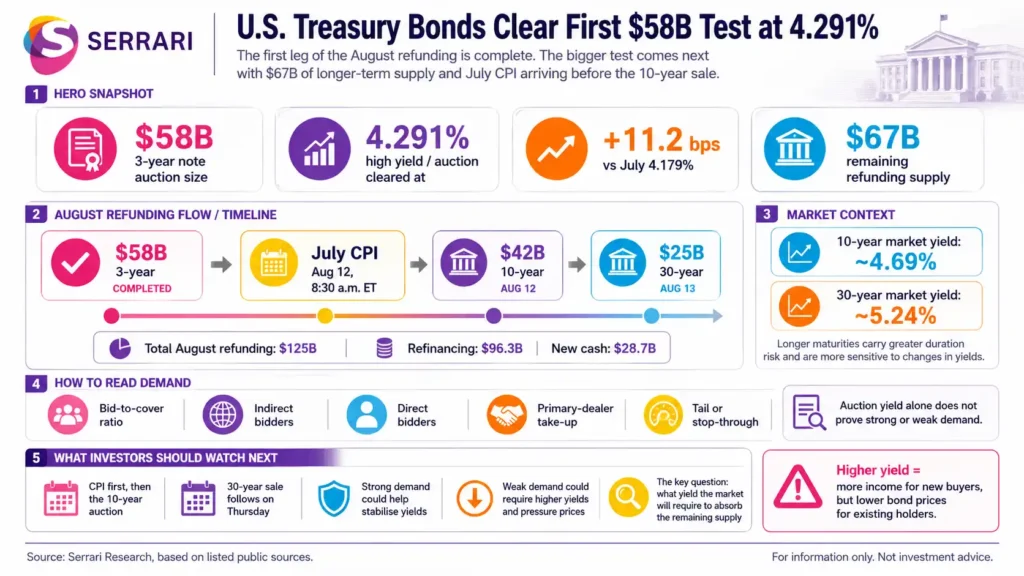
The U.S. Treasury’s $125 billion August refunding starts with a completed $58 billion three-year auction at 4.291%. It is followed by $42 billion of 10-year notes on August 12 and $25 billion of 30-year bonds on August 13. July CPI lands before the 10-year sale. Treasury is refinancing $96.3 billion and raising $28.7 billion of new cash.
What Investors Should Watch Next
Wednesday is now the critical session.
Investors will see CPI first and the 10-year auction later. Thursday adds the 30-year bond sale, where longer duration creates even greater sensitivity to changing rate expectations.
Strong demand could help stabilise yields.
Weak demand could require higher yields and pressure bond prices.
The interaction between inflation and auction demand will therefore determine whether today’s 4.291% three-year result marks the high point for the week or only the beginning of further upward pressure on Treasury yields.
Conclusion
The first $58 billion leg of the August refunding cleared at 4.291%, 11.2 basis points above July’s three-year auction yield.
But the bigger test remains ahead: $67 billion of longer-term supply alongside fresh inflation data.
The key investor question is now what yield the market will require to absorb the 10- and 30-year securities after CPI resets expectations.
The three-year auction has completed the first test.
The harder part of the refunding programme begins Wednesday.
FAQs
1. What yield did the three-year auction clear at?
The $58 billion three-year Treasury auction cleared at a high yield of 4.291%, compared with 4.179% in July.
2. Does the higher yield mean weak demand?
Not by itself. Market yields have also moved higher. Bid-to-cover, bidder composition and the auction’s relationship with pre-auction market pricing provide better evidence of demand quality.
3. What Treasury auctions come next?
Treasury will sell $42 billion of 10-year notes on August 12 and $25 billion of 30-year bonds on August 13.
4. Why does July CPI matter?
Inflation affects the purchasing power of fixed bond payments and expectations for Federal Reserve policy. A significant CPI surprise can therefore reprice Treasury yields immediately before the 10-year auction.
Sources: official Treasury August refunding statement, TreasuryDirect current auction results page, official TreasuryDirect auction mechanics guide, official BLS July CPI schedule, Federal Reserve July policy statement, Trading Economics current Treasury curve.
Your financial future isn’t something you wait for—it’s something you build.
The real question is: when do you begin?
Move beyond simply staying informed.
Navigate the markets with clarity—track trends through the Serrari Group Market Index, uncover opportunities in the Serrari Marketplace, and build practical knowledge with our Curated Wealth Builder Platform.
Stay connected to what truly matters.
Get daily insights on macro trends and financial movements across Kenya, Africa, and global markets—delivered through the Serrari Newsletter.
Growth opens doors.
Advance your career through professional programs including ACCA, HESI A2, ATI TEAS 7 , HESI EXIT , NCLEX – RN and NCLEX – PN, Financial Literacy!🌟—designed to move you forward with confidence.
See where money is flowing—clearly and in real time.
Track Money Market Funds, Treasury Bills, Treasury Bonds, Green Bonds, and Fixed Deposits, alongside global and African indexes, key economic indicators, and the evolving Crypto and stablecoin landscape—all within Serrari’s Market Index.