
The recent Nairobi Securities Exchange selloff has seen foreign investors offload approximately Sh10 billion worth of shares, primarily from Kenya’s largest listed companies. While the move has raised concerns about capital flight, some market analysts believe the decline presents an opportunity for local investors to acquire fundamentally strong companies at discounted valuations.
LIVENSE market summarySee NSE data →Key Overview
- Foreign investors have sold approximately Sh10 billion worth of shares on the NSE.
- The selloff has largely targeted Kenya’s biggest blue-chip companies.
- The move is linked primarily to global interest rate trends rather than company-specific weaknesses.
- Higher U.S. Treasury yields have encouraged capital flows away from frontier markets.
- Several leading Kenyan companies continue to report strong profitability despite share price declines.
- Falling share prices have increased dividend yields across some blue-chip counters.
- Certain tier-one banks are now offering dividend yields above 12%.
- Local pension funds and retail investors may benefit from lower entry prices.
- Market participants view the situation as both a challenge and a potential investment opportunity.
- The selloff highlights the influence of global capital flows on the Kenyan equity market.
Foreign Investors NSE Exit Reshapes Market Dynamics
The latest wave of selling by foreign investors NSE participants has become one of the most closely watched developments in Kenya’s capital markets.
Foreign investors have reportedly offloaded approximately Sh10 billion worth of shares, primarily concentrated in some of the largest and most actively traded companies on the Nairobi Securities Exchange. The move has generated concerns about foreign capital flight and its impact on market valuations.
However, beneath the headlines, many analysts argue that the situation presents a different story—one that could create opportunities for domestic investors willing to take a long-term view.
While international investors continue reducing exposure to emerging and frontier markets, the underlying fundamentals of many Kenyan blue-chip companies remain largely unchanged.
As a result, falling prices may be creating attractive entry points for local investors seeking exposure to high-quality businesses.
Foreign Investor Selloff Driven by Global Factors
The recent foreign investor selloff has largely been driven by international economic conditions rather than weaknesses within Kenyan companies.
One of the primary factors influencing global investment flows has been the interest rate environment in the United States. Higher yields on U.S. Treasury securities have made American fixed-income investments increasingly attractive to global fund managers.
As investors seek higher returns from lower-risk assets, capital has been flowing out of emerging and frontier markets, including Kenya.
This trend has affected stock exchanges across several developing economies, where foreign institutional investors have reduced positions to rebalance portfolios and take advantage of opportunities in developed markets.
Importantly, the selling pressure appears to be linked more to macroeconomic considerations than to company-specific performance.
This distinction is critical for investors evaluating the long-term outlook for Kenyan equities.
Kenya Stock Market Faces External Pressure
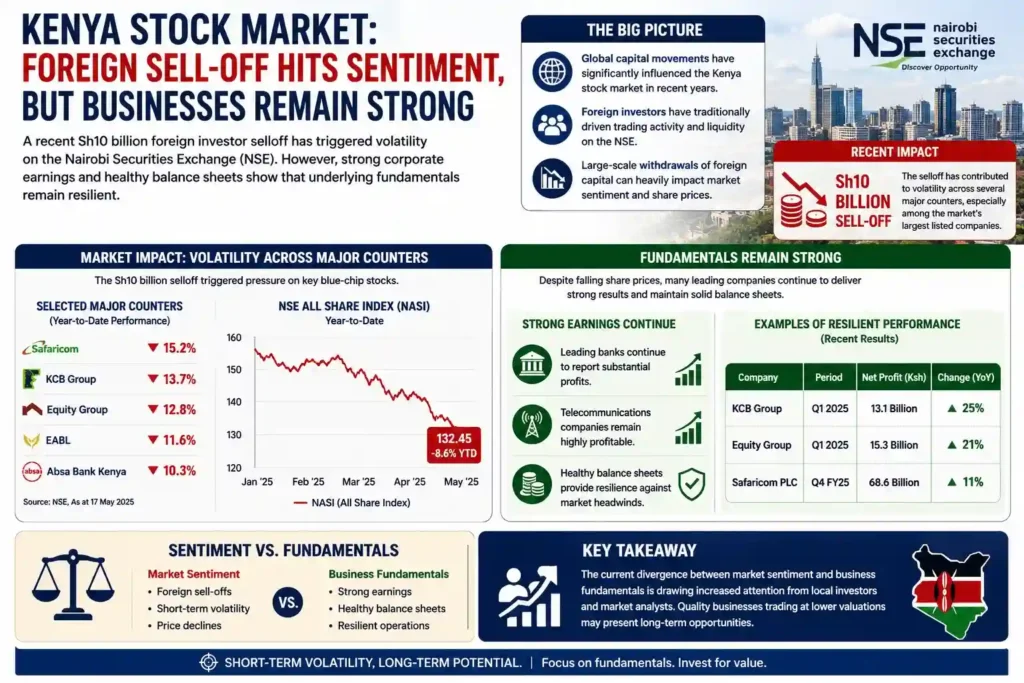
The broader Kenya stock market has been significantly influenced by global capital movements over the past several years.
Foreign investors have traditionally played a major role in driving trading activity and liquidity on the Nairobi Securities Exchange. As a result, large-scale withdrawals of foreign capital can have a noticeable impact on market sentiment and share prices.
The recent Sh10 billion selloff has contributed to volatility across several major counters, particularly among the market’s largest listed companies.
However, despite declining share prices, many of these businesses continue to generate strong earnings and maintain healthy balance sheets.
Several leading banks and telecommunications companies have continued reporting substantial profits, suggesting that operational performance remains relatively resilient.
This divergence between market sentiment and business fundamentals has attracted attention from local investors and market analysts.
Context is everything. Stay ahead of shifting trends with today’s market updates, and uncover emerging opportunities using the Serrari Group Market Index and Marketplace. Then, take control of your own financial future by exploring our Money & Life Reset Transformation Blueprint ™ to build stronger habits, create better systems, and design a path toward lasting wealth.
Foreign Equity Outflows Create Valuation Opportunities
The ongoing foreign equity outflows have placed downward pressure on valuations across several blue-chip stocks.
When foreign investors sell large positions within a short period, share prices often decline regardless of the underlying financial strength of the companies involved.
For long-term investors, these declines can create opportunities to acquire shares at more attractive prices.
Some analysts describe the current environment as a potential transfer of ownership from international investors to domestic institutions and retail participants.
Local pension funds, insurance companies, and individual investors may be able to increase exposure to strategic Kenyan companies at valuations that were unavailable during periods of stronger foreign demand.
The National Social Security Fund (NSSF) and other institutional investors are frequently viewed as potential beneficiaries of such market dislocations.
NSE Trading Activity Remains Focused on Blue Chips
Recent NSE trading activity has remained concentrated in a handful of large-cap stocks that dominate market turnover.
LIVENSE market summarySee NSE data →The companies most affected by the foreign selloff are among the exchange’s most liquid and widely held counters. These firms typically attract both local and international investors because of their scale, profitability, and dividend-paying histories.
As foreign investors reduce positions, domestic participants increasingly influence trading patterns and market direction.
While reduced foreign participation can temporarily affect liquidity, it can also contribute to greater local ownership of strategic national assets.
Market observers note that the current environment may encourage more Kenyan investors to engage actively with the stock market.
Blue-Chip Stocks Kenya Continue Delivering Profits
Many of the affected blue-chip stocks Kenya remain financially strong despite share price declines.
Leading banks, telecommunications firms, and other major listed companies continue to generate substantial earnings and maintain established market positions.
In some cases, lower share prices have increased dividend yields significantly. According to market reports, several tier-one banks are now offering dividend yields exceeding 12%.
For income-focused investors, higher dividend yields can enhance the attractiveness of long-term investments, particularly when supported by stable profitability.
While short-term volatility remains a concern, many blue-chip companies continue to demonstrate resilience through strong cash generation and consistent business performance.
Institutional Investors Kenya Could Play a Larger Role
The current market environment may increase the influence of institutional investors Kenya within the equity market.
Pension funds, insurance companies, and investment managers often take a longer-term approach than foreign portfolio investors. This allows them to focus more on company fundamentals than short-term market fluctuations.
As foreign ownership declines, local institutions could expand their holdings in strategic sectors such as banking, telecommunications, and consumer services.
Greater domestic participation may also help strengthen market stability by reducing dependence on external capital flows.
Over time, increased local ownership could contribute to deeper capital markets and stronger investor confidence.
Conclusion
The recent foreign investors NSE selloff has resulted in approximately Sh10 billion worth of blue-chip shares being offloaded from the Nairobi Securities Exchange. While the move reflects broader global investment trends and higher U.S. interest rates, it does not necessarily indicate weakness among Kenya’s leading listed companies.
Many affected firms continue to report strong profits, maintain healthy balance sheets, and offer attractive dividend yields. As foreign investors reduce exposure, local institutions and retail investors may find opportunities to acquire high-quality assets at discounted valuations. The situation highlights both the challenges and opportunities created by global capital flows within Kenya’s equity market.
FAQs
1. Why are foreign investors selling shares on the Nairobi Securities Exchange?
Foreign investors are primarily reducing exposure because higher U.S. interest rates have made American government bonds more attractive. Many global fund managers are reallocating capital from emerging and frontier markets into lower-risk developed-market assets. The selling is largely driven by international economic conditions rather than poor performance by Kenyan companies.
2. How much have foreign investors sold on the NSE?
Recent market reports indicate that foreign investors have offloaded approximately Sh10 billion worth of shares, mainly from large blue-chip companies. These firms represent some of the most actively traded and widely held stocks on the exchange, making their share prices particularly sensitive to foreign investment flows.
3. Why do some analysts see the selloff as an opportunity?
Many analysts believe the selloff has pushed the prices of fundamentally strong companies below their intrinsic value. Since several affected firms continue to report healthy profits and attractive dividend payouts, long-term investors may be able to purchase quality shares at discounted prices compared to previous market levels.
4. How could local investors benefit from the current NSE environment?
Local retail investors, pension funds, and institutional investors may be able to increase ownership in profitable Kenyan companies while valuations remain relatively low. Additionally, declining share prices have boosted dividend yields in some blue-chip counters, potentially providing stronger income opportunities for investors focused on long-term returns.
Sources: Business Daily, Streamline Feed
Your financial future isn’t something you wait for—it’s something you build.
The real question is: when do you begin?
Move beyond simply staying informed.
Navigate the markets with clarity—track trends through the Serrari Group Market Index, uncover opportunities in the Serrari Marketplace, and build practical knowledge with our Curated Wealth Builder Platform.
Stay connected to what truly matters.
Get daily insights on macro trends and financial movements across Kenya, Africa, and global markets—delivered through the Serrari Newsletter.
Growth opens doors.
Advance your career through professional programs including ACCA, HESI A2, ATI TEAS 7 , HESI EXIT , NCLEX – RN and NCLEX – PN, Financial Literacy!🌟—designed to move you forward with confidence.
See where money is flowing—clearly and in real time.
Track Money Market Funds, Treasury Bills, Treasury Bonds, Green Bonds, and Fixed Deposits, alongside global and African indexes, key economic indicators, and the evolving Crypto and stablecoin landscape—all within Serrari’s Market Index.