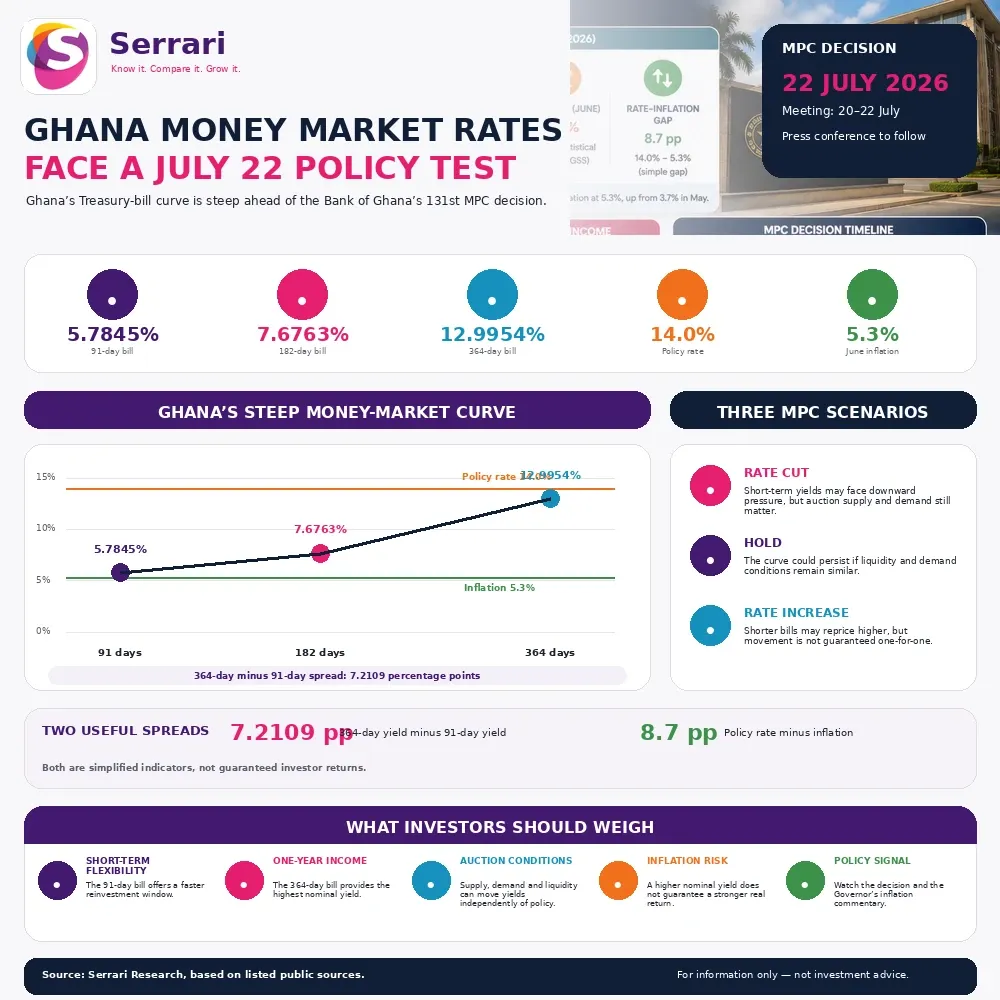
Ghana Treasury bill rates show an unusually steep money-market curve ahead of the July MPC decision. The 91-day bill yields 5.7845%, while the 364-day bill yields 12.9954%, creating a 7.2109-percentage-point spread between the shortest and longest bill. That gap may reflect liquidity preference, maturity risk, auction supply, demand conditions and expectations about future policy, but it should not be attributed to one cause without deeper auction-flow analysis. Investors must weigh short-term flexibility against higher one-year nominal income, while remembering that Treasury bill yields do not always move one-for-one with the Bank of Ghana policy rate.
Key Overview
- The Bank of Ghana MPC meeting runs from 20 to 22 July 2026.
- The 91-day Treasury bill yield is 5.7845%.
- The 182-day Treasury bill yield is 7.6763%.
- The 364-day Treasury bill yield is 12.9954%.
- The current Bank of Ghana policy rate is 14.0%.
- Ghana’s June inflation rate stands at 5.3%.
- The 364-day-minus-91-day yield spread is 7.2109 percentage points.
- The policy-rate-minus-inflation gap is a simple 8.7 percentage points, before any investor-specific tax, compounding or inflation-basket effects. (Bank of Ghana)
Ghana Money Market Rates Face a July 22 Policy Test
The MPC Decision Is the Immediate Catalyst
The Bank of Ghana’s notice says the Monetary Policy Committee will hold its 131st regular meetings from Monday, 20 July to Wednesday, 22 July 2026, and will conclude with a press conference announcing the Committee’s decision. That makes the 22 July announcement the immediate catalyst for Ghana’s money-market outlook. (Bank of Ghana)
The policy backdrop is restrictive. The Bank of Ghana’s own homepage shows a current monetary policy rate of 14.00%, while the May MPC press release confirms that the Committee maintained the policy rate at 14.0% at its previous meeting. (Bank of Ghana)
The Bill Curve Is Steep
The latest Bank of Ghana Treasury bill table shows the 20 July issue at 5.7845% for the 91-day bill, 7.6763% for the 182-day bill and 12.9954% for the 364-day bill. Compared with the 13 July issue, the 91-day yield fell from 5.8617%, the 182-day yield fell from 7.7884%, and the 364-day yield edged up from 12.9915%. (Bank of Ghana)
That produces a clear curve message. Investors receive much less nominal income for staying at the short end, while the one-year bill offers more than twice the 91-day yield. But a higher one-year yield also means the investor gives up more flexibility.
The 364-Day Bill Carries the Income Premium
The 364-day bill’s 12.9954% yield is the standout number. It is 7.2109 percentage points above the 91-day bill, giving investors a much larger nominal income opportunity if they can commit funds for one year. (Bank of Ghana)
However, the spread should not be read as a single-message market forecast. It may reflect investors demanding compensation for maturity risk, liquidity conditions, bill supply, expectations around future policy rates, government funding needs or portfolio preferences among banks, pension funds and asset managers.
Inflation Complicates the Policy Debate
Ghana Statistical Service reports that inflation stood at 5.3% in June 2026. Independent reporting on the release also notes that June inflation rose from 3.7% in May, marking a sharp monthly increase in the headline rate. (Ghana Statistical Service)
That matters for the MPC. A 14.0% policy rate against 5.3% inflation gives a simple policy-rate-minus-inflation gap of 8.7 percentage points. But that is only a simplified indicator of policy restrictiveness. It is not the real return earned by investors in Treasury bills, because investors must consider taxes, compounding, holding period and their own spending basket.
Context is everything. Stay ahead of shifting trends with today’s market updates, and uncover emerging opportunities using the Serrari Group Market Index and Marketplace. Then, take control of your own financial future by exploring our Money & Life Reset Transformation Blueprint ™ to build stronger habits, create better systems, and design a path toward lasting wealth.
Short Bills Offer Flexibility
The 91-day bill offers the lowest yield, but it also gives investors the fastest reinvestment window. That can matter in an MPC week. If the policy decision changes market expectations, investors in short bills can reprice sooner than those locked into one-year paper.
This flexibility may appeal to investors managing liquidity, businesses with near-term cash commitments, or funds that prefer to wait for clearer signals from inflation and policy. The cost of that flexibility is lower income today.
One-Year Bills Offer Income, But Less Optionality
The 364-day bill offers the highest yield, but it requires a longer holding period. For investors who can lock funds for one year, the yield premium may be attractive. For investors who need liquidity or expect better opportunities later, the same maturity may be less appealing.
The decision is therefore not simply “highest yield wins.” It is a trade-off between income and optionality. The one-year bill may suit investors seeking predictable nominal income, while the 91-day and 182-day bills may suit investors who value flexibility.
Policy Does Not Move Bills Mechanically
The Bank of Ghana’s May MPC statement noted that short-term rates had declined as inflation expectations eased and the monetary-policy stance remained tight. It also said the Committee would continue monitoring incoming data and take policy action when necessary.
That is useful context, but investors should avoid assuming a mechanical link between the MPC decision and bill yields. Treasury bill rates also respond to government issuance, auction demand, bank liquidity, institutional portfolio decisions and fiscal financing needs.
Three Scenarios for Investors
A rate cut could put downward pressure on short-term yields, especially if investors interpret the decision as the start of easier policy. But the effect may be uneven if the government’s funding needs keep supply high.
A hold could preserve the current curve for longer, especially if the MPC stresses caution after June inflation rose. A rate increase would likely surprise parts of the market and could support higher short-bill yields, although the pass-through would still depend on auction conditions.
What Investors Should Watch
Investors should watch the policy-rate decision, Governor Johnson Pandit Asiama’s press-conference tone, comments on inflation risks, and the next weekly auction results. They should also monitor whether the 91-day and 182-day yields continue falling while the 364-day rate remains elevated.
The key signal will be whether demand rotates toward shorter bills or whether investors begin accepting one-year maturity for the higher income. That rotation would say more about liquidity preference and reinvestment appetite than the headline policy rate alone.
Conclusion
Ghana Money Market Rates enter the July MPC decision with a steep bill curve and a clear investor trade-off. The 91-day bill offers liquidity at 5.7845%, while the 364-day bill offers much higher nominal income at 12.9954%. The policy rate remains 14.0%, and inflation has risen to 5.3%.
The 22 July decision may shape expectations, but it will not be the only driver of money-market yields. Auction supply, investor demand, liquidity and government financing needs will still matter. For investors, the central question is whether to prioritise short-term flexibility or accept one-year maturity for the higher yield premium.
FAQs
1. What are Ghana Money Market Rates right now?
The latest Bank of Ghana Treasury bill table shows the 91-day bill at 5.7845%, the 182-day bill at 7.6763% and the 364-day bill at 12.9954% for the 20 July 2026 issue. The Bank of Ghana policy rate currently stands at 14.0%, while June inflation is 5.3%. (Bank of Ghana)
2. When is Ghana’s July MPC decision?
The Bank of Ghana’s 131st MPC meeting runs from 20 to 22 July 2026. The meeting concludes with a press conference on Wednesday, 22 July, where the Committee will announce its policy decision. (Bank of Ghana)
3. Why is the 364-day Treasury bill yield so much higher?
The 364-day bill yields 12.9954%, compared with 5.7845% for the 91-day bill. The gap may reflect maturity risk, liquidity preference, auction supply, investor demand and expectations around future policy. It should not be attributed to one cause without auction-demand and liquidity analysis.
4. Does the policy rate determine Treasury bill yields?
Not directly. The policy rate influences financial conditions and short-term rate expectations, but Treasury bill yields are also affected by government funding needs, auction supply, market liquidity, investor demand and maturity preferences. A policy change does not guarantee a one-for-one move in bill yields.
5. Is the policy-rate-minus-inflation gap an investor real return?
No. The 14.0% policy rate minus 5.3% inflation gives a simple 8.7-percentage-point indicator, but it is not an investor’s exact real return. Actual outcomes depend on the specific Treasury bill yield, tax, compounding, holding period and each investor’s inflation experience.
Sources Used
- Bank of Ghana — Notice of the 131st MPC Meeting — supports the 20–22 July MPC meeting dates and the 22 July press-conference decision schedule. (Bank of Ghana)
- Bank of Ghana — Treasury Bill Rates — supports the 20 July Treasury bill yields of 5.7845%, 7.6763% and 12.9954%, and the 13 July comparison yields of 5.8617%, 7.7884% and 12.9915%. (Bank of Ghana)
- Bank of Ghana — Weekly GOG T-Bill Auction Results Page — supports the official weekly government-bill auction-result context and the 17 July tender-results listing. (Bank of Ghana)
- Bank of Ghana — May 2026 MPC Press Release — supports the previous MPC decision to maintain the monetary policy rate at 14.0%, the discussion of declining short-term money-market rates and the scheduled July 20–22 meeting.
- Bank of Ghana — Homepage Policy Dashboard — supports the current monetary policy rate of 14.00% and the central bank’s current dashboard context. (Bank of Ghana)
- Ghana Statistical Service — Inflation Rate Page — supports June 2026 inflation at 5.3%. (Ghana Statistical Service)
- Business Ghana / GSS Inflation Coverage — supports the June inflation move to 5.3% from 3.7% in May and the third consecutive monthly increase context. (BusinessGhana)
- Bank of Ghana — Monetary Policy Reports Page — supports the official monetary-policy-report archive and the May 2026 report context. (Bank of Ghana)
Your financial future isn’t something you wait for—it’s something you build.
The real question is: when do you begin?
Move beyond simply staying informed.
Navigate the markets with clarity—track trends through the Serrari Group Market Index, uncover opportunities in the Serrari Marketplace, and build practical knowledge with our Curated Wealth Builder Platform.
Stay connected to what truly matters.
Get daily insights on macro trends and financial movements across Kenya, Africa, and global markets—delivered through the Serrari Newsletter.
Growth opens doors.
Advance your career through professional programs including ACCA, HESI A2, ATI TEAS 7 , HESI EXIT , NCLEX – RN and NCLEX – PN, Financial Literacy!🌟—designed to move you forward with confidence.
See where money is flowing—clearly and in real time.
Track Money Market Funds, Treasury Bills, Treasury Bonds, Green Bonds, and Fixed Deposits, alongside global and African indexes, key economic indicators, and the evolving Crypto and stablecoin landscape—all within Serrari’s Market Index.