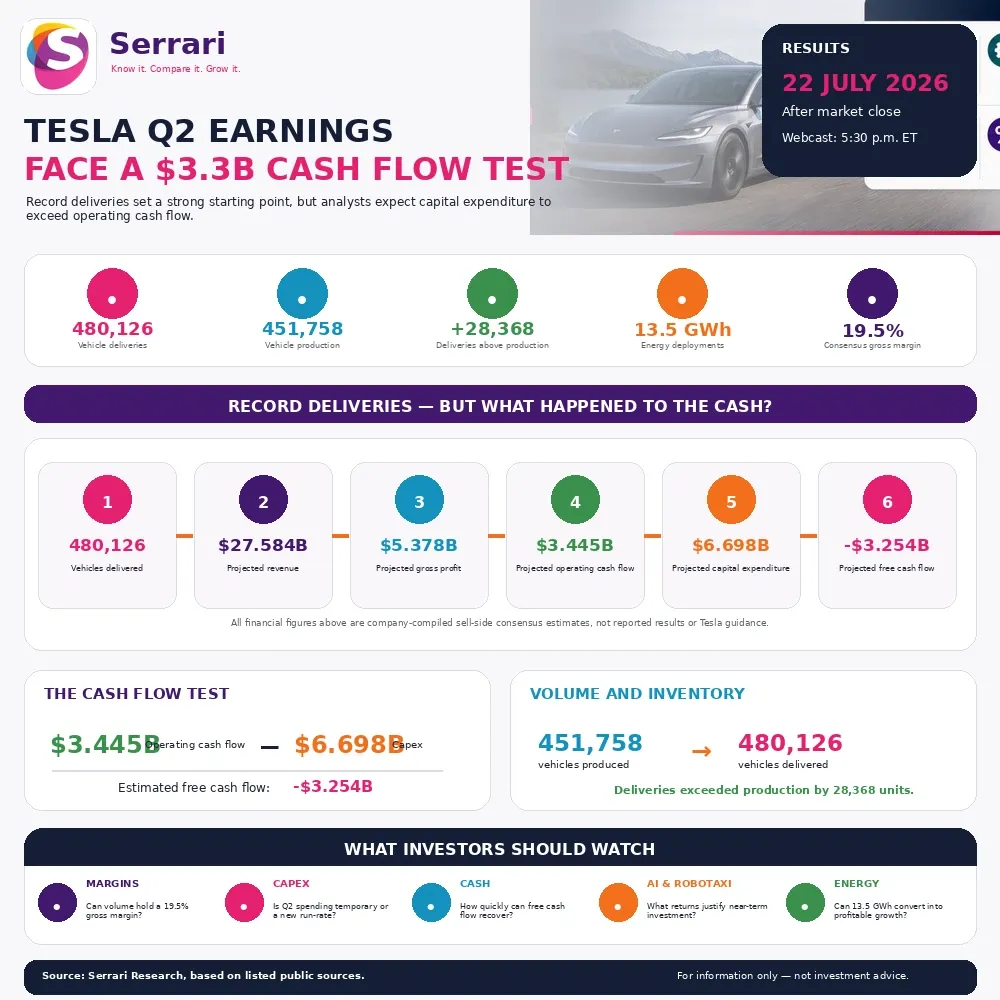
Tesla free cash flow is the central test in Q2 because vehicle deliveries improved sharply, but analysts expect capital expenditure to exceed operating cash flow. Tesla’s company-compiled consensus shows estimated operating cash flow of $3.445 billion against $6.698 billion of capital expenditure, implying negative free cash flow of about $3.254 billion. That does not automatically signal weakness if the spending supports future robotaxi, AI, energy-storage or Optimus capacity. However, investors need to see whether Tesla can explain the timing, returns and strategic necessity of this investment surge without eroding confidence in its balance sheet.
Key Overview
- Tesla delivered 480,126 vehicles in Q2 2026.
- Production was 451,758 vehicles, meaning deliveries exceeded production by 28,368 units.
- Model 3/Y deliveries reached 467,762, while other-model deliveries were 12,364.
- Energy-storage deployments reached 13.5 GWh.
- Company-compiled consensus estimates revenue at $27.584 billion.
- Consensus gross margin is 19.5%, with operating margin at 5.4%.
- Analysts estimate operating cash flow of $3.445 billion, capex of $6.698 billion and free cash flow of negative $3.254 billion.
- Results are scheduled after market close on 22 July, followed by a 5:30 p.m. Eastern Time webcast. (Tesla Investor Relations)
Tesla Q2 Earnings Face a $3.3 Billion Cash Flow Test
Deliveries Set a Strong Starting Point
Tesla’s Q2 operating update gives the earnings report a strong volume base. The company produced 442,936 Model 3/Y vehicles and 8,822 other vehicles, for total production of 451,758. Deliveries were higher at 467,762 Model 3/Y vehicles and 12,364 other vehicles, for total deliveries of 480,126. (Tesla Investor Relations)
The delivery-over-production gap matters because it suggests Tesla reduced inventory during the quarter. That can support cash flow if vehicles already built in prior periods were sold. But it does not automatically prove margin strength, because final profitability still depends on pricing, discounts, financing promotions, product mix, costs and foreign exchange.
Tesla Warns Against Reading Too Much Into Deliveries
Tesla’s own release includes a caution that deliveries and storage deployments are only two measures of financial performance and should not be relied on as an indicator of quarterly results. The company said Q2 financial performance depends on factors including average selling price, cost of sales and foreign-exchange movements, with more detail to be disclosed in the 10-Q. (Tesla Investor Relations)
That warning is especially relevant this quarter. Strong deliveries can lift revenue, but investors still need to know whether those deliveries required lower prices, richer incentives or higher costs. A volume recovery with weak margins would be less valuable than a volume recovery that also improves profitability.
Consensus Shows Revenue Growth, But Thin Operating Margin
Tesla’s company-compiled earnings consensus estimates Q2 revenue at $27.584 billion. Automotive revenue is forecast at $20.048 billion, energy generation and storage at $3.773 billion, and services and other revenue at $3.763 billion. Gross profit is estimated at $5.378 billion, implying a 19.5% gross margin. (Tesla Investor Relations)
The operating line is more demanding. Analysts estimate GAAP operating expenses of $3.874 billion and operating income of $1.503 billion, producing an estimated operating margin of 5.4%. That means investors will be watching whether Tesla can defend profitability while funding new growth platforms.
The Cash Flow Test Is Bigger Than EPS
Consensus estimates put GAAP EPS at $0.36 and non-GAAP EPS at $0.55. Those figures matter for the earnings headline, but cash flow may matter more for the stock narrative. Tesla’s company-compiled consensus shows operating cash flow of $3.445 billion and capital expenditure of $6.698 billion, resulting in estimated free cash flow of negative $3.254 billion. (Tesla Investor Relations)
That is the central investor test. Tesla can justify negative free cash flow if management shows that spending is building capacity, software, compute, energy or manufacturing infrastructure that creates future returns. But if investors see the capex surge as poorly timed or unclear, the market may focus on cash burn rather than delivery growth.
Context is everything. Stay ahead of shifting trends with today’s market updates, and uncover emerging opportunities using the Serrari Group Market Index and Marketplace. Then, take control of your own financial future by exploring our Money & Life Reset Transformation Blueprint ™ to build stronger habits, create better systems, and design a path toward lasting wealth.
Capex Is the Strategic Pressure Point
The capex number is the pressure point because Tesla’s valuation increasingly reflects businesses beyond vehicle manufacturing. Investor’s Business Daily reported that investors are focused on spending tied to robotaxis, Optimus and other long-term AI projects, with Q2 capex expected to jump sharply and free cash flow expected to turn negative. (Investor’s Business Daily)
That spending could be positive if it accelerates high-return platforms. Robotaxi infrastructure, AI compute, energy-storage manufacturing and humanoid robotics could justify heavy investment if they become scalable businesses. The risk is timing: capital expenditure depresses current free cash flow before future returns are proven.
The Balance Sheet Still Provides Cushion
Tesla’s company-compiled consensus estimates cash, cash equivalents and marketable securities at $40.998 billion for Q2. That gives the company financial flexibility even if free cash flow is negative in the quarter. (Tesla Investor Relations)
Still, investors will care about direction. If cash balances decline while capex remains high, management will need to explain whether this is a temporary investment phase or the start of a more persistent cash-consumption pattern. Strong companies can spend aggressively, but public-market investors usually want a clear path from spending to return.
Energy Storage Is Becoming More Important
Tesla’s 13.5 GWh of energy-storage deployments add another layer to the earnings story. Energy revenue is estimated at $3.773 billion in the company-compiled consensus, making the segment large enough to influence the quarter’s margin mix. (Tesla Investor Relations)
Investors should watch whether energy-storage growth improves consolidated gross margin or requires heavy spending that adds to the cash-flow burden. The business can support the broader Tesla growth story, but only if deployment growth converts into profitable revenue and durable cash generation.
Guidance May Matter More Than the Quarter
The share-price reaction may depend more on management’s commentary than on the historical numbers alone. Barron’s noted that investors are watching Tesla earnings in the context of volatility, valuation and expectations around AI-related opportunities. (Barron’s)
That means the call matters. Investors will listen for updates on vehicle demand, pricing, production costs, robotaxi progress, Optimus milestones, AI compute spending, energy-storage margins and whether capex is front-loaded or likely to remain elevated.
What Investors Should Watch
The first item is automotive gross margin. If revenue rises but margin disappoints, the market may conclude that volume was supported by pricing pressure. The second is free cash flow. A deficit close to the consensus estimate may be acceptable if explained clearly; a larger deficit could raise concern.
The third item is capex guidance. Investors need to know whether Q2 spending is an investment surge or a new run-rate. The fourth is cash and marketable securities. The fifth is management’s explanation of how robotaxi, AI and Optimus spending will translate into future revenue.
Conclusion
Tesla Q2 Earnings face a clear cash-flow test. Deliveries were strong at 480,126 vehicles, energy-storage deployments reached 13.5 GWh, and analysts expect revenue of about $27.6 billion. But the company-compiled consensus also forecasts $6.7 billion of capital expenditure and negative free cash flow of about $3.25 billion.
For investors, the key question is whether Tesla’s core automotive and energy operations can fund the company’s next growth ambitions. A strong quarter will need more than volume. It will need margin resilience, disciplined spending, credible capex explanation and management guidance that connects today’s cash use to tomorrow’s returns.
FAQs
1. When will Tesla Q2 Earnings be released?
Tesla will release its Q2 2026 financial results after the market closes on Wednesday, 22 July 2026. Management will host a live Q&A webcast at 4:30 p.m. Central Time, or 5:30 p.m. Eastern Time, with a replay available about two hours after the session. (Tesla Investor Relations)
2. How many vehicles did Tesla deliver in Q2 2026?
Tesla delivered 480,126 vehicles in Q2 2026, compared with production of 451,758 vehicles. Model 3/Y deliveries were 467,762, while other-model deliveries were 12,364. Tesla also deployed 13.5 GWh of energy-storage products during the quarter. (Tesla Investor Relations)
3. Why is Tesla free cash flow important this quarter?
Tesla free cash flow is important because analysts expect capital expenditure to exceed operating cash flow. Tesla’s company-compiled consensus estimates operating cash flow at $3.445 billion, capex at $6.698 billion and free cash flow at negative $3.254 billion. That makes cash generation a central investor test. (Tesla Investor Relations)
4. Are the consensus figures Tesla guidance?
No. Tesla says the estimates are company-compiled consensus estimates of sell-side analysts and that it does not endorse the information, recommendations or conclusions made by those analysts. The figures are not actual reported results and are not company guidance. (Tesla Investor Relations)
5. What should investors listen for on the earnings call?
Investors should listen for commentary on automotive gross margin, pricing, operating cash flow, capex timing, energy-storage margins, robotaxi rollout, AI infrastructure spending and Optimus development. Guidance may matter more than the historical quarter if it clarifies whether heavy investment can create future value.
Sources Used
- Tesla — Q2 Production, Deliveries & Deployments — supports Q2 production of 451,758 vehicles, deliveries of 480,126 vehicles, Model 3/Y and other-model breakdowns, 13.5 GWh of energy-storage deployments, the 22 July results timing and Tesla’s warning that deliveries should not be treated as a direct indicator of financial results. (Tesla Investor Relations)
- SEC — Tesla July 2 Form 8-K Exhibit 99.1 — supports the official SEC-filed version of Tesla’s Q2 production, deliveries and deployments release, including delivery numbers, results timing and the delivery-results caveat. (SEC)
- Tesla — Q2 2026 Earnings Consensus — supports the company-compiled consensus estimates for revenue, automotive revenue, energy revenue, gross profit, gross margin, operating income, operating margin, GAAP EPS, non-GAAP EPS, operating cash flow, capex, free cash flow and cash plus marketable securities. (Tesla Investor Relations)
- Tesla — SEC filings page — supports the 2 July 2026 8-K filing reference and Tesla’s investor-relations filing context. (Tesla Investor Relations)
- Investor’s Business Daily — Tesla earnings preview — supports the market framing that investors are focused on robotaxi, Optimus and AI-related spending, and that capex and free cash flow are key concerns ahead of Q2 earnings. (Investor’s Business Daily)
- Barron’s — Tesla earnings volatility preview — supports the market context around Tesla’s pre-earnings volatility, investor attention to AI opportunities and earnings expectations. (Barron’s)
Your financial future isn’t something you wait for—it’s something you build.
The real question is: when do you begin?
Move beyond simply staying informed.
Navigate the markets with clarity—track trends through the Serrari Group Market Index, uncover opportunities in the Serrari Marketplace, and build practical knowledge with our Curated Wealth Builder Platform.
Stay connected to what truly matters.
Get daily insights on macro trends and financial movements across Kenya, Africa, and global markets—delivered through the Serrari Newsletter.
Growth opens doors.
Advance your career through professional programs including ACCA, HESI A2, ATI TEAS 7 , HESI EXIT , NCLEX – RN and NCLEX – PN, Financial Literacy!🌟—designed to move you forward with confidence.
See where money is flowing—clearly and in real time.
Track Money Market Funds, Treasury Bills, Treasury Bonds, Green Bonds, and Fixed Deposits, alongside global and African indexes, key economic indicators, and the evolving Crypto and stablecoin landscape—all within Serrari’s Market Index.