Treasury bond yield to maturity is not the same as the coupon rate. The coupon is the fixed interest rate paid on the bond’s face value, while yield to maturity depends on the auction price, accrued interest, tax and how long the investor holds the bond. In Kenya’s July bond auction, the 25-year reopening carries a 14.188% coupon, but investors may earn a higher or lower yield depending on the accepted price. Because the bond has 21.4 years remaining, it is more sensitive to changes in market yields than the 12.8-year bond. That makes duration risk central to the decision.
LIVEKenya bond yields: Average yield 11.93% across 58 bonds · 16 OctSee yields →Key Overview
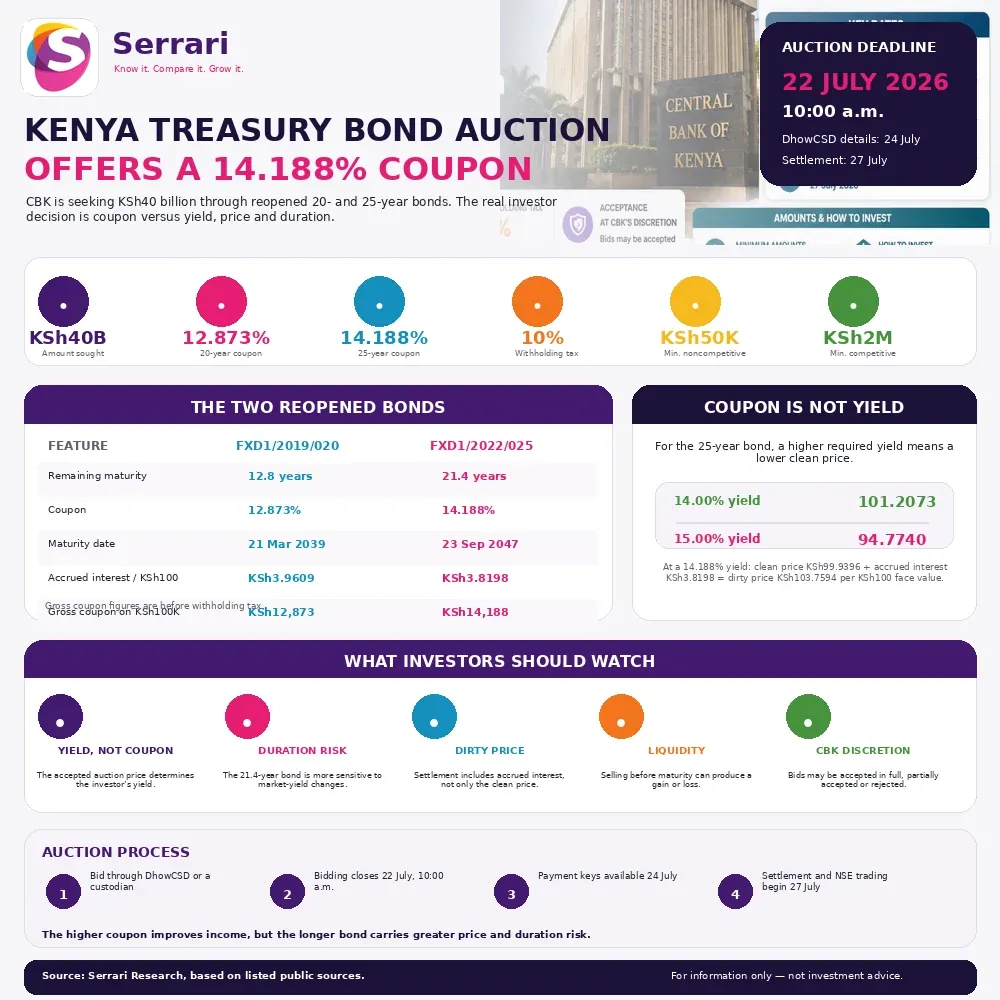
- CBK is seeking KSh40 billion for budgetary support.
- FXD1/2019/020 has 12.8 years remaining and a 12.8730% coupon.
- FXD1/2022/025 has 21.4 years remaining and a 14.1880% coupon.
- Both bonds carry 10% withholding tax.
- The auction deadline is 22 July at 10:00 a.m.
- Settlement and secondary trading begin on 27 July.
- Successful bidders obtain payment keys and amounts through DhowCSD on 24 July.
- CBK may accept bids in full, accept them partially or reject them. (Central Bank of Kenya)
Kenya Treasury Bond Auction Offers a 14.188% Coupon
CBK Reopens Two Long Bonds
The CBK prospectus describes the sale as a reopening of 20- and 25-year fixed-coupon Treasury bonds. FXD1/2019/020 matures on 21 March 2039, while FXD1/2022/025 matures on 23 September 2047. Both instruments carry 10% withholding tax and are being sold for budgetary support. (Central Bank of Kenya)
The structure matters because these are not newly created bonds with fresh coupon terms. They are existing securities being reopened. That means the coupon is already set, but the auction yield and price will be determined by investor bids and CBK’s acceptance decisions.
The 25-Year Bond Offers More Income
The 14.188% Treasury bond will naturally attract attention because it offers the higher coupon. On a KSh100,000 face-value investment, the gross annual coupon would be KSh14,188 before withholding tax. The 12.873% bond would pay KSh12,873 gross annually on the same face value.
That income difference is meaningful for pension schemes, insurers, bond funds and income-oriented retail investors. But the higher coupon should not be analysed alone. The longer bond locks the investor into exposure that runs to 2047, making it more vulnerable to changes in market yields, inflation and liquidity conditions.
Coupon Is Not Yield
CBK’s own pricing table demonstrates the inverse relationship between yield and price. For the 25-year reopening, the clean price is 101.2073 per KSh100 at a 14.00% yield, but falls to 94.7740 at a 15.00% yield. That shows how a higher required yield reduces the bond’s price. (Central Bank of Kenya)
This is the core investor lesson. A 14.188% coupon does not mean every successful bidder earns exactly 14.188%. If the bond is bought above par, yield can be lower than the coupon. If it is bought below par, yield can be higher. The final auction result will determine the accepted yield and therefore the investor’s actual return profile.
Accrued Interest Raises the Settlement Amount
Reopened bonds also carry accrued interest. CBK says FXD1/2019/020 attracts accrued interest of KSh3.9609 per KSh100, while FXD1/2022/025 attracts KSh3.8198 per KSh100. CBK’s example shows that if the 25-year bond is quoted at a 14.1880% yield, the clean price of KSh99.9396 plus accrued interest of KSh3.8198 gives a dirty price of KSh103.7594 per KSh100. (Central Bank of Kenya)
That means investors should not budget only for face value. The cash paid on settlement can exceed or fall below KSh100 per KSh100 face value depending on the clean price, but accrued interest must also be included.
Context is everything. Stay ahead of shifting trends with today’s market updates, and uncover emerging opportunities using the Serrari Group Market Index and Marketplace. Then, take control of your own financial future by exploring our Money & Life Reset Transformation Blueprint ™ to build stronger habits, create better systems, and design a path toward lasting wealth.
Long Duration Cuts Both Ways
The 21.4-year remaining maturity is the main trade-off. A long-dated bond can help investors lock predictable semiannual income for many years. CBK’s investor guide says most Treasury bonds carry semiannual interest payments, while NSE describes Treasury bonds as medium- to long-term government debt securities that normally pay interest every six months. (Central Bank of Kenya)
But duration risk cuts both ways. If market yields fall after purchase, the bond price may rise. If market yields rise, the long bond’s price can fall sharply. Investors who hold to maturity may focus on coupons and principal repayment, but investors who may sell early must care about market price.
Secondary Trading Helps, But Does Not Remove Risk
CBK says secondary trading in multiples of KSh50,000 starts on 27 July for both bonds, and the prospectus states that the bonds will be listed on the Nairobi Securities Exchange. It also says investors can pledge government securities as collateral to access loans from regulated financial institutions. (Central Bank of Kenya)
That improves flexibility, but it does not guarantee an exit at face value. NSE confirms that Treasury bonds are listed for secondary trading, but secondary-market outcomes still depend on buyer demand, prevailing yields, liquidity and the specific bond’s trading activity. (Nairobi Securities Exchange PLC)
DhowCSD Keeps Retail Access Open
The offer is accessible to smaller investors through the noncompetitive window. CBK’s prospectus sets the minimum noncompetitive bid at KSh50,000 and the maximum at KSh50 million, while competitive bids require at least KSh2 million per CSD account per tenor. Successful bidders are expected to obtain payment keys and amounts through the DhowCSD portal or app on 24 July. (Central Bank of Kenya)
CBK’s investor guide says individuals and corporates can invest in Treasury bonds through the DhowCSD portal or mobile app, or through commercial banks and investment banks acting as custodians. That keeps long-term government securities accessible beyond large institutions. (Central Bank of Kenya)
LIVEKenya bond yields: Average yield 11.93% across 58 bonds · 16 OctSee yields →Why the Auction Matters for Debt Markets
The offer also matters because Treasury bonds dominate Kenya’s domestic debt structure. The Public Debt Management Office domestic-debt dashboard shows Treasury bonds at KSh5.58 trillion in December 2025, equal to 81.6% of total domestic debt, with banks and pensions among the largest holders. (pdmo.treasury.go.ke)
That context explains why long-bond auctions attract close attention from pension schemes, insurers, banks and fund managers. The government is raising budgetary support, while investors are deciding how much long-duration exposure they are willing to hold.
What Investors Should Watch
Investors should watch the accepted yields, bid distribution and accepted amount after the 22 July auction. A lower accepted yield would lift prices and suggest stronger demand. A higher accepted yield would signal that investors require more compensation for duration.
They should also watch inflation, future CBK policy expectations, secondary-market bond yields and the government’s borrowing calendar. The 14.188% coupon is attractive on income, but the final investment case depends on yield, price, tax, liquidity and holding period.
Conclusion
Kenya Treasury Bond Auction activity this week gives investors a clear duration choice. FXD1/2019/020 offers a 12.873% coupon with 12.8 years remaining, while FXD1/2022/025 offers a 14.188% coupon with 21.4 years remaining. The higher coupon can support income, but it also comes with substantially longer exposure to interest-rate, inflation and liquidity risk.
The central lesson is simple: coupon is not yield. Investors in reopened bonds must account for auction price, accrued interest, withholding tax and secondary-market risk. The July auction may suit long-term income buyers, but it should not be treated as a simple headline-coupon comparison.
FAQs
1. What is the Kenya Treasury Bond Auction offering?
The July Kenya Treasury Bond Auction is offering reopened 20- and 25-year fixed-coupon Treasury bonds. FXD1/2019/020 has 12.8 years remaining and a 12.873% coupon, while FXD1/2022/025 has 21.4 years remaining and a 14.188% coupon. CBK is seeking KSh40 billion for budgetary support. (Central Bank of Kenya)
2. Is the 14.188% Treasury bond coupon the same as the yield?
No. The 14.188% figure is the coupon on FXD1/2022/025. The investor’s yield to maturity depends on the accepted auction price, accrued interest, withholding tax and holding period. If the bond is bought above face value, the yield can be lower than the coupon; if bought below face value, it can be higher.
3. Why does accrued interest matter?
Accrued interest matters because these are reopened bonds. Successful investors must compensate existing holders for interest earned since the last coupon period began. CBK lists accrued interest of KSh3.9609 per KSh100 for FXD1/2019/020 and KSh3.8198 per KSh100 for FXD1/2022/025. (Central Bank of Kenya)
4. Can investors sell before maturity?
Yes. CBK says secondary trading begins on 27 July, and the bonds will be listed on the Nairobi Securities Exchange. However, selling before maturity exposes investors to market-price and liquidity risk. If market yields rise, the bond’s price can fall.
5. Who is the auction most relevant for?
The auction is relevant to pension schemes, insurers, banks, bond funds, income-oriented retail investors and retirement-income portfolios. The longer bond may suit investors seeking long-term income, while the shorter remaining maturity may be better for investors who want less duration exposure.
Sources Used
- CBK — Official July 2026 Treasury Bond Prospectus — supports the reopened 20- and 25-year bond offer, issue numbers, remaining maturities, coupons, withholding tax, maturity dates, offer period, bid deadline, settlement date, KSh40 billion target, bid thresholds, DhowCSD payment process, secondary trading, pledge rules, pricing table, accrued interest and coupon-payment schedule. (Central Bank of Kenya)
- CBK — Treasury Bonds Pricing and Reopening Calculators — supports the explanation that CBK provides bond pricing, reopening and rediscounting calculators, and that final pricing is determined by the Central Bank. (Central Bank of Kenya)
- CBK — Treasury Bond Investor Guide — supports the explanation of Treasury bonds as medium- to long-term investments, semiannual interest payments, fixed coupon bonds, DhowCSD access, and the need to review prospectuses for tenor, coupon, coupon dates and taxation. (Central Bank of Kenya)
- NSE — Government Bonds — supports the explanation that Treasury bonds are listed on the NSE for secondary trading, generally provide semiannual interest payments, and form part of Kenya’s debt market. (Nairobi Securities Exchange PLC)
- Public Debt Management Office — Domestic Debt Dashboard — supports the domestic-debt context, including Treasury bonds as the largest domestic debt instrument at KSh5.58 trillion and 81.6% of domestic debt as of December 2025. (pdmo.treasury.go.ke)
- Kenyan Wall Street — CBK second bond auction report — supports independent market coverage of CBK reopening the 20- and 25-year Treasury bonds and seeking KSh40 billion ahead of the 22 July auction. (The Kenyan Wallstreet)
Your financial future isn’t something you wait for—it’s something you build.
The real question is: when do you begin?
Move beyond simply staying informed.
Navigate the markets with clarity—track trends through the Serrari Group Market Index, uncover opportunities in the Serrari Marketplace, and build practical knowledge with our Curated Wealth Builder Platform.
Stay connected to what truly matters.
Get daily insights on macro trends and financial movements across Kenya, Africa, and global markets—delivered through the Serrari Newsletter.
Growth opens doors.
Advance your career through professional programs including ACCA, HESI A2, ATI TEAS 7 , HESI EXIT , NCLEX – RN and NCLEX – PN, Financial Literacy!🌟—designed to move you forward with confidence.
See where money is flowing—clearly and in real time.
Track Money Market Funds, Treasury Bills, Treasury Bonds, Green Bonds, and Fixed Deposits, alongside global and African indexes, key economic indicators, and the evolving Crypto and stablecoin landscape—all within Serrari’s Market Index.