The World Bank Group is exploring the use of Circle’s USDC stablecoin and blockchain-based payment infrastructure to improve how it distributes development funds to countries worldwide. The initiative, announced on November 17, 2026, involves collaboration with Citi and Circle to test whether regulated, dollar-pegged stablecoins can make international disbursements faster, cheaper and more transparent than traditional correspondent banking. Citi will provide connections to established banking networks, while Circle will supply the infrastructure to mint and settle payments in USDC. The initiative builds on the World Bank’s existing FundsChain platform, which tracks disbursements across more than 350 projects in 96 countries. The first phase will be limited to borrower countries where digital assets are legally permitted.
Key Takeaways
- The World Bank Group is exploring regulated USDC stablecoin payments with Circle and Citi to improve international development-fund transfers.
- Circle will provide the infrastructure to mint and settle payments in USDC, while Citi will connect transactions to established banking networks.
- The initiative aims to reduce the time and costs associated with traditional correspondent banking.
- The project builds on FundsChain, the World Bank’s blockchain platform, which tracks more than 350 projects across 96 countries.
- The initial phase will use an intermediated and interoperable model, restricted to borrower countries where digital assets are permitted.
- The World Bank Group delivered $123.5 billion in loans, grants, equity investments and guarantees during the fiscal year ended June 30, 2026.
- The initiative is an exploration rather than a confirmed global rollout of stablecoin payments.
Why Is the World Bank Exploring USDC for Development-Fund Payments?
The World Bank Group is exploring the use of regulated dollar-pegged stablecoins to improve how development funds reach countries and projects around the world.
The initiative, announced on November 17, 2026, brings together the World Bank Group, Circle and Citi to examine how blockchain-based payment infrastructure could complement or improve the institution’s existing international disbursement arrangements.
The World Bank Group said it will explore using Circle’s $USDC and blockchain-based payment rails, alongside Citi’s banking connections, to make its global development-funds disbursement faster, cheaper and more transparent than correspondent banking.
The existing system relies on correspondent banking, a network of intermediary financial institutions that facilitate international payments between banks. Although this system supports cross-border transactions globally, payments can pass through several institutions before reaching their final destinations, adding processing time and transaction costs.
For an institution distributing development finance across multiple countries, these delays and expenses can affect how efficiently funds reach intended beneficiaries.
The proposed stablecoin arrangement is intended to test whether digital payment infrastructure can improve this process.
World Bank Group President Ajay Banga described the initiative as an effort to improve the financial systems supporting development finance.
“This initiative is about exploring ways to make the financial plumbing of development work better for the people who need it most,” Banga said.
He added that faster and cheaper transfers could help ensure that development projects receive funding when it is needed, including healthcare facilities and agricultural activities.
The initiative therefore focuses on improving the movement of existing development funds rather than announcing a new funding programme.
How Will Circle, Citi and the World Bank Work Together?
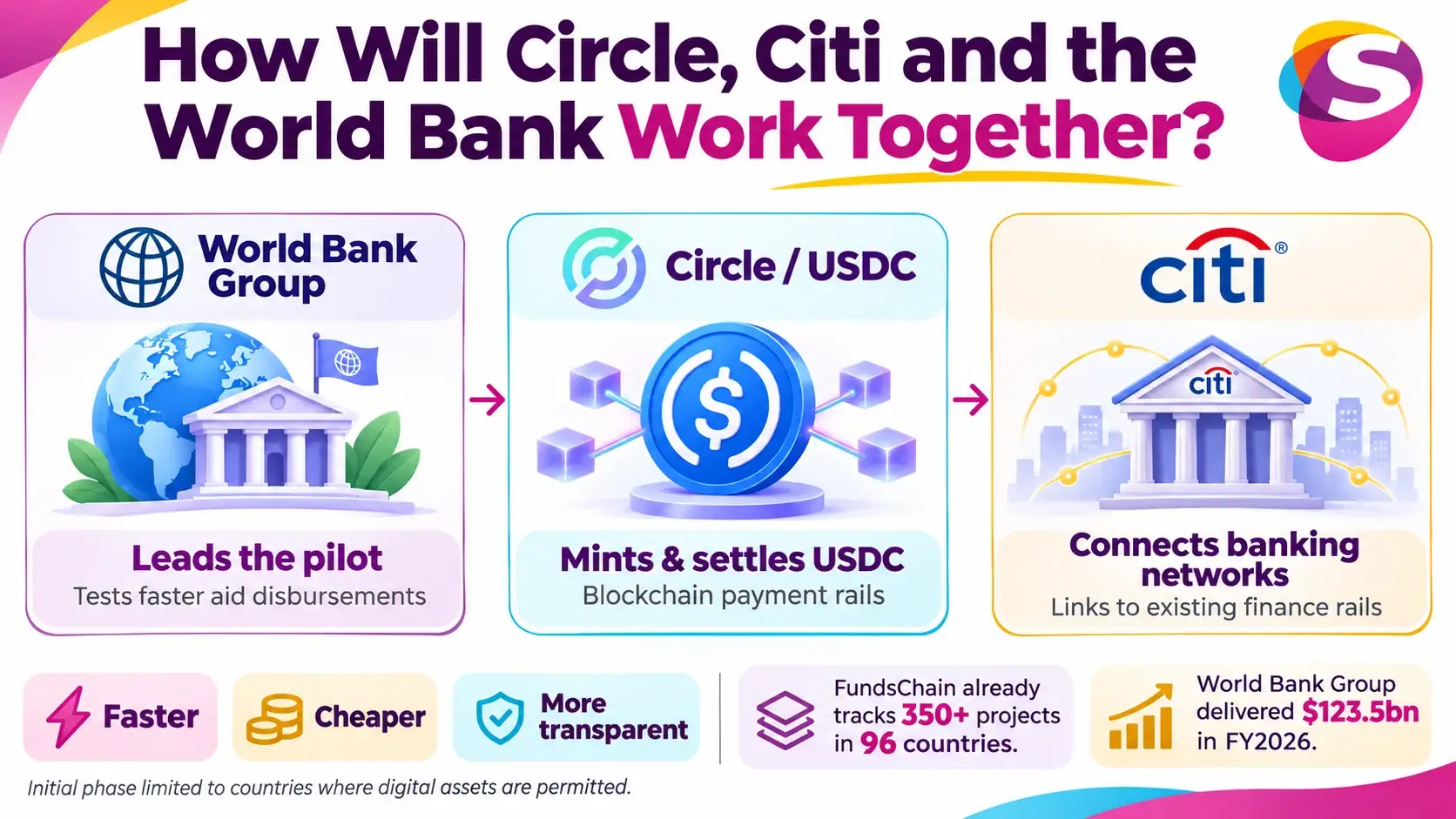
The proposed arrangement brings together three institutions with different responsibilities in the payment process.
Each organisation will contribute infrastructure or services needed to test the stablecoin-based payment model.
Circle: Providing USDC payment infrastructure
Circle will provide the technology required to mint and settle funds in USDC, its US dollar-pegged stablecoin.
USDC is designed to maintain a value equivalent to one US dollar. Unlike cryptocurrencies such as Bitcoin, whose market prices fluctuate, stablecoins are designed to maintain a relatively stable value by being linked to an underlying asset.
In this arrangement, USDC would provide the digital payment instrument through which funds could be transferred and settled using blockchain infrastructure.
Circle Chief Executive Jeremy Allaire described development finance as one of the most important potential applications of the company’s technology.
“Money that moves at the speed of the internet shouldn’t be reserved for the world’s biggest banks and corporations; it should reach the people and places that need it most, with full visibility into where every dollar goes,” Allaire said.
Citi: Connecting digital payments to traditional banking networks
Citi will provide access to established banking infrastructure and correspondent banking connections.
This role is important because the proposed initiative is not designed to operate entirely outside the existing financial system. Instead, it will explore how stablecoin payments can work alongside conventional banking arrangements.
Citi’s network provides access to clients across more than 180 jurisdictions, although participation in the initiative will remain subject to applicable local regulations.
Citi’s Shahmir Khaliq said the collaboration would provide “24/7 capabilities at scale so that critical funds move in real time.”
World Bank Group: Coordinating the initiative
The World Bank Group will lead the exploration and build on its existing FundsChain platform to improve the traceability of development-fund disbursements.
The institution will also work with participating borrower countries to test the proposed payment model within the applicable regulatory frameworks.
Together, the three organisations will examine whether stablecoin infrastructure can improve the efficiency of international development payments while maintaining the institutional connections and safeguards required for large-scale financial transactions.
What Is FundsChain and How Does It Support the Initiative?
The stablecoin exploration builds on the World Bank Group’s existing blockchain work through a platform known as FundsChain.
FundsChain is designed to improve the traceability of development funds by recording how money moves through projects.
More than 350 projects across 96 countries are already onboarded to its digital ledgers, allowing participants to see how funds are being spent.
This visibility is important because development projects often involve several organisations, including governments, financial institutions, contractors and implementing partners.
Tracking the movement of funds can help participants monitor how resources are distributed and used throughout a project’s implementation.
The proposed USDC initiative would extend this work by exploring how blockchain-based payment infrastructure could support the actual movement and settlement of funds.
It is important to distinguish between the two functions. FundsChain already supports the tracking of project disbursements, while the stablecoin initiative is intended to test whether digital payment rails can improve the transfer process itself.
By combining payment infrastructure with existing fund-tracking capabilities, the World Bank Group hopes to improve both the movement and visibility of development finance.
How Could Stablecoins Make Development Payments Faster and Cheaper?
Stablecoins could offer an alternative way to transfer dollar-denominated value across borders.
Traditional correspondent banking often involves several intermediary institutions. Each stage can introduce processing requirements, delays and transaction fees.
Blockchain-based payments could potentially reduce some of these steps by allowing digital assets to move between participating institutions through a shared payment infrastructure.
For development finance, even relatively small improvements in transaction efficiency could have a meaningful effect when applied to large volumes of international payments.
For example, faster transfers could help a government or project implementer receive funds sooner, while lower transaction costs could leave more resources available for development activities.
The World Bank Group’s scale makes these potential efficiencies particularly relevant.
During the fiscal year ended June 30, 2026, the World Bank Group delivered $123.5 billion in loans, grants, equity investments, and guarantees to partner countries and private businesses.
This included:
Region
Financing delivered
Sub-Saharan Africa
$35.8 billion
Latin America and the Caribbean
$25.1 billion
Europe and Central Asia
$24.6 billion
World Bank Group total
$123.5 billion
These figures illustrate the scale of the institution’s development-finance activities and why improving payment efficiency could be significant.
However, the $123.5 billion represents the group’s overall financing delivered during the financial year. It should not be interpreted as the amount that will be transferred through USDC.
The initiative is still exploratory, and the World Bank has not announced the proportion of its future disbursements that could use stablecoin payment infrastructure.
Which Countries Will Participate in the Initial Phase?
The first phase will focus on an intermediated and interoperable stablecoin-based payment model involving borrower countries where digital assets are permitted under local law.
This means the initiative will not automatically extend to every country receiving World Bank financing.
Participation will depend on the legal and regulatory environment in each jurisdiction, as well as the ability to connect the proposed digital payment system with existing financial infrastructure.
An intermediated model also means that financial institutions will remain involved in facilitating transactions rather than payments operating entirely outside traditional banking arrangements.
The World Bank Group has indicated that additional banks could join the initiative over time, potentially widening the network of participating institutions.
The focus on interoperability is important because international development payments involve different banking systems, currencies, regulatory requirements and financial institutions.
For stablecoin payments to operate across multiple jurisdictions, the technology must work alongside these systems while meeting applicable compliance requirements.
Context is everything. Stay ahead of shifting trends with today’s market updates, and uncover emerging opportunities using the Serrari Group Market Index and Marketplace. Then, take control of your own financial future by exploring our Money & Life Reset Transformation Blueprint ™ to build stronger habits, create better systems, and design a path toward lasting wealth.
What Are the Risks of Using Stablecoins for Development Finance?
Although stablecoins could improve the speed and cost of international payments, their use in development finance introduces several issues that the initiative will need to address.
1. Regulatory differences between countries
Digital asset regulations vary across jurisdictions. A stablecoin payment arrangement that is permitted in one country may face restrictions in another.
The World Bank’s decision to initially limit participation to borrower countries where digital assets are permitted reflects the importance of local regulatory approval.
2. Financial compliance and oversight
International development payments must meet financial controls and applicable requirements for monitoring transactions.
The proposed system will need to demonstrate that digital payment infrastructure can operate within these requirements while maintaining appropriate oversight of funds.
3. Interoperability with traditional banking
The initiative relies on connecting stablecoin infrastructure with established banking networks.
Ensuring that digital payments can work smoothly alongside conventional banking arrangements will be essential, particularly when transactions involve several financial institutions and jurisdictions.
4. Stablecoin reliability
USDC is designed to maintain a value linked to the US dollar, but stablecoin arrangements still require confidence in their reserves, redemption mechanisms and operational infrastructure.
For an institution distributing public development finance, reliability and accountability will be particularly important.
5. Transparency and accountability
Although blockchain records can improve transaction visibility, the system must also ensure that funds are used for their intended development purposes.
Tracking a payment does not automatically establish that a project has delivered its expected results. Monitoring the actual use and impact of funds will remain important.
The initiative will therefore need to demonstrate that faster payments can be achieved without weakening financial oversight and institutional accountability.
The Bigger Picture: Traditional Finance Is Moving Towards Stablecoin Payments
The World Bank Group’s exploration comes as traditional financial institutions increasingly examine the role of stablecoins and blockchain-based infrastructure in financial services.
Banks and financial companies are exploring how tokenised money and digital payment networks could improve the movement of funds, settlement processes and access to financial services.
A group of major banks, including Goldman Sachs, Citi, Santander and Deutsche Bank, has committed approximately $270 million to a joint stablecoin venture.
Deutsche Bank has also moved into cryptocurrency custody following a five-year development process.
These developments indicate that digital assets are increasingly being considered within established financial institutions rather than operating exclusively within cryptocurrency markets.
For Circle, the World Bank initiative could provide an important institutional use case for USDC beyond conventional cryptocurrency trading and payments.
USDC is already the second-largest stablecoin by market value, and participation in a development-finance payment initiative could strengthen its position in institutional financial services.
However, the World Bank’s announcement remains an exploration, not a confirmation that USDC will become a standard payment instrument across its global operations.
Why Does This Matter Now?
The initiative comes at a time when development finance institutions face increasing pressure to use available resources efficiently while responding to complex economic and social challenges.
The World Bank Group distributes substantial amounts of financing across countries and sectors. Improving the systems through which that money moves could help reduce administrative costs and delays.
For developing economies, more efficient disbursements could support the timely financing of infrastructure, healthcare, agriculture and other development priorities.
The involvement of Citi and Circle is also significant because it brings together traditional banking infrastructure and regulated stablecoin technology in an institutional setting.
For the stablecoin industry, the initiative represents an opportunity to demonstrate that digital dollar payment systems can serve purposes beyond cryptocurrency trading.
The key test will be whether the technology can deliver measurable improvements in speed and cost while meeting the regulatory, security and accountability requirements of international development finance.
Outlook: Could USDC Become Part of Global Development Payments?
The World Bank Group’s collaboration with Circle and Citi marks an important exploration of how stablecoins could support international development finance.
By combining USDC payment infrastructure with Citi’s banking connections and the World Bank’s FundsChain platform, the initiative aims to test whether digital payment rails can make development-fund transfers faster, cheaper and more transparent.
The immediate focus will be on establishing an intermediated and interoperable model in borrower countries where digital assets are legally permitted.
The next developments to watch include the participating countries, the operational structure of the pilot, the role of additional banks and whether the initiative produces measurable improvements in transaction costs and settlement times.
The World Bank has not announced a full rollout or confirmed that stablecoins will replace its existing correspondent banking arrangements.
Ultimately, the initiative’s success will depend on whether regulated stablecoin payments can work reliably across different jurisdictions while maintaining the compliance and accountability standards required for development finance.
Frequently Asked Questions (FAQs)
1. What is the World Bank exploring with Circle and Citi?
The World Bank Group is exploring the use of regulated USDC stablecoin payments and blockchain-based infrastructure to improve the speed, cost and transparency of international development-fund disbursements.
2. What role will Circle play in the initiative?
Circle will provide the infrastructure required to mint and settle payments in USDC, its US dollar-pegged stablecoin.
3. What is FundsChain?
FundsChain is the World Bank Group’s blockchain platform for tracking development-fund disbursements. It already covers more than 350 projects across 96 countries.
4. Will the World Bank replace traditional banking with USDC?
No replacement has been announced. The initial initiative will test an intermediated and interoperable model that works alongside established banking infrastructure, with participation restricted to countries where digital assets are permitted.
Your financial future isn’t something you wait for—it’s something you build.
The real question is: when do you begin?
Move beyond simply staying informed.
Navigate the markets with clarity—track trends through the Serrari Group Market Index, uncover opportunities in the Serrari Marketplace, and build practical knowledge with our Curated Wealth Builder Platform.
Stay connected to what truly matters.
Get daily insights on macro trends and financial movements across Kenya, Africa, and global markets—delivered through the Serrari Newsletter.
Growth opens doors.
Advance your career through professional programs including ACCA, HESI A2, ATI TEAS 7 , HESI EXIT , NCLEX – RN and NCLEX – PN, Financial Literacy!🌟—designed to move you forward with confidence.
See where money is flowing—clearly and in real time.
Track Money Market Funds, Treasury Bills, Treasury Bonds, Green Bonds, and Fixed Deposits, alongside global and African indexes, key economic indicators, and the evolving Crypto and stablecoin landscape—all within Serrari’s Market Index.