Kenya is promoting an industrial investment pipeline worth approximately Sh2.6 trillion, dominated by Aliko Dangote’s planned refinery and petrochemical complex in Lamu and a proposed electric-mobility manufacturing venture. The government argues that major projects, more foreign investment and special economic zones can turn the country into a stronger manufacturing and export hub. Yet the headline value represents projects at different stages, not money already spent or factories already operating. The economic question is whether Kenya can overcome financing, infrastructure, regulatory and skills constraints to convert investor commitments into productive capacity, sustained employment and foreign-exchange earnings.
Key Overview
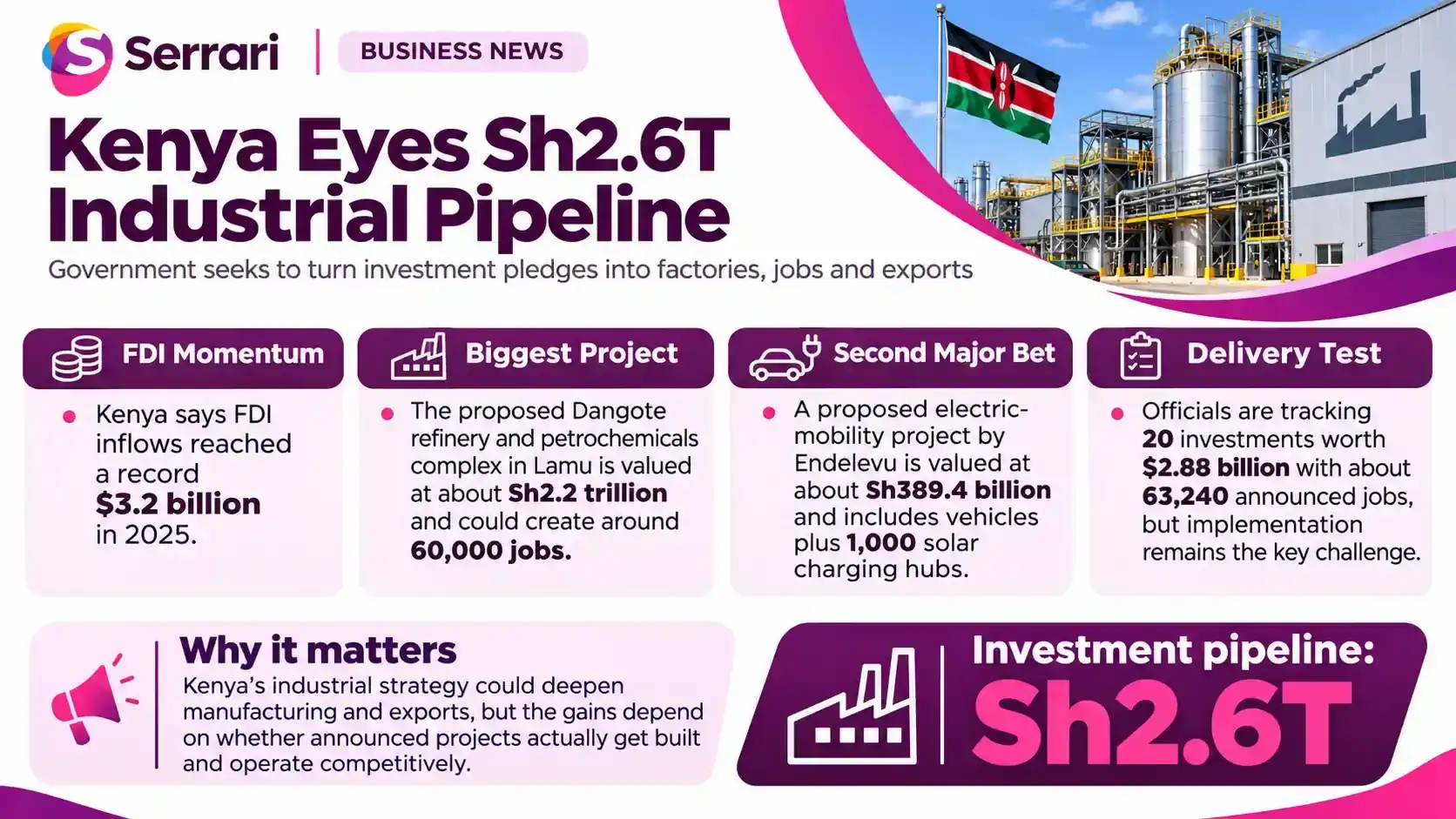
- Headline pipeline: The Sh2.6 trillion figure largely reflects a Sh2.2 trillion refinery proposal and an approximately Sh389.4 billion electric-mobility plan, not realised investment expenditure.
- Foreign investment: Reported inward foreign direct investment reached $3.2 billion in 2025, compared with the smaller historical levels recorded in earlier years.
- Lamu project: Dangote’s proposed $16 billion refinery targets 700,000 barrels of crude processing per day; a September groundbreaking does not mean the facility is producing fuel.
- Electric mobility: Endelevu’s proposed $3 billion investment envisages vehicle assembly and 1,000 solar-powered charging hubs, but remains subject to implementation.
- Visible progress: A separate portfolio of 20 investments has announced $2.88 billion in commitments and roughly 63,240 potential jobs, with some facilities already operating.
- Main economic test: Local purchasing, training, export sales and reliable operations—not announcement values—will determine the gains to households and businesses.
Why Kenya Is Making Manufacturing a National Investment Priority
Kenya’s investment drive reflects a fundamental economic problem: a country can attract trade, financial services and technology activity without producing enough manufactured goods to narrow its import needs or provide large numbers of stable industrial jobs. Factories can connect agricultural producers, miners, transport firms and engineers to higher-value markets, while exports provide foreign currency needed to finance imported fuel, equipment and intermediate inputs.
The government’s latest industrial investment update frames the strategy around major investors, special economic zones and support that continues after an initial commitment. Investment, Trade and Industry Cabinet Secretary Lee Kinyanjui has presented improved regulation and institutional coordination as reasons companies are considering Kenya. Those claims are best judged by whether sites progress through permits, financing, construction and commissioning.
Geography is part of the pitch. The Port of Mombasa and developing Lamu corridor connect Kenya to markets in neighbouring countries, while transport links and electricity supply influence where factories can operate competitively. But location alone cannot offset high logistics costs, interruptions to utilities, slow approvals or uncertainty over taxes. A manufacturer deciding where to place an export facility calculates the total cost and predictability of production, not simply the availability of an investment incentive.
The Sh2.2 Trillion Lamu Refinery Could Reshape Supply Chains
The largest undertaking is the Dangote refinery and petrochemicals project in Lamu, valued at approximately $16 billion, or Sh2.2 trillion. Its proposed capacity of 700,000 barrels of crude oil daily would make it a major regional processing facility if completed and fully utilised. Officials have also outlined related chemicals, fertiliser and power infrastructure, potentially creating demand for contractors, storage facilities, ports and skilled technicians.
The September 30 groundbreaking and arrival of project equipment represent concrete early milestones, but they do not establish that financing, construction or future output is fully secured. The refinery’s proposed 60,000 jobs should similarly be treated as an estimate spanning project activity and related employment, not an existing payroll.
The business case rests on regional fuel demand and access to crude. Processing oil closer to East African consumers could reduce dependence on imported refined products and develop local petrochemical supply chains. However, refined fuel prices would still respond to global crude markets, transport costs, taxes and competition. A refinery’s existence does not guarantee cheaper petrol at the pump or a reduction in Kenya’s overall import bill, especially when crude feedstock must itself be imported.
Large-scale construction also brings risks that directly affect whether projected benefits materialise. Residents and civil-society groups have raised questions about land, environmental safeguards and disclosure. Those issues are economically material: unresolved disputes can delay works, increase costs and damage relationships with surrounding communities. Transparent compensation, credible environmental assessment and accessible procurement opportunities are therefore not peripheral concerns but part of the project’s ability to operate sustainably.
Why Electric Vehicles Form the Second Pillar
The government has separately signed an investment memorandum with Endelevu Enterprise Corporation covering a proposed $3 billion, or approximately Sh389.4 billion, electric-mobility ecosystem. The ambition includes annual production capacity for 50,000 four-wheeled vehicles and 100,000 two-wheelers and other light vehicles, supported by 1,000 solar-powered charging hubs.
This addresses a different industrial opportunity from petroleum refining. Rather than relying only on imported finished vehicles, Kenya wants a larger share of assembly, components, engineering, distribution and charging infrastructure. Local production could support jobs and reduce selected imports if manufacturers can source meaningful inputs domestically and sell competitively priced vehicles.
An announcement of planned production capacity is not evidence of future sales. Demand will depend on upfront vehicle prices, financing options, maintenance networks and charging availability. The project also requires decisions about factory sites, capital mobilisation, component sourcing and operational partners. Government facilitation within special economic zones or industrial locations such as Nakuru could help, but the memorandum should not be described as a completed Sh389.4 billion investment.
The two headline projects account for roughly Sh2.59 trillion combined, explaining the rounded Sh2.6 trillion figure. They are not identical to the government’s separate March investment-conference pipeline, and combining every number without checking overlap would exaggerate the total.
Context is everything. Stay ahead of shifting trends with today’s market updates, and uncover emerging opportunities using the Serrari Group Market Index and Marketplace. Then, take control of your own financial future by exploring our Money & Life Reset Transformation Blueprint ™ to build stronger habits, create better systems, and design a path toward lasting wealth.
Which Projects Have Actually Moved Beyond Announcements?
The ministry says it has monitored 20 projects announced around the March 2026 investment conference, representing $2.88 billion in commitments and approximately 63,240 projected jobs across ten counties. Fifteen were reported to be progressing on the ground, but that category combines enterprises at very different stages. A company importing machinery is not economically equivalent to a factory already manufacturing and selling goods.
Some reported milestones are tangible. Lucky DJX’s operation at the Konza export-processing zone was reported to have about 1,000 workers on site. Textile manufacturer Singtex had begun production on 16 lines, with a further 14 planned for early 2027. ADEC Innovations and Fullcare EPZ were also identified as operational or expanding. These examples are more useful indicators of execution than the number of companies announcing an intention to invest, although independently verified production and employment data remain important.
Outside that group, the Sh70 billion Devki cement and clinker plant broke ground in Kitui on October 27. Local clinker production could retain more manufacturing value within Kenya and supply construction companies, but the future gain depends on operating costs, demand and whether expanded capacity translates into competitive output rather than oversupply.
The distinction between milestones also matters for jobs. Construction creates temporary demand for labour and services; an operating factory may provide ongoing employment but usually requires a different mix of skills. Credible reporting should separately track planned positions, current construction workers and permanent jobs established after commissioning.
What the $3.2 Billion FDI Figure Does—and Does Not—Prove
Kenya’s investment promotion agency cites foreign direct investment inflows of $3.2 billion in 2025. The figure is consistent with country investment data attributed to international investment statistics. It supports the government’s argument that foreign-capital inflows have strengthened, but FDI is a flow of investment recorded over a period, not a measure of the entire value of future project announcements.
Nor should registered companies, planned investments and FDI be added together. A foreign company’s registration does not guarantee substantial capital expenditure, and the estimated cost of a multiyear project is not necessarily recorded in a single year’s inflows. The ministry’s company-registration figures also warrant caution: the reported counts of 181 in 2023, 189 in 2024 and 202 in 2025 total 572, not the stated 671; adding 99 registrations in 2026 brings the total to 671. That suggests the published headline total includes 2026 rather than describing registrations solely through 2025.
The wider 2026 global investment assessment warns that investment growth is concentrated in a limited number of countries and megaprojects. Kenya’s industrial ambitions therefore face international competition for capital, making the quality of implementation and consistency of policy unusually important.
The Bigger Test Is Jobs, Exports and Local Value Added
A strong investment programme should ultimately show up in completed factories, reliable output, higher exports, supplier contracts and tax revenue generated by profitable businesses. The benefits are larger when Kenyan companies can provide materials, packaging, transport and maintenance services instead of most inputs being sourced abroad. Skills programmes can also turn construction and assembly opportunities into longer-term technical careers.
Success will require publishing more than headline project valuations. A credible public scorecard would show capital actually disbursed, projects under construction, commissioning dates, verified employment, local procurement and exports. It should also identify delays and distinguish wholly private financing from any state guarantees or public spending commitments.
For investors, this would reduce uncertainty about project execution. For taxpayers and workers, it would make it possible to judge whether the industrial push is producing benefits commensurate with the incentives, infrastructure and public attention devoted to it. Kenya’s Sh2.6 trillion ambition is substantial, but the defining result will not be the value of agreements signed. It will be the number of commercially viable industries still operating, employing people and earning revenue years after the announcements.
Sources: The Star / Ministry of Foreign and Diaspora Affairs Kenya / Ministry of Roads and Transport Kenya / Kenya News Agency / Kenya Investment Authority / Citizen Digital / UN Trade and Development / Lloyds Bank International Trade Portal
Your financial future isn’t something you wait for—it’s something you build.
The real question is: when do you begin?
Move beyond simply staying informed.
Navigate the markets with clarity—track trends through the Serrari Group Market Index, uncover opportunities in the Serrari Marketplace, and build practical knowledge with our Curated Wealth Builder Platform.
Stay connected to what truly matters.
Get daily insights on macro trends and financial movements across Kenya, Africa, and global markets—delivered through the Serrari Newsletter.
Growth opens doors.
Advance your career through professional programs including ACCA, HESI A2, ATI TEAS 7 , HESI EXIT , NCLEX – RN and NCLEX – PN, Financial Literacy!🌟—designed to move you forward with confidence.
See where money is flowing—clearly and in real time.
Track Money Market Funds, Treasury Bills, Treasury Bonds, Green Bonds, and Fixed Deposits, alongside global and African indexes, key economic indicators, and the evolving Crypto and stablecoin landscape—all within Serrari’s Market Index.