
The US Treasury market is facing mounting structural challenges as hedge funds account for a growing share of Treasury purchases while traditional long-term investors reduce their exposure. The shift is raising concerns about bond market liquidity, market volatility and the resilience of the U.S. debt market amid record government borrowing.
Key Overview
- The US deficit requires up to $2 trillion in borrowing.
- Hedge funds are increasing Treasury holdings.
- Long-term investors continue reducing exposure.
- Treasury yields reflect growing fiscal concerns.
- Primary dealer participation has declined sharply.
- SEC introduces central clearing reforms.
- Liquidity risks remain under scrutiny.
- Institutional investors remain cautious.
US Treasury Market Faces Rising Liquidity Concerns as Hedge Funds Gain Influence
The US Treasury market, widely regarded as the world’s safest and most liquid financial market, is showing signs of increasing structural strain as rising government borrowing coincides with changing investor behaviour. While demand for Treasury securities remains strong on the surface, analysts are warning that the market’s underlying resilience is weakening as hedge funds replace traditional long-term buyers.
The shift comes as the U.S. government is expected to issue between US$1.8 trillion and US$2 trillion in Treasury debt this year to finance the expanding federal budget deficit. Although auctions continue attracting strong investor participation, the growing dominance of leveraged investors has raised concerns about future market stability, particularly during periods of financial stress.
Record Government Borrowing Keeps Treasury Supply Elevated
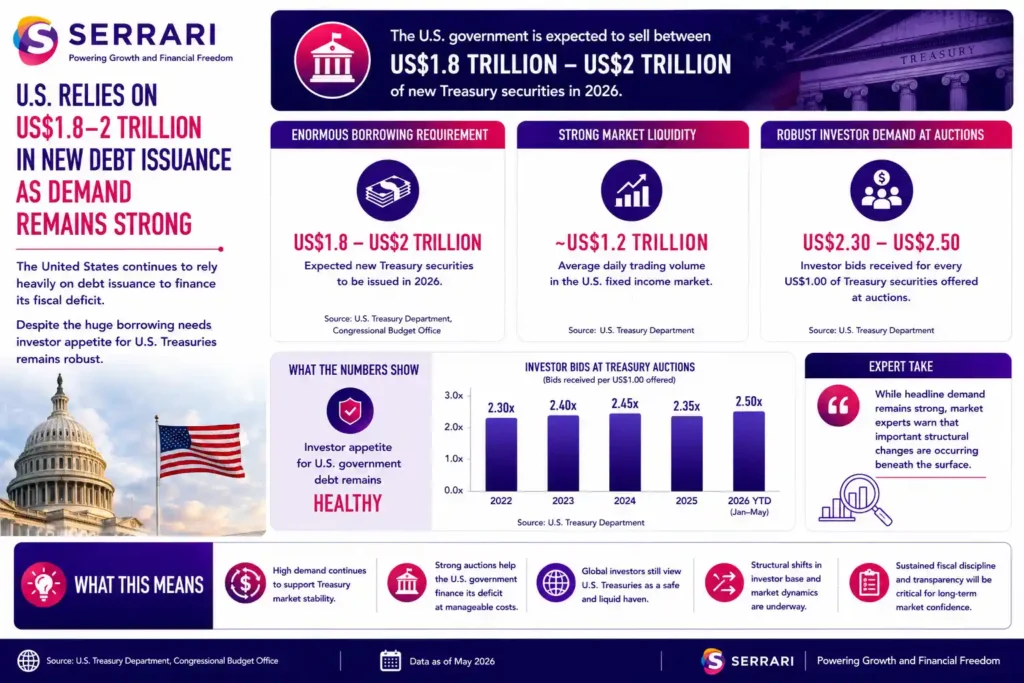
The United States continues to rely heavily on debt issuance to finance its fiscal deficit.
According to data from the U.S. Treasury Department and the Congressional Budget Office, the federal government is expected to sell between US$1.8 trillion and US$2 trillion of new Treasury securities during the year.
Despite this enormous borrowing requirement, demand has remained robust. Daily trading volume in the fixed income market averages approximately US$1.2 trillion, while Treasury auctions continue receiving between US$2.30 and US$2.50 in investor bids for every dollar of securities offered.
These figures suggest that investor appetite for U.S. government debt remains healthy. However, market experts argue that headline demand masks important structural changes taking place beneath the surface.
Long-Term Investors Reduce Treasury Exposure
One of the most significant developments within the US Treasury market has been the gradual withdrawal of traditional long-term investors.
Historically, pension funds, insurance companies, overseas central banks and other large institutional investors have provided a stable source of demand for government debt by purchasing Treasuries and holding them until maturity.
That investor base has steadily declined over the past two decades.
Data from JPMorgan shows that, when combined with primary dealers, overseas central banks and pension funds, long-term investors accounted for approximately 75% of Treasury holdings in 2007. Today, that figure has fallen to around 52%.
The reduced participation of long-term investors has increased reliance on shorter-term market participants whose investment strategies are generally more sensitive to changes in financing conditions.
Rising Treasury Yields Reflect Growing Fiscal Concerns
Market pricing is also signalling increased caution among investors.
The yield on the 30-year U.S. Treasury bond now trades approximately 0.5 percentage points above the 10-year Treasury yield, compared with a spread of only 0.2 percentage points at the beginning of 2025.
Because bond prices move inversely to yields, the increase indicates that prices of long-dated Treasuries have fallen as investors demand greater compensation for holding long-term government debt.
Analysts attribute the rise in long-term Treasury yields to growing concerns over persistent fiscal deficits, increasing debt issuance and the possibility that inflation may remain elevated for longer than previously expected.
Longer-duration bonds are particularly sensitive to changes in inflation expectations because investors commit capital for extended periods.
Hedge Funds Play a Larger Role in Treasury Markets
As traditional investors reduce their participation, hedge funds have become increasingly important buyers of U.S. government debt.
Many hedge funds employ highly leveraged trading strategies that involve purchasing Treasury securities while financing much of the investment through repurchase agreements, commonly known as repos.
Under this approach, a fund might invest US$10 of its own capital while borrowing US$90 from a financial institution to purchase US$100 worth of Treasury securities.
This leverage allows hedge funds to generate attractive returns from relatively small price differences under normal market conditions.
However, the strategy also introduces greater risk during periods of financial stress, particularly if banks reduce repo lending or if rapid market movements force leveraged investors to unwind positions quickly.
Federal Reserve data shows that hedge fund positions in U.S. Treasuries—including both cash securities and derivatives—rose to approximately US$4.04 trillion by September last year, representing an increase of nearly 40% compared with the end of 2023.
Cayman-Based Funds Become Major Treasury Buyers
Additional regulatory analysis highlights the growing influence of offshore investment vehicles.
Regulatory filings estimate that Cayman Islands-based hedge funds held approximately US$1.85 trillion in U.S. Treasury securities at the end of 2024, substantially exceeding the holdings reflected in official Treasury International Capital (TIC) data.
Between 2022 and 2024, these hedge funds are estimated to have absorbed approximately 37% of net issuance of longer-dated Treasury notes and bonds.
Remarkably, that level of purchasing roughly matched the combined buying activity of all other foreign investors during the same period.
The figures illustrate how leveraged investors have become an increasingly important source of demand within the U.S. debt market, replacing some of the stabilising influence previously provided by pension funds and central banks.
Primary Dealers Have Reduced Market Support
Another structural change involves the declining role of primary dealers, the large financial institutions responsible for supporting Treasury auctions and maintaining liquidity across government bond markets.
According to JPMorgan, primary dealers accounted for between 40% and 50% of Treasury purchases across maturities in 2010.
Today, their share has declined dramatically to approximately 10% to 15%.
The reduced participation of these institutions means the market increasingly depends on private investment funds and other non-traditional buyers to absorb the growing supply of government debt.
This shift has prompted concerns that liquidity could deteriorate more rapidly during periods of market stress.
SEC Introduces Central Clearing Reforms
In response to evolving market risks, U.S. regulators have introduced significant reforms aimed at strengthening Treasury market infrastructure.
The Securities and Exchange Commission (SEC) finalized rules in 2024 requiring eligible Treasury transactions to be cleared through a central counterparty (CCP).
The reforms will be introduced in phases:
- 31 December 2026 for eligible Treasury cash-market transactions.
- 30 June 2027 for eligible Treasury repo transactions.
Central clearing is intended to reduce bilateral counterparty risk, improve transparency and lower the likelihood of a disorderly market disruption similar to the severe Treasury market volatility experienced during March 2020.
By moving more Treasury transactions through central clearing platforms, regulators hope to improve market resilience while strengthening confidence in the world’s largest government bond market.
Outlook for the US Treasury Market
The US Treasury market continues to demonstrate remarkable depth, supported by strong auction demand and exceptionally high trading volumes. However, the composition of its investor base is changing significantly as hedge funds increasingly replace long-term investors that traditionally provided market stability.
While this transition has not disrupted the market so far, the growing reliance on leveraged participants has raised important questions about future bond market liquidity during periods of financial stress. Combined with rising government borrowing requirements and persistent fiscal deficits, these structural shifts are likely to remain a key focus for policymakers, regulators and institutional investors as they monitor the long-term resilience of the U.S. government debt market.
FAQs
Why are analysts concerned about the US Treasury market?
Analysts are concerned because traditional long-term investors such as pension funds and central banks are reducing their Treasury holdings while hedge funds using leverage are becoming larger buyers. This shift could increase market volatility and reduce liquidity during periods of financial stress.
How do hedge funds invest in Treasury securities?
Many hedge funds purchase Treasury securities using repurchase agreements, or repos, which allow them to borrow money against their holdings. This leverage enables them to profit from small pricing differences but also increases the risk of forced selling if financing conditions tighten.
Why are long-term Treasury yields rising?
Long-term Treasury yields have increased because investors are demanding higher returns to compensate for concerns about persistent U.S. budget deficits, rising government debt and the possibility that inflation could remain elevated over the long term. Higher yields also reflect increased supply as the government issues more debt.
What is the SEC’s new Treasury market clearing rule?
The SEC has introduced mandatory central clearing for eligible Treasury transactions to improve market stability and transparency. Cash-market transactions must begin using central clearing by 31 December 2026, while eligible Treasury repo transactions will follow by 30 June 2027, reducing counterparty risk and strengthening the resilience of the U.S. Treasury market.
Sources: Bloombingbit, Northern Trust
Your financial future isn’t something you wait for—it’s something you build.
The real question is: when do you begin?
Move beyond simply staying informed.
Navigate the markets with clarity—track trends through the Serrari Group Market Index, uncover opportunities in the Serrari Marketplace, and build practical knowledge with our Curated Wealth Builder Platform.
Stay connected to what truly matters.
Get daily insights on macro trends and financial movements across Kenya, Africa, and global markets—delivered through the Serrari Newsletter.
Growth opens doors.
Advance your career through professional programs including ACCA, HESI A2, ATI TEAS 7 , HESI EXIT , NCLEX – RN and NCLEX – PN, Financial Literacy!🌟—designed to move you forward with confidence.
See where money is flowing—clearly and in real time.
Track Money Market Funds, Treasury Bills, Treasury Bonds, Green Bonds, and Fixed Deposits, alongside global and African indexes, key economic indicators, and the evolving Crypto and stablecoin landscape—all within Serrari’s Market Index.