
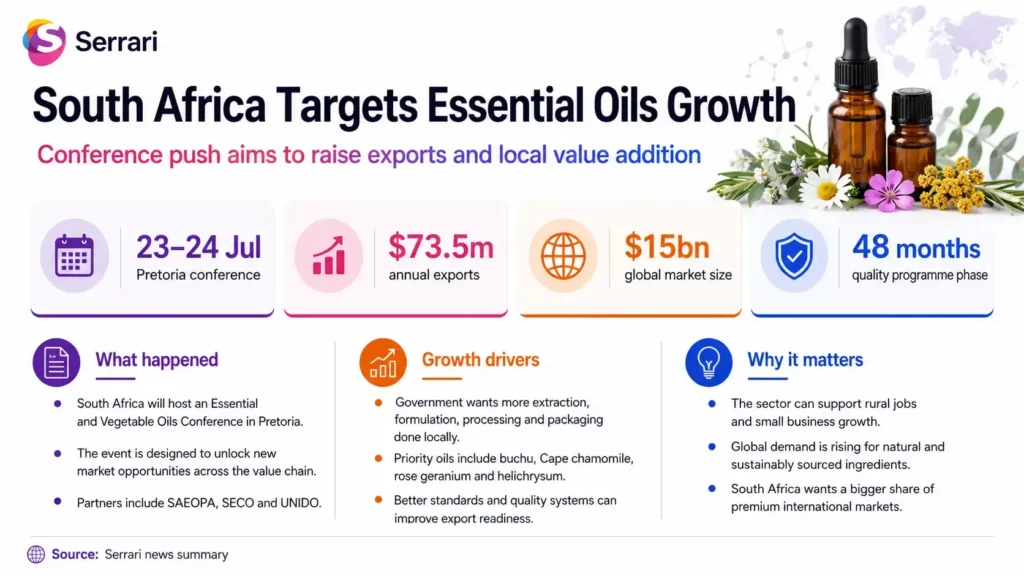
South Africa is intensifying efforts to turn its biodiversity into a larger, higher-value essential oils industry. The Department of Trade, Industry and Competition will host the fourth Essential and Vegetable Oils Conference in Pretoria East on July 23 and 24, 2026.
The event will bring together producers, exporters, researchers, regulators, buyers and investors to discuss quality assurance, innovation, sustainability, market diversification and local processing. The broader objective is to help South African businesses move beyond exporting raw oils and capture more value through manufacturing, branding and stronger participation in international supply chains.
Key Overview
- The conference will take place at Rosemary Hill in Pretoria East on July 23–24, 2026.
- South Africa exports approximately $73.5 million worth of essential oils annually.
- High-value indigenous oils include buchu, Cape chamomile, rose geranium and helichrysum.
- Marula and baobab are vegetable oils but form part of the same natural-products value chain.
- Government wants more extraction, formulation, processing and packaging to happen locally.
- Export growth depends on consistent quality, reliable supply and internationally recognised standards.
- Smaller producers could benefit through improved market access and rural job creation.
Pretoria Conference Targets Export Competitiveness
The Department of Trade, Industry and Competition will convene the Essential and Vegetable Oils Conference under the theme “Treasures of the Past Leading to the Trophy of the Future.”
The event is being organised with the Southern African Essential Oil Producers’ Association, the Swiss State Secretariat for Economic Affairs and the United Nations Industrial Development Organization. The conference invitation also identifies the Technology Innovation Agency as a partner.
Sessions will examine responsible agriculture, emerging technologies, sustainability, quality requirements and export opportunities. The practical value will depend on whether producers gain clearer knowledge of buyer requirements, certification, testing, pricing and routes into premium markets.
Local Value Addition Is Central to the Strategy
South Africa exports about $73.5 million in essential oils annually, according to government figures. The Department of Trade, Industry and Competition believes the country can capture a larger share of global trade by processing more natural resources before export.
That means expanding beyond bulk oils into refined ingredients, fragrances, cosmetics, wellness products, food applications and pharmaceutical inputs. It also requires investment in extraction facilities, formulation, packaging and internationally recognised testing.
Local value addition can increase revenue from each crop while creating jobs beyond farming. Instead of exporting a raw input and allowing manufacturing margins to be captured elsewhere, South African businesses could participate across more stages of the supply chain.
The country’s targeted essential oils include buchu, Cape chamomile, helichrysum, lippia and rose geranium. The programme also covers vegetable oils such as baobab, marula, Kalahari melon, manketti and Ximenia.
Quality Standards Remain a Major Market Barrier
Biodiversity alone does not guarantee export success. The signed UNIDO programme document identifies inconsistent quality, fluctuating supply volumes, compliance costs and limited market information as barriers facing producers.
International buyers need confidence that oils will meet agreed chemical, safety and sustainability specifications across repeated orders. Producers therefore require credible laboratories, traceable measurements, appropriate standards and systems that verify compliance.
The Global Quality and Standards Programme is designed to strengthen this infrastructure while improving the ability of small and medium-sized businesses to satisfy technical regulations. Its second phase began in June 2023 and is scheduled to run for 48 months.
A UNIDO conference report says the programme supports SME market access in the cosmetics, food and health sectors through stronger standards compliance and quality systems.
Context is everything. Stay ahead of shifting trends with today’s market updates, and uncover emerging opportunities using the Serrari Group Market Index and Marketplace. Then, take control of your own financial future by exploring our Money & Life Reset Transformation Blueprint ™ to build stronger habits, create better systems, and design a path toward lasting wealth.
Global Demand Creates Opportunity and Competition
Market estimates vary according to the products and applications included. One industry forecast values the global essential oils market at $15.01 billion in 2026 and projects continued expansion through 2034.
Demand is supported by cosmetics, food and beverages, natural fragrances, aromatherapy and wellness products. Buyers are also placing greater emphasis on traceability, sustainable sourcing and transparent production.
South African oils already reach markets including the United States, Germany, the Netherlands and the United Kingdom, according to UNIDO programme documentation. However, competing successfully requires reliable commercial volumes and consistent specifications, not simply unique plant species.
The country’s strongest opportunity may therefore lie in combining distinctive indigenous ingredients with verifiable quality, responsible harvesting and higher-value product development.
Rural Enterprises Could Benefit
The essential and vegetable oils value chain can support farmers, harvesters, distillers, laboratories, manufacturers, packaging companies and exporters. This makes the sector relevant to rural development as well as industrial policy.
Small producers often struggle with finance, technology, certification and direct access to international buyers. Collaboration through industry associations, government programmes and development partners could help lower those barriers.
Success will ultimately be measured by contracts, production growth and sustainable businesses rather than conference attendance alone. If South Africa can improve consistency, expand processing and connect more producers to buyers, its natural diversity could support a larger export industry while retaining more economic value within the country.
Sources
The Department of Trade, Industry and Competition / SAnews / Southern African Essential Oil Producers’ Association / United Nations Industrial Development Organization / Fortune Business Insights
Your financial future isn’t something you wait for—it’s something you build.
The real question is: when do you begin?
Move beyond simply staying informed.
Navigate the markets with clarity—track trends through the Serrari Group Market Index, uncover opportunities in the Serrari Marketplace, and build practical knowledge with our Curated Wealth Builder Platform.
Stay connected to what truly matters.
Get daily insights on macro trends and financial movements across Kenya, Africa, and global markets—delivered through the Serrari Newsletter.
Growth opens doors.
Advance your career through professional programs including ACCA, HESI A2, ATI TEAS 7 , HESI EXIT , NCLEX – RN and NCLEX – PN, Financial Literacy!🌟—designed to move you forward with confidence.
See where money is flowing—clearly and in real time.
Track Money Market Funds, Treasury Bills, Treasury Bonds, Green Bonds, and Fixed Deposits, alongside global and African indexes, key economic indicators, and the evolving Crypto and stablecoin landscape—all within Serrari’s Market Index.