The US high-grade bond market is experiencing one of its busiest periods of 2026, with 19 companies entering the market in a single session, the highest number of high-grade borrowers in seven months. The surge comes despite August traditionally being one of the slowest months for corporate bonds. Strong investor demand, refinancing needs, favourable market windows and heavy borrowing by large companies are pushing investment-grade bonds toward record issuance levels, reinforcing the strength of global credit markets.
Key Overview
The latest rush into the US high-grade bond market highlights how aggressively companies are using public debt markets in 2026. Investment-grade issuance has already surpassed the pace recorded during 2020, the previous benchmark year for corporate borrowing. Many issuers are refinancing debt raised during the low-rate period of 2020 and 2021, while others are taking advantage of favourable Treasury yields, tight credit spreads and relatively stable equity markets to lock in financing before conditions potentially become less attractive.
US High-Grade Bond Market Records 19 Issuers in One Session
The US high-grade bond market started the week with a surge in activity as 19 companies entered the primary market, marking the busiest day for investment-grade borrowers in seven months.
Only one session this year has recorded a larger number of issuers. On January 5, approximately 20 high-grade borrowers entered the market as companies rushed to raise capital at the beginning of the year.
The latest activity is particularly notable because August is normally one of the quietest periods for bond issuance.
Historically, companies have issued an average of about $95 billion in U.S. investment-grade debt during August since 2019. Yet 2026 is breaking that seasonal pattern, with approximately $80 billion of new supply hitting the market in the previous week alone.
Dealers had already expected another $40 billion in issuance during the current week, but the number of companies rushing to market suggests borrowing activity could remain elevated.
Investment-Grade Bond Issuance Accelerates in 2026
The latest supply forms part of a much larger boom in investment-grade bonds.
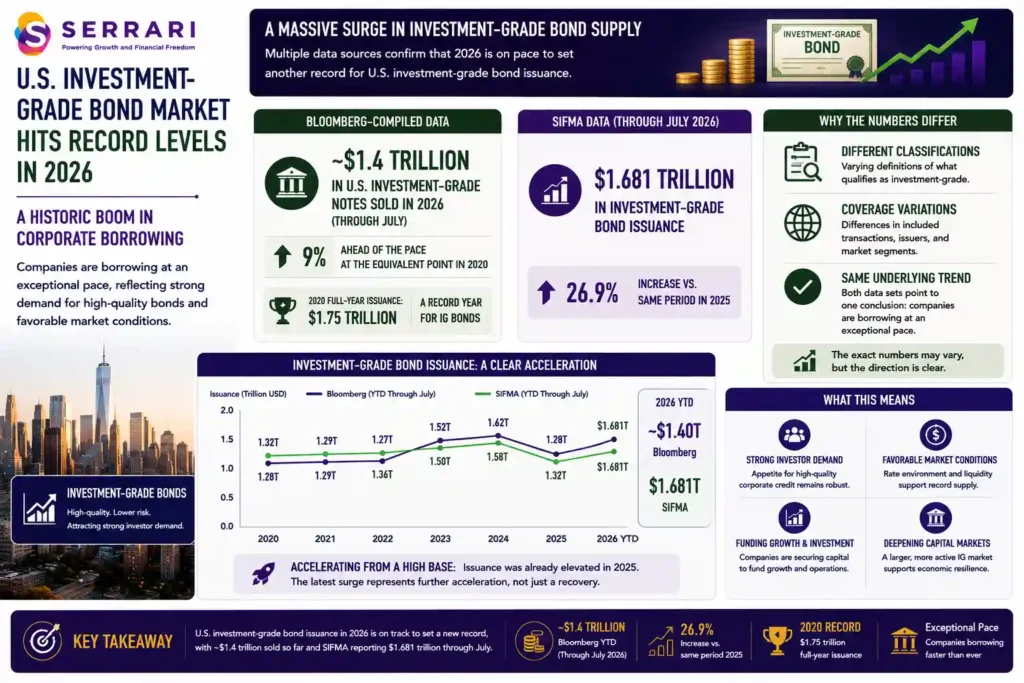
According to Bloomberg-compiled figures, approximately $1.4 trillion in U.S. investment-grade notes has already been sold this year.
That volume is around 9% ahead of the pace recorded at the equivalent point in 2020, which ultimately ended with a record $1.75 trillion in full-year issuance.
Separate data from the Securities Industry and Financial Markets Association shows investment-grade issuance reached about $1.681 trillion through July 2026, representing a 26.9% increase compared with the same period of 2025.
The difference between data sources can reflect varying classifications and transaction coverage, but both indicate the same underlying trend: companies are borrowing at an exceptional pace.
This is not simply a recovery from weak issuance. Corporate borrowing was already elevated in 2025, meaning the latest increase represents acceleration from a high base.
Companies Rush to Refinance Older Corporate Debt
One of the biggest drivers behind the surge is refinancing.
Many companies issued large amounts of corporate debt during 2020 and 2021, when borrowing costs were unusually low as central banks maintained highly accommodative monetary policies.
Those securities are gradually reaching maturity, forcing companies to decide whether to refinance today or wait for potentially better conditions.
Many issuers appear to be choosing certainty.
Rather than risk higher Treasury yields, wider credit spreads or increased market volatility later, companies are locking in current funding costs while investor demand remains strong.
This refinancing cycle is likely to remain an important source of debt issuance as maturities from the pandemic-era borrowing boom continue coming due.
Treasury Yields and Credit Spreads Shape Issuance Windows
Companies do not enter the capital markets randomly.
Corporate treasurers and investment banks closely monitor Treasury yields, credit spreads, stock market volatility and Federal Reserve signals when deciding when to sell bonds.
Treasury yields provide the underlying risk-free benchmark used to price many U.S. corporate bonds, while credit spreads determine how much additional yield investors demand for taking corporate credit risk.
When Treasury yields stabilise, spreads remain tight and equity markets show limited volatility, companies often view the environment as an attractive issuance window.
The result can be a sudden wave of deals as multiple firms attempt to raise financing at the same time.
Earlier in January, for example, roughly $37 billion of investment-grade debt was reportedly sold during a single session, demonstrating how concentrated issuance can become when market conditions align.
Bond Investors Continue Absorbing Heavy Supply
The extraordinary volume of issuance would not be possible without strong demand from bond investors.
Institutional buyers such as pension funds, insurance companies, mutual funds, asset managers and foreign investors continue allocating substantial capital to U.S. investment-grade credit.
Higher bond yields compared with the ultra-low-rate environment of several years ago have made high-quality corporate debt more attractive to investors seeking income.
At the same time, investment-grade companies generally carry relatively low default risk compared with speculative-grade borrowers, making their bonds appealing to institutions balancing yield and capital preservation.
This demand has helped companies absorb historically large volumes of debt without causing a significant breakdown in credit markets.
Context is everything. Stay ahead of shifting trends with today’s market updates, and uncover emerging opportunities using the Serrari Group Market Index and Marketplace. Then, take control of your own financial future by exploring our Money & Life Reset Transformation Blueprint ™ to build stronger habits, create better systems, and design a path toward lasting wealth.
Global Bond Issuance Approaches $5 Trillion
The U.S. corporate borrowing boom is part of a wider global surge in bond financing.
Global syndicated bond issuance is expected to reach approximately $5 trillion, according to Bloomberg-compiled figures.
The market is reaching that milestone more than a month earlier than the previous fastest pace recorded last year.
The acceleration reflects strong borrowing activity from companies, financial institutions and governments around the world.
For the global fixed income market, the milestone demonstrates the increasingly central role that public debt markets play in financing corporate investment, refinancing obligations and government spending.
August Defies Traditional Seasonal Slowdown
The scale of activity is especially striking because August historically experiences reduced issuance.
Bankers, investors and corporate executives often take holidays during the northern hemisphere summer, while lower trading volumes can make companies more reluctant to launch major debt transactions.
This year, however, companies appear unwilling to wait.
The $80 billion of U.S. investment-grade issuance recorded in the previous week represented the third-highest weekly volume of 2026.
If issuance continues at the current pace, August could significantly exceed its historical average and become another major contributor to what is already shaping up as a record year.
Why Companies Are Choosing Debt Financing
Several factors are encouraging companies to rely on the US high-grade bond market.
Refinancing remains the most immediate driver, but companies are also raising money for acquisitions, capital expenditure, shareholder distributions and general corporate purposes.
Large technology companies have contributed heavily to supply as they finance artificial intelligence infrastructure, data centres and other capital-intensive projects.
Financial institutions also remain frequent issuers because banks regularly access wholesale debt markets to manage funding and regulatory capital requirements.
The diversity of borrowers means the issuance boom is not confined to a single sector.
Credit Markets Remain Resilient
Heavy supply can sometimes pressure credit markets if investors demand larger yield premiums to absorb new bonds.
So far, however, the market has remained relatively resilient.
Strong institutional demand and attractive absolute yields have helped prevent issuance volumes from overwhelming buyers.
That resilience is important because continued heavy borrowing depends on investors being willing to absorb new supply without requiring sharply wider spreads.
If economic conditions deteriorate or market volatility rises, that balance could change quickly.
Risks to the Bond Market Outlook
Despite the current strength, several risks could affect the US high-grade bond market during the remainder of 2026.
A renewed rise in Treasury yields could increase borrowing costs and cause companies to delay issuance.
Unexpected Federal Reserve policy shifts could also change expectations for interest rates, while stronger inflation data could push government bond yields higher.
Credit spreads could widen if investors become more concerned about economic growth or corporate profitability.
At the same time, exceptionally heavy issuance itself could eventually test demand if investors become saturated with new corporate debt.
Outlook for the US High-Grade Bond Market
The US high-grade bond market is on track for one of its strongest years ever, supported by refinancing needs, robust institutional demand and companies’ willingness to take advantage of favourable issuance windows.
With investment-grade borrowing already running well ahead of last year’s pace and global bond issuance approaching historic levels, 2026 is emerging as an extraordinary year for corporate bonds.
The key question is whether investor demand can remain strong enough to absorb continued supply.
If Treasury yields remain relatively stable and credit spreads stay contained, companies are likely to continue tapping the market aggressively. However, any deterioration in monetary policy expectations or investor sentiment could quickly slow issuance.
For now, the market remains firmly open, and companies appear determined to use it.
FAQs
Why is the US high-grade bond market so active?
The US high-grade bond market is seeing heavy activity because companies are refinancing older debt, locking in current borrowing costs and taking advantage of strong investor demand for investment-grade securities.
How much investment-grade debt has been issued in 2026?
Different market data sets show U.S. investment-grade issuance above $1.4 trillion during 2026, with SIFMA figures indicating approximately $1.681 trillion through July, significantly ahead of the previous year’s pace.
Why are companies issuing bonds now instead of waiting?
Many bond issuers are concerned that future Treasury yields, credit spreads or market volatility could become less favourable. Issuing now allows companies to secure financing while market conditions remain relatively supportive.
Can heavy bond issuance push yields higher?
Yes. If new corporate bonds enter the market faster than investors can absorb them, issuers may need to offer higher yields or wider credit spreads. So far, however, strong demand from institutional investors has helped the market absorb the elevated supply.
Sources: Yahoo Finance, MooMoo, Crypto Briefing, Briefs
Your financial future isn’t something you wait for—it’s something you build.
The real question is: when do you begin?
Move beyond simply staying informed.
Navigate the markets with clarity—track trends through the Serrari Group Market Index, uncover opportunities in the Serrari Marketplace, and build practical knowledge with our Curated Wealth Builder Platform.
Stay connected to what truly matters.
Get daily insights on macro trends and financial movements across Kenya, Africa, and global markets—delivered through the Serrari Newsletter.
Growth opens doors.
Advance your career through professional programs including ACCA, HESI A2, ATI TEAS 7 , HESI EXIT , NCLEX – RN and NCLEX – PN, Financial Literacy!🌟—designed to move you forward with confidence.
See where money is flowing—clearly and in real time.
Track Money Market Funds, Treasury Bills, Treasury Bonds, Green Bonds, and Fixed Deposits, alongside global and African indexes, key economic indicators, and the evolving Crypto and stablecoin landscape—all within Serrari’s Market Index.