


















The Bitcoin price slipped below $64,000 on August 11, 2026, as investors reduced exposure to risk assets ahead of fresh U.S. inflation data. Bitcoin fell about 1.6% to around $63,855, while Ethereum and XRP also weakened as rising oil prices and higher Treasury yields renewed concerns about the Federal Reserve’s interest-rate outlook. Despite the broader crypto selloff, several altcoins recorded gains, highlighting an increasingly mixed cryptocurrency market. U.S. spot Bitcoin exchange-traded funds also returned to net outflows after five consecutive sessions of inflows, adding another source of near-term pressure.
Key Overview
Bitcoin’s decline comes as macroeconomic uncertainty returns to the centre of cryptocurrency trading. Brent crude held near $87.81 a barrel after jumping more than 5% in the previous session, while the benchmark U.S. 10-year Treasury yield moved toward 4.7%. Meanwhile, U.S. spot Bitcoin ETFs recorded $144.6 million in net withdrawals on Monday after attracting $865.3 million over the previous five sessions. Traders are now watching the July U.S. Consumer Price Index release on August 12 for clues about inflation and the Federal Reserve’s next policy move.
Bitcoin Price Drops Below $64,000
The Bitcoin price fell below the psychologically important $64,000 level on Tuesday as traders adopted a more cautious stance ahead of key U.S. inflation figures.
Bitcoin declined approximately 1.6% to trade around $63,855, extending weakness across some of the largest digital assets.
The move places the cryptocurrency around a critical short-term area after investors had previously attempted to push prices higher. Bitcoin now needs to recover above $65,000 to improve near-term momentum, while the $63,000 to $64,000 region remains an important area for traders watching for potential support.
A sustained break below that range could increase selling pressure, particularly if Wednesday’s U.S. inflation figures strengthen expectations that interest rates will remain elevated.
Conversely, a recovery above $65,000 could shift attention back toward the $67,500 to $70,000 region.
Ethereum and XRP Join the Crypto Selloff
Bitcoin was not the only major cryptocurrency under pressure.
Ethereum and XRP also declined as investors reduced exposure to some of the market’s largest assets. Weakness in the Ether price is particularly important because Ethereum remains the second-largest cryptocurrency and plays a central role in decentralised finance, tokenisation and blockchain-based applications.
When both Bitcoin and Ether decline simultaneously, the moves can influence sentiment across the broader cryptocurrency market.
XRP’s weakness provided another indication that selling pressure was extending beyond Bitcoin.
However, the market was far from uniformly negative. Several smaller cryptocurrencies continued to advance even as the largest digital assets struggled.
Altcoins Record Mixed Performance
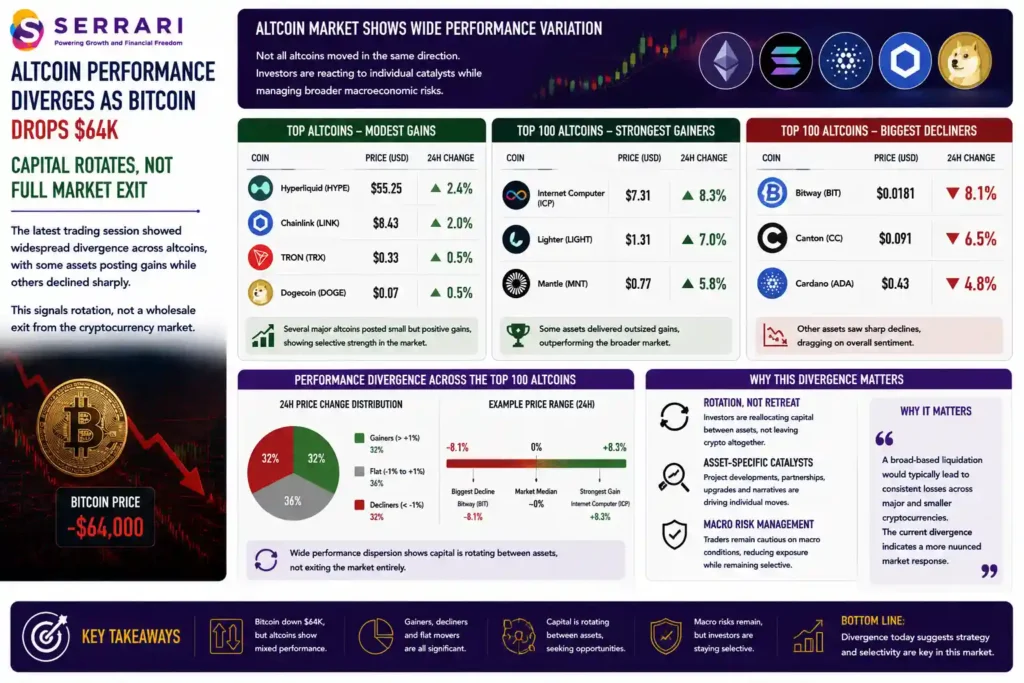
The latest trading session highlighted significant differences in performance across altcoins.
Hyperliquid gained approximately 2.4% to $55.25, while Chainlink advanced around 2% to $8.43. TRX increased approximately 0.5% to $0.33, while Dogecoin also added roughly 0.5% around $0.07.
Some assets among the top 100 cryptocurrencies recorded considerably stronger gains. Internet Computers advanced approximately 8.3%, Lighter climbed around 7%, and Mantle gained about 5.8%.
At the other end of the market, Bitway declined approximately 8.1%, Canton dropped 6.5% and Cardano fell 4.8%.
The divergence suggests investors are not simply exiting the entire cryptocurrency market. Instead, capital appears to be rotating between assets as traders respond to individual catalysts while simultaneously reducing exposure to broader macroeconomic risks.
That distinction matters because a broad-based liquidation would normally produce more consistent losses across major and smaller cryptocurrencies.
Rising Oil Prices Create New Inflation Risk
One of the most important external pressures affecting crypto prices is the renewed rise in energy prices.
Brent crude held around $87.81 per barrel on Tuesday after gaining more than 5% during the previous session.
The increase followed weakening expectations that Washington and Tehran would reach an agreement capable of easing geopolitical tensions.
Higher oil prices can have implications far beyond energy markets. Oil influences transportation, manufacturing and logistics costs, meaning sustained increases can eventually contribute to broader consumer inflation.
That creates a potential problem for cryptocurrency investors.
If higher energy prices keep U.S. inflation elevated, the Federal Reserve could have less room to reduce interest rates. Expectations of tighter monetary policy can strengthen yields on conventional assets and make speculative investments relatively less attractive.
Bitcoin has increasingly traded as an institutional macro asset, making movements in interest rates, bond yields and liquidity conditions important influences on short-term investor sentiment.
Treasury Yields Add Pressure to Digital Assets
The U.S. Treasury market is already reflecting some of those inflation concerns.
The benchmark 10-year Treasury yield moved toward 4.7% alongside rising oil prices on Monday.
Higher Treasury yields can create challenges for Bitcoin and other risk assets because investors can obtain higher returns from government securities without assuming the volatility associated with cryptocurrencies.
The relationship is not always direct, and Bitcoin can rise during periods of increasing yields. However, sudden increases in yields caused by changing inflation or Federal Reserve expectations can trigger broader reductions in risk exposure.
For the cryptocurrency market, Wednesday’s inflation figures could therefore influence prices indirectly through movements in Treasury yields and expectations for U.S. monetary policy.
Bitcoin ETF Inflow Streak Ends
Institutional flows are providing another mixed signal for Bitcoin.
U.S. spot Bitcoin ETFs recorded five consecutive sessions of positive flows between August 3 and August 7, attracting a combined $865.3 million, according to Farside Investors.
That streak ended on Monday when the funds recorded approximately $144.6 million in net withdrawals.
BlackRock’s IBIT accounted for $53.6 million of the outflows, while Grayscale’s GBTC recorded approximately $52 million in withdrawals.
The reversal is significant because spot Bitcoin ETFs have become an important bridge between traditional financial markets and cryptocurrency investment.
Sustained inflows can create additional demand for Bitcoin, while persistent withdrawals can indicate weaker institutional appetite or broader risk reduction.
However, a single day of outflows does not necessarily establish a longer-term trend. The $144.6 million withdrawal also needs to be viewed against the $865.3 million accumulated during the preceding five positive sessions.
Investors will therefore be watching subsequent ETF flows to determine whether Monday represented temporary profit-taking or the beginning of a broader shift in institutional sentiment.
Context is everything. Stay ahead of shifting trends with today’s market updates, and uncover emerging opportunities using the Serrari Group Market Index and Marketplace. Then, take control of your own financial future by exploring our Money & Life Reset Transformation Blueprint ™ to build stronger habits, create better systems, and design a path toward lasting wealth.
U.S. Inflation Data Becomes the Next Major Catalyst
Attention is now turning to the July U.S. Consumer Price Index report scheduled for August 12.
The inflation release could become the next significant catalyst for Bitcoin, Ethereum, XRP and the broader digital asset market because of its potential implications for Federal Reserve policy.
A softer-than-expected CPI reading could reduce concerns about persistent inflation and potentially ease pressure on Treasury yields.
Such an outcome could improve sentiment toward risk assets, including cryptocurrencies.
A hotter-than-expected inflation report could produce the opposite reaction. Investors could increase expectations for tighter monetary policy, potentially pushing bond yields higher and strengthening the case for maintaining exposure to less volatile assets.
The inflation report carries additional significance because of the recent increase in oil prices. Traders will be looking for indications of whether broader price pressures are already proving difficult to contain before the latest energy shock filters through the economy.
Bitcoin Faces Critical $63K to $65K Trading Range
From a short-term market perspective, Bitcoin is now trading within an important range.
The $63,000 to $64,000 region is emerging as an immediate area to watch following the latest Bitcoin losses.
If buyers defend that area, Bitcoin could attempt to recover the $65,000 level. A convincing move above $65,000 would put the $67,500 to $70,000 region back into focus.
Failure to hold the current range could leave the cryptocurrency vulnerable to additional selling, particularly if macroeconomic conditions deteriorate.
Technical levels should not be viewed in isolation, however. Bitcoin’s next major move is likely to depend heavily on inflation data, Treasury yields, oil prices and institutional flows.
Cryptocurrency Market Waits for Direction
The latest decline in the Bitcoin price illustrates how closely cryptocurrency markets are interacting with developments across traditional financial markets.
Bitcoin remains below $64,000, Ethereum and XRP are under pressure, and institutional ETF flows have turned negative after several days of strong inflows. At the same time, gains across selected altcoins show that investors have not abandoned digital assets altogether.
The immediate question is whether the latest weakness develops into a deeper crypto selloff or proves to be a temporary period of risk reduction ahead of important economic data.
Wednesday’s CPI report could provide the clearest answer.
If inflation comes in softer than markets expect and Treasury yields retreat, Bitcoin could receive the conditions needed to challenge $65,000 again. If inflation surprises to the upside, however, pressure on cryptocurrencies could intensify as investors reassess the Federal Reserve’s interest-rate path.
For now, the battle around $63,000 to $65,000 remains central to the short-term Bitcoin outlook.
FAQs
Why did the Bitcoin price fall below $64,000?
The Bitcoin price fell below $64,000 as investors reduced risk ahead of U.S. inflation data. Rising oil prices and higher Treasury yields also increased concerns about inflation and the Federal Reserve’s future interest-rate decisions.
Are Ethereum and XRP also falling?
Yes. Ethereum and XRP declined alongside Bitcoin, although performance across the broader cryptocurrency market was mixed. Several altcoins, including Hyperliquid, Chainlink, Internet Computer and Mantle, recorded gains.
Are investors withdrawing money from Bitcoin ETFs?
U.S. spot Bitcoin ETFs recorded approximately $144.6 million in net outflows on Monday after five consecutive positive sessions. Those previous sessions attracted a combined $865.3 million, meaning the latest withdrawal has not erased the preceding inflows.
What Bitcoin price levels should investors watch?
The $63,000 to $64,000 area is an important near-term support region. Bitcoin would need to reclaim approximately $65,000 to strengthen short-term momentum, after which the $67,500 to $70,000 range could become relevant again.
Sources: Crypto News, Pluang, CoinFi
Your financial future isn’t something you wait for—it’s something you build.
The real question is: when do you begin?
Move beyond simply staying informed.
Navigate the markets with clarity—track trends through the Serrari Group Market Index, uncover opportunities in the Serrari Marketplace, and build practical knowledge with our Curated Wealth Builder Platform.
Stay connected to what truly matters.
Get daily insights on macro trends and financial movements across Kenya, Africa, and global markets—delivered through the Serrari Newsletter.
Growth opens doors.
Advance your career through professional programs including ACCA, HESI A2, ATI TEAS 7 , HESI EXIT , NCLEX – RN and NCLEX – PN, Financial Literacy!🌟—designed to move you forward with confidence.
See where money is flowing—clearly and in real time.
Track Money Market Funds, Treasury Bills, Treasury Bonds, Green Bonds, and Fixed Deposits, alongside global and African indexes, key economic indicators, and the evolving Crypto and stablecoin landscape—all within Serrari’s Market Index.