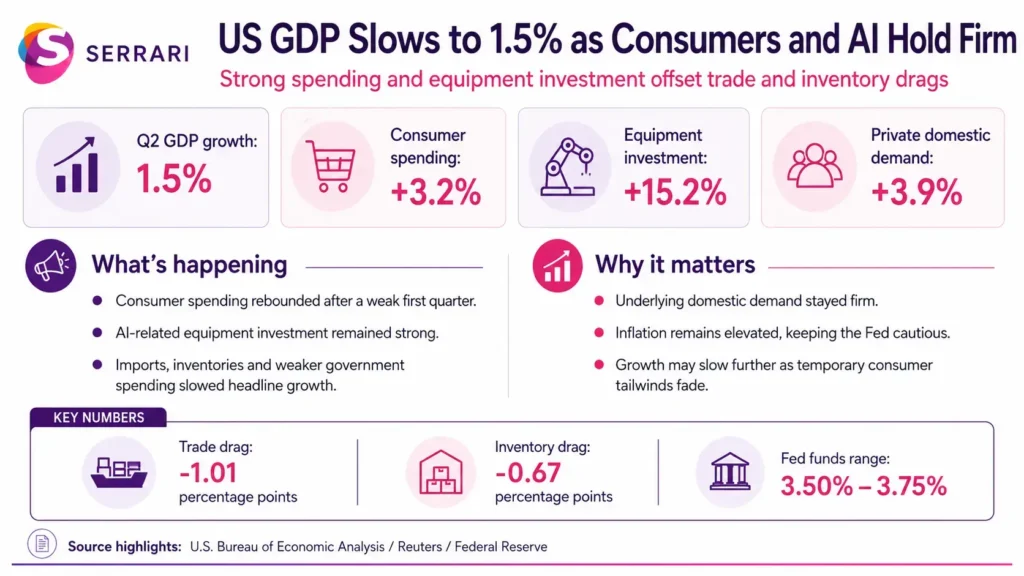
The US economy expanded at an annualised rate of 1.5% in the second quarter of 2026, slowing from 2.1% in the first quarter and falling below the earlier 2.1% consensus forecast. Stronger household consumption and another surge in equipment investment prevented a sharper slowdown.
Consumer spending increased at a 3.2% pace, while business expenditure on equipment rose by 15.2%, supported partly by the continuing buildout of artificial intelligence infrastructure. However, rising imports, shrinking inventories and weaker government spending reduced headline growth.
Key Overview
- Second-quarter GDP growth: 1.5% annualised
- First-quarter GDP growth: 2.1%
- Consumer spending growth: 3.2%
- Business equipment investment growth: 15.2%
- Private domestic demand growth: 3.9%
- Trade contribution: Reduced GDP growth by 1.01 percentage points
- Inventory contribution: Reduced growth by 0.67 percentage points
- Federal funds target range: 3.50%–3.75%
Consumer Spending Rebounded Sharply
The official advance GDP estimate showed that household spending accelerated substantially after growing by only 0.5% in the first quarter. Both goods and services contributed to the increase.
Spending on goods was led by prescription drugs, motor vehicles and household furnishings. Food services, accommodation, financial services and insurance were among the main contributors on the services side.
The rebound indicates that consumers remained willing to spend despite elevated inflation and higher energy costs. Larger tax refunds, gains in household asset values and spending associated with major events also helped support demand during the quarter.
However, the strength may be difficult to maintain. The June income and spending report showed that the personal saving rate fell to 2.7%, meaning households retained a relatively small share of disposable income after spending.
Income growth was also modest in June, with personal income and disposable personal income each rising by 0.2%. Consumers may therefore have less room to maintain rapid spending growth if energy prices remain elevated or labour-market conditions weaken.
AI Investment Boosted Demand but Increased Imports
Business investment remained an important source of growth, particularly expenditure on equipment and intellectual property. Equipment investment rose at a 15.2% annualised rate, recording a second consecutive quarter of double-digit expansion.
The increase was broad-based, with industrial, transportation and information-processing equipment contributing to the gain. The continuing AI infrastructure boom has encouraged spending on servers, computing hardware, data-centre systems and related equipment.
According to post-release economic analysis, the AI buildout also increased demand for imported technology. That created an unusual combination: AI-related spending strengthened domestic demand while the corresponding import surge reduced measured GDP.
Trade subtracted 1.01 percentage points from second-quarter growth. Imports rose for a second consecutive quarter at a double-digit rate, while businesses also brought forward some purchases because of concerns about tariffs and future price increases.
Context is everything. Stay ahead of shifting trends with today’s market updates, and uncover emerging opportunities using the Serrari Group Market Index and Marketplace. Then, take control of your own financial future by exploring our Money & Life Reset Transformation Blueprint ™ to build stronger habits, create better systems, and design a path toward lasting wealth.
Domestic Demand Was Stronger Than Headline GDP
The 1.5% headline figure understated the strength of demand within the private domestic economy. Real final sales to private domestic purchasers—which combine consumer spending and private fixed investment while excluding trade, inventories and government—grew by 3.9%.
That was more than double the first quarter’s 1.7% pace and the strongest increase in the measure since early 2023. It suggests that households and businesses were still spending robustly even as imports and inventory movements weighed on total output.
Inventories reduced GDP growth by 0.67 percentage points as companies drew down existing stocks to meet demand. Government spending also contracted at a 0.8% pace, with federal expenditure falling more sharply.
Investment was not uniformly strong. Non-residential structures declined, continuing a prolonged period of weakness in areas such as factory and commercial construction. Residential investment also remained under pressure from elevated mortgage rates and housing affordability constraints.
Inflation Keeps the Federal Reserve Cautious
Price pressures remained a major concern despite the resilient private-sector demand. The price index for gross domestic purchases increased at a 5.7% annualised pace during the quarter, up from 3.6% in the first quarter.
The personal consumption expenditures price index rose at a 5.1% quarterly annualised rate, while core PCE inflation, excluding food and energy, increased by 3.4%. Separate monthly data showed annual PCE inflation easing to 3.7% in June from 4.1% in May, but it remained above the Federal Reserve’s 2% objective.
In its July policy decision, the Federal Reserve maintained the federal funds target range at 3.50%–3.75%. The decision passed by a 9–3 vote, with three policymakers preferring a quarter-percentage-point increase.
The combination of strong domestic demand, elevated inflation and higher energy prices leaves policymakers balancing two risks: tightening too aggressively and weakening growth, or holding rates steady for too long and allowing inflation to remain entrenched.
Outlook Points to Slower Growth Risks
The second-quarter report showed an economy with firmer underlying demand than the headline growth rate suggested. Consumers continued spending, and businesses remained committed to AI-related investment.
Nonetheless, several temporary supports may fade during the second half of the year. Tax-refund effects are receding, household savings are low, energy costs are pressuring budgets and higher borrowing costs could restrain housing and business activity.
The initial 1.5% GDP estimate may also be revised when more complete data become available. The second estimate is scheduled for August 26, 2026.
Sources: U.S. Bureau of Economic Analysis / Reuters / Federal Reserve
Your financial future isn’t something you wait for—it’s something you build.
The real question is: when do you begin?
Move beyond simply staying informed.
Navigate the markets with clarity—track trends through the Serrari Group Market Index, uncover opportunities in the Serrari Marketplace, and build practical knowledge with our Curated Wealth Builder Platform.
Stay connected to what truly matters.
Get daily insights on macro trends and financial movements across Kenya, Africa, and global markets—delivered through the Serrari Newsletter.
Growth opens doors.
Advance your career through professional programs including ACCA, HESI A2, ATI TEAS 7 , HESI EXIT , NCLEX – RN and NCLEX – PN, Financial Literacy!🌟—designed to move you forward with confidence.
See where money is flowing—clearly and in real time.
Track Money Market Funds, Treasury Bills, Treasury Bonds, Green Bonds, and Fixed Deposits, alongside global and African indexes, key economic indicators, and the evolving Crypto and stablecoin landscape—all within Serrari’s Market Index.