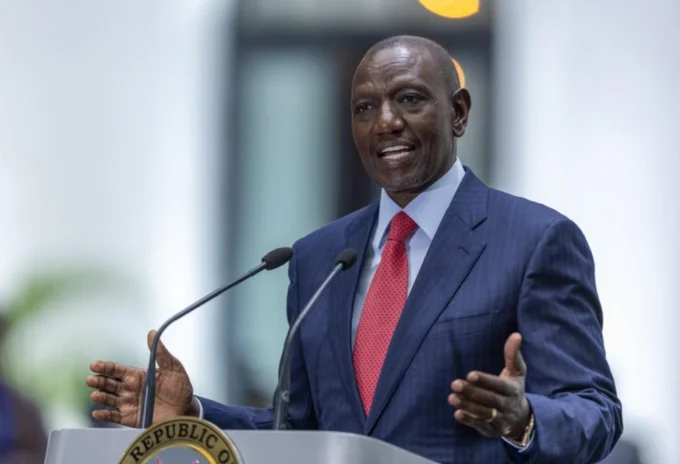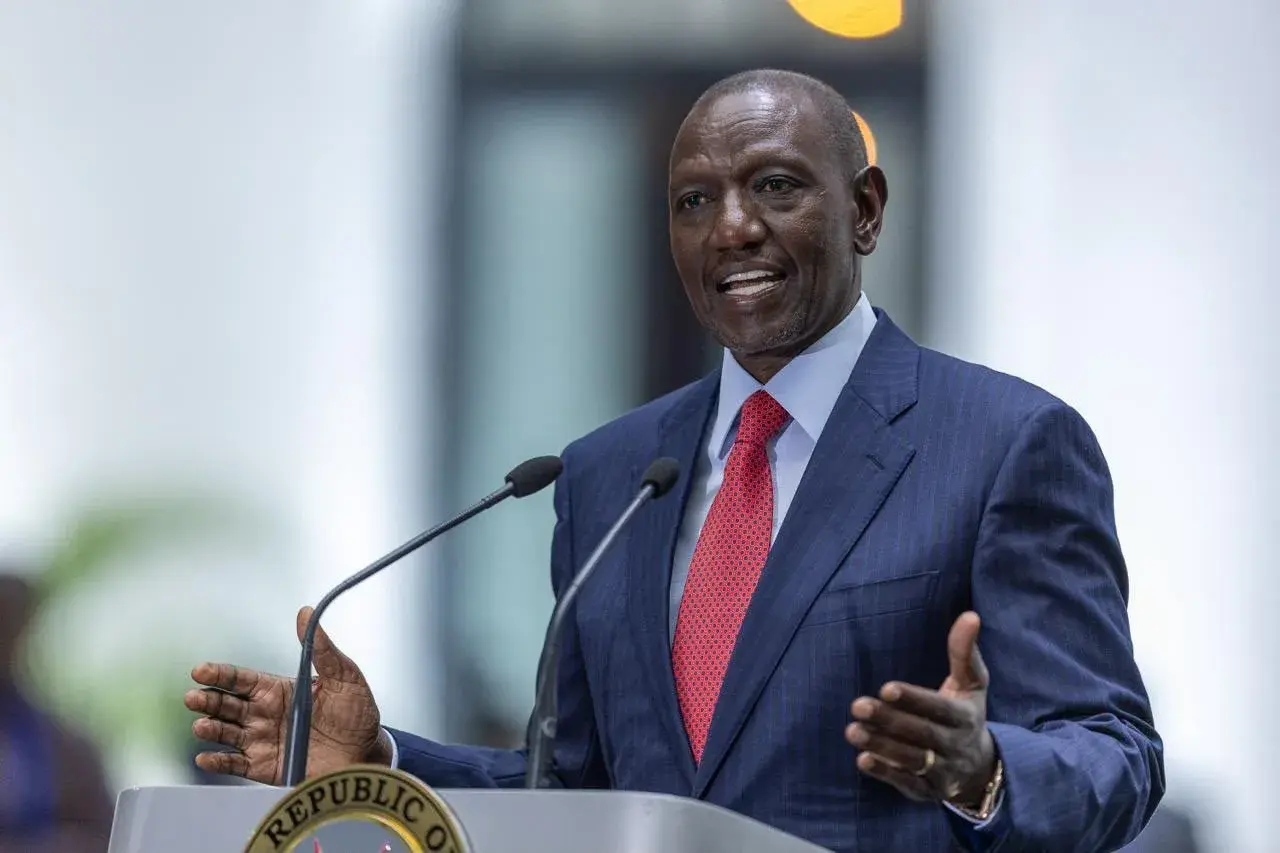
President William Ruto has called for a new national development charter to guide Kenya after Vision 2030, arguing that the next long-term plan should be citizen-led, anchored in the Constitution and protected from political cycles.
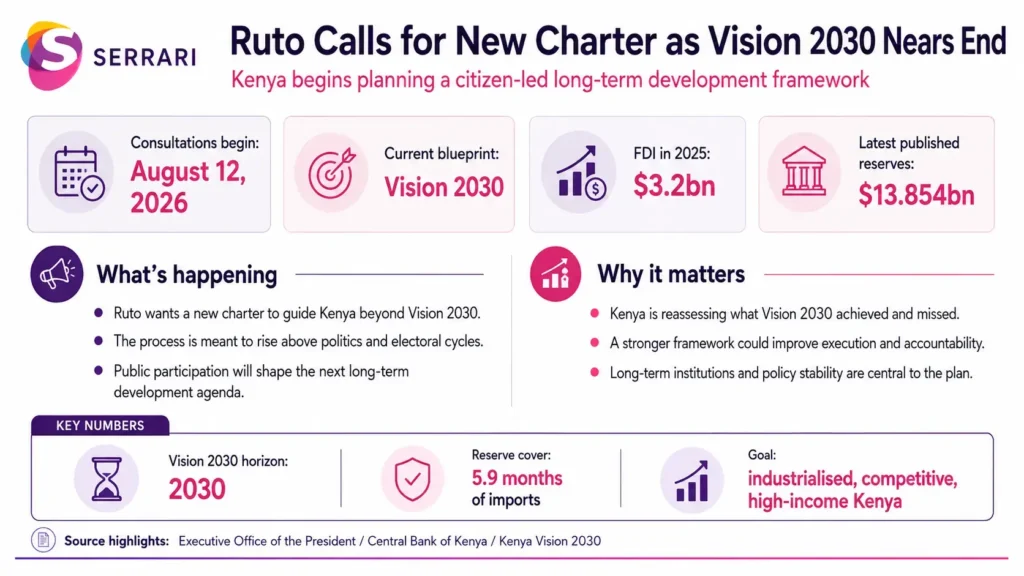
Nationwide consultations are scheduled to begin on August 12, 2026. The process is expected to involve political leaders, professionals, businesses, workers, faith groups, academia, civil society, innovators and young people.
Ruto presented the initiative as an opportunity to assess Vision 2030 honestly, retain what worked and develop a more ambitious framework capable of turning constitutional rights into measurable economic and social outcomes.
Key Overview
- Vision 2030 is approaching the end of its planning period.
- Public consultations on a successor framework begin on August 12, 2026.
- The proposed charter is intended to extend beyond governments and elections.
- Initial proposals were prepared by a team led by Professors Hiroyuki Hino and Anyang’ Nyong’o.
- The long-term ambition is an industrialised, globally competitive and high-income Kenya within one generation.
- Some economic claims in the address differ from the latest publicly available data.
Kenya Starts Planning Beyond Vision 2030
In the official account of the national address, Ruto said Kenya had reached a defining moment as Vision 2030 approached its conclusion. He argued that its successor should not become another government document that changes with each administration.
The proposed charter would define the country future generations should inherit and translate constitutional commitments into national targets. These include healthcare, housing, education, food security, economic opportunity and improved living standards.
A team led by economists Hiroyuki Hino and Anyang’ Nyong’o has already developed proposals envisioning an industrialised, globally competitive and prosperous high-income country within one generation. Public consultations will allow citizens and institutions to test and expand those ideas.
Vision 2030 Delivered Progress but Missed Targets
Kenya Vision 2030 was introduced as a development blueprint covering 2008 to 2030. Its official objective is to transform Kenya into a newly industrialising, middle-income country offering a high quality of life in a clean and secure environment.
The presidential address described upper-middle-income status as one of the ambitions that remains unmet. This differs slightly from the original wording, which refers more broadly to middle-income status. Kenya entered the World Bank’s lower-middle-income category in 2014 but has not advanced into the upper-middle-income group.
Vision 2030 has guided infrastructure, public policy and investment through successive five-year plans. However, persistent public debt, youth unemployment, inequality, weak industrial growth and uneven delivery of flagship projects have limited the scale of transformation.
A successor framework will need clearer priorities, reliable financing, measurable targets and stronger accountability for missed commitments.
Economic Claims Require Careful Verification
Ruto said Kenya had restored macroeconomic stability, citing lower inflation, a steadier currency, falling borrowing costs, stronger reserves and record foreign investment.
The foreign direct investment figure has independent support. Kenya attracted an estimated $3.2 billion in 2025, according to figures from the latest global investment report. The reported inflows increased by 37.7% from a revised $2.32 billion in 2024, supported partly by digital infrastructure and renewable energy.
The reserve figure requires more caution. The address cited reserves above $15 billion, equivalent to 6.5 months of import cover. However, the latest publicly available weekly bulletin before the speech reported $13.854 billion, equal to 5.9 months of import cover, as of July 23.
The larger amount may reflect newer information that had not yet appeared in the published bulletin, but it remains a presidential claim pending confirmation through subsequent monetary data.
Context is everything. Stay ahead of shifting trends with today’s market updates, and uncover emerging opportunities using the Serrari Group Market Index and Marketplace. Then, take control of your own financial future by exploring our Money & Life Reset Transformation Blueprint ™ to build stronger habits, create better systems, and design a path toward lasting wealth.
New Funds Support Long-Term Investment Plans
Ruto identified the National Infrastructure Fund and Sovereign Wealth Fund as institutions intended to finance strategic projects and preserve national wealth beyond individual administrations.
The National Infrastructure Fund Act established a framework for mobilising and managing infrastructure capital. The broader policy aims to attract pension funds, development institutions, sovereign investors and private capital while reducing dependence on conventional public borrowing.
These institutions could improve long-term financing if they operate with professional management, transparent investment rules and effective oversight. Their credibility will depend on project selection, conflict-of-interest controls, public reporting and measurable returns.
Africa’s Growth Opportunity Shapes the Charter
Ruto argued that Africa’s youthful population, renewable-energy resources, minerals, agricultural potential and expanding consumer markets could place the continent at the centre of the next global economic transformation.
The demographic opportunity is substantial. By 2050, one in every four people worldwide is expected to be African. Countries will need to create millions of productive jobs while expanding education, healthcare, housing, energy and urban infrastructure.
For Kenya, benefiting from this shift will require more than a vision statement. The country must raise productivity, strengthen manufacturing, support exports, expand technical skills and improve the capacity of public institutions.
Public Participation Will Determine Credibility
The proposed charter’s legitimacy will depend on whether consultations allow genuine public influence rather than simply endorsing a predetermined government agenda.
Publishing the proposals, conducting county-level engagement, inviting independent technical review and reporting public submissions would strengthen trust. The process should also identify funding needs, implementation responsibilities and regular progress reviews.
Vision 2030 established a common national direction, but its incomplete targets show that ambition without disciplined execution is insufficient. Kenya’s next charter will be credible only if it combines public ownership with institutions capable of delivering results across multiple administrations.
Sources: Executive Office of the President / Kenya Vision 2030 / Business Daily / Central Bank of Kenya / Kenya Law / World Bank
Your financial future isn’t something you wait for—it’s something you build.
The real question is: when do you begin?
Move beyond simply staying informed.
Navigate the markets with clarity—track trends through the Serrari Group Market Index, uncover opportunities in the Serrari Marketplace, and build practical knowledge with our Curated Wealth Builder Platform.
Stay connected to what truly matters.
Get daily insights on macro trends and financial movements across Kenya, Africa, and global markets—delivered through the Serrari Newsletter.
Growth opens doors.
Advance your career through professional programs including ACCA, HESI A2, ATI TEAS 7 , HESI EXIT , NCLEX – RN and NCLEX – PN, Financial Literacy!🌟—designed to move you forward with confidence.
See where money is flowing—clearly and in real time.
Track Money Market Funds, Treasury Bills, Treasury Bonds, Green Bonds, and Fixed Deposits, alongside global and African indexes, key economic indicators, and the evolving Crypto and stablecoin landscape—all within Serrari’s Market Index.