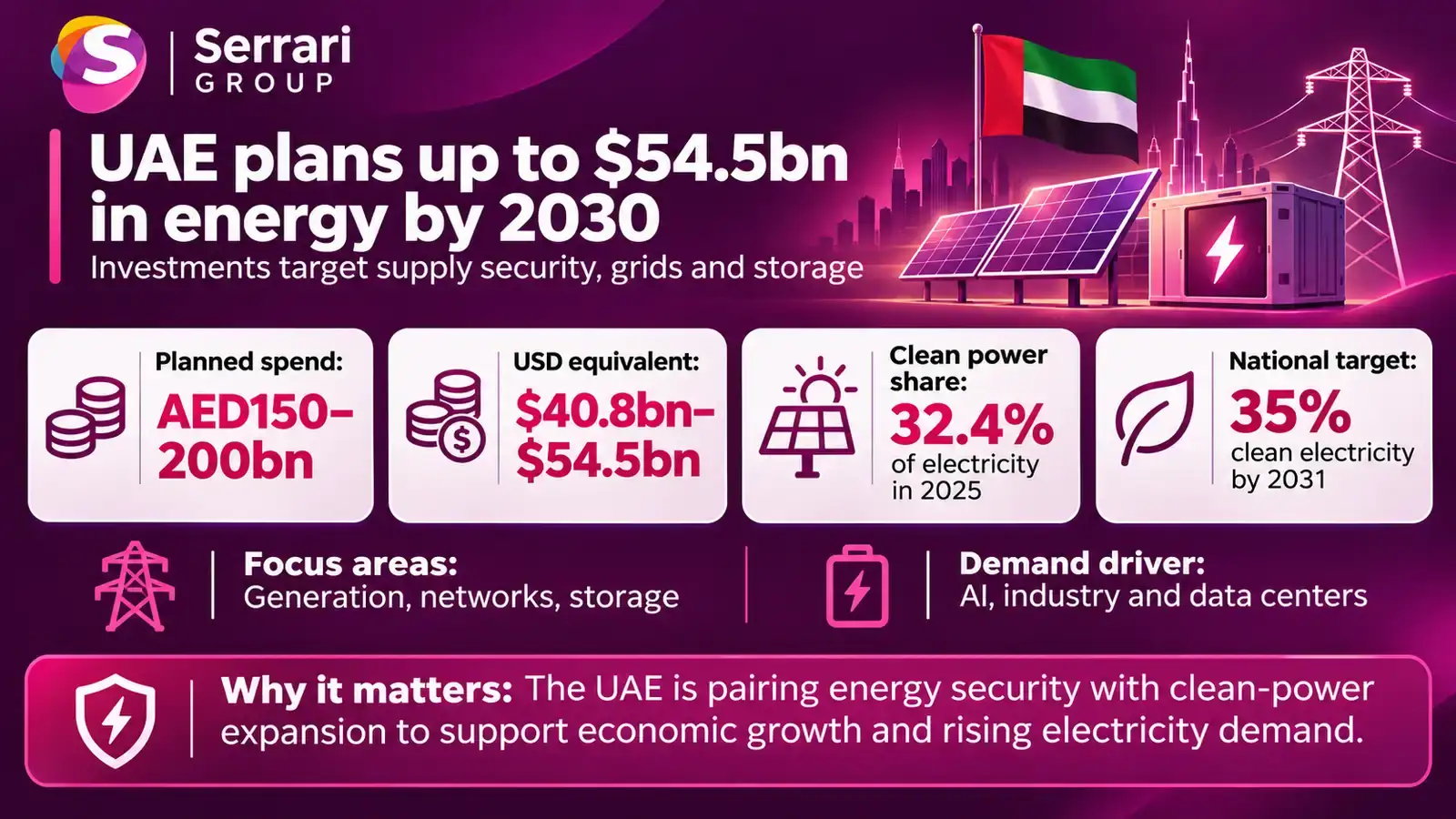
The United Arab Emirates plans to invest AED150 billion to AED200 billion (40.8billion–54.5 billion) in its energy sector by 2030, targeting electricity generation, networks, storage and system reliability. Energy and Infrastructure Minister Suhail bin Mohammed Al Mazrouei outlined the plans at ADIPEC 2026 in Abu Dhabi, positioning secure power supplies as essential to industrial development, artificial intelligence and economic growth.
Key Overview
- Investment pipeline: AED150 billion–AED200 billion (40.8billion–54.5 billion) in planned energy spending by 2030.
- Infrastructure priorities: Power generation, electricity grids, energy storage and integrated system operations.
- Clean-energy progress: Nuclear and renewable sources accounted for 32.4% of electricity generation in 2025.
- National target: Increase clean electricity generation to 35% by 2031.
- Strategic focus: Reduce exposure to supply disruptions while supporting AI, data centres and advanced manufacturing.
UAE Puts Energy Security at the Centre of Investment
Speaking at the November 2 ministerial panel, Al Mazrouei outlined an AED150 billion–AED200 billion investment programme intended to meet rising electricity demand and strengthen the resilience of the national energy system. The figure represents planned investment, not money already spent or a newly itemised list of approved projects.
He argued that sufficient fuel supplies alone cannot guarantee energy security. Grid reliability, physical protection, cybersecurity, climate resilience and the ability to maintain essential services during disruptions are increasingly central to national planning.
The policy comes as electricity demand from industrial expansion and data centres places greater pressure on energy infrastructure. Strengthening transmission networks and storage could help balance supply and demand, reduce system bottlenecks and support more dependable electricity delivery.
Context is everything. Stay ahead of shifting trends with today’s market updates, and uncover emerging opportunities using the Serrari Group Market Index and Marketplace. Then, take control of your own financial future by exploring our Money & Life Reset Transformation Blueprint ™ to build stronger habits, create better systems, and design a path toward lasting wealth.
Clean Electricity Reaches 32.4% of UAE Generation
Clean energy supplied 32.4% of the country’s electricity generation in 2025, according to official electricity-sector figures. Generation from clean sources exceeded 62,400 gigawatt-hours, out of total electricity generation of 192,735 gigawatt-hours.
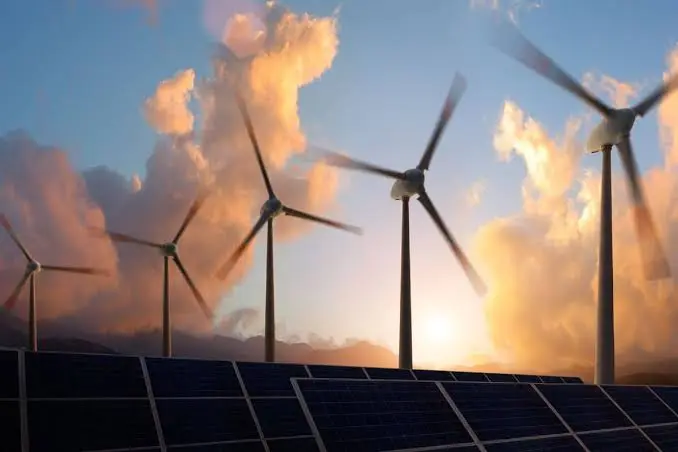
The UAE aims to raise the clean-generation share to 35% by 2031, combining nuclear power with renewable technologies including solar, wind and waste-to-energy. Natural gas remains part of the broader energy mix, providing dispatchable generation that can complement variable renewable output.
Renewable generation capacity rose from 129 megawatts in 2015 to more than 8.2 gigawatts in 2025, reflecting a substantial build-out of non-fossil electricity infrastructure. The clean-generation share includes nuclear energy and should not be mistaken for the share supplied by renewables alone.
Under the UAE Energy Strategy 2050, the government also intends to more than double installed clean-energy capacity to over 28 gigawatts by 2031 and improve energy efficiency. The strategy’s broader investment framework references AED150 billion–AED200 billion by 2031, while Al Mazrouei’s latest remarks identify 2030 as the planned spending horizon.
Grid Protection, Storage and Domestic Supply Chains
Energy infrastructure resilience extends beyond building new generation facilities. Al Mazrouei emphasised coordinated emergency preparedness, business continuity and protection of critical infrastructure against both physical and digital threats.
The investment agenda also places importance on local manufacturing, reliable access to essential equipment and specialised technical skills. These priorities could reduce dependence on vulnerable international supply chains, although the government has not provided a project-by-project allocation of the announced funding range.
Closer coordination between electricity producers, grid operators, technology developers and large industrial consumers will be important as new power projects and increasingly complex networks come online.
AI Growth and Private Investment Shape the Outlook
The energy minister’s comments came during ADIPEC’s energy security discussions, which examined how geopolitical uncertainty, infrastructure vulnerabilities and rising demand affect long-term investment decisions.
For investors and businesses, the proposed spending range signals potential opportunities across power generation, transmission equipment, grid technology, energy storage and related services. Actual opportunities will depend on procurement decisions, regulatory requirements, financing structures and project execution.
The wider economic test will be whether the UAE can expand electricity supply while keeping costs competitive and improving system reliability. Delivering those objectives would help support data-centre growth and industrial diversification alongside the country’s longer-term net-zero ambitions.
Sources: Emirates News Agency / UAE Ministry of Energy and Infrastructure / ADIPEC
Your financial future isn’t something you wait for—it’s something you build.
The real question is: when do you begin?
Move beyond simply staying informed.
Navigate the markets with clarity—track trends through the Serrari Group Market Index, uncover opportunities in the Serrari Marketplace, and build practical knowledge with our Curated Wealth Builder Platform.
Stay connected to what truly matters.
Get daily insights on macro trends and financial movements across Kenya, Africa, and global markets—delivered through the Serrari Newsletter.
Growth opens doors.
Advance your career through professional programs including ACCA, HESI A2, ATI TEAS 7 , HESI EXIT , NCLEX – RN and NCLEX – PN, Financial Literacy!🌟—designed to move you forward with confidence.
See where money is flowing—clearly and in real time.
Track Money Market Funds, Treasury Bills, Treasury Bonds, Green Bonds, and Fixed Deposits, alongside global and African indexes, key economic indicators, and the evolving Crypto and stablecoin landscape—all within Serrari’s Market Index.