South Africa’s economy grew faster than expected in the first quarter of 2026, expanding by 0.5% quarter-on-quarter on a seasonally adjusted basis. The performance marked another modest step forward for Africa’s most industrialised economy, with nine of the ten major industries tracked by the statistics agency recording positive growth.
The data offers a cautiously positive signal after years of weak momentum, power constraints and fragile investor confidence. However, the recovery remains uneven. Fixed investment declined, manufacturing contracted, and economists warned that the full impact of the Iran war and higher energy costs had not yet been captured in the first-quarter numbers.
Key Overview
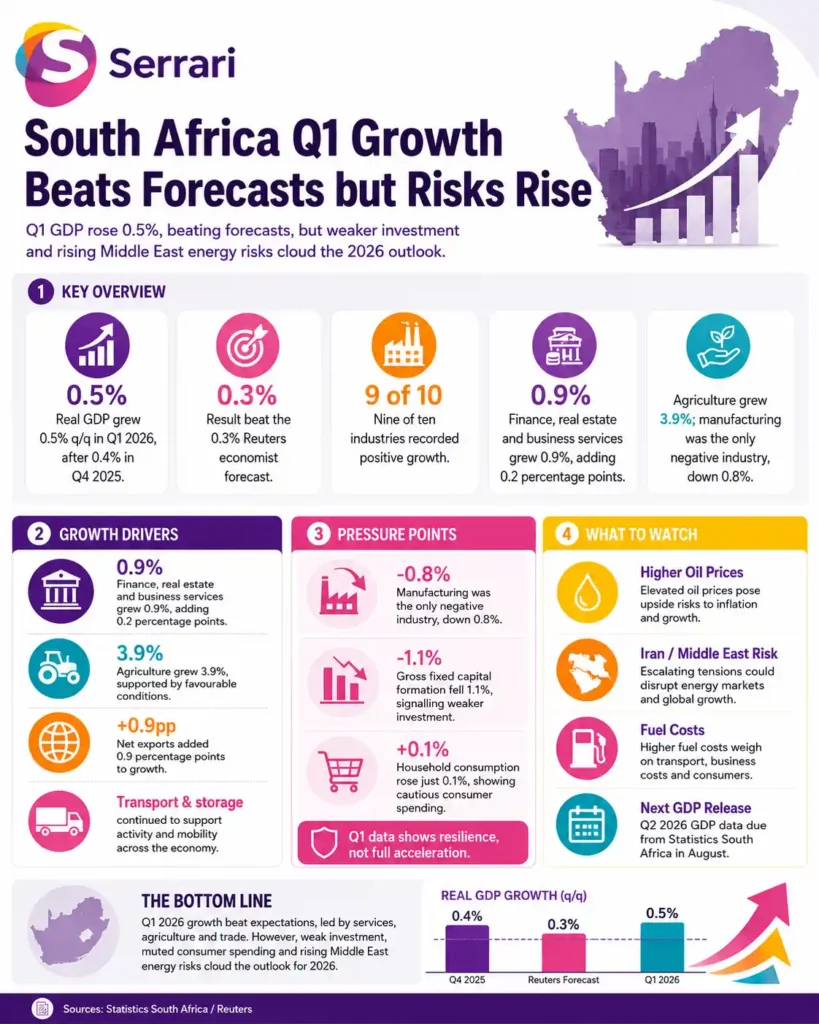
South Africa’s real GDP increased by 0.5% in Q1 2026, after rising 0.4% in Q4 2025.
The result beat a 0.3% forecast from economists polled by Reuters.
Nine out of ten industries recorded positive growth during the quarter.
Finance, real estate and business services made the biggest positive contribution to GDP.
Manufacturing was the only negative contributor, falling by 0.8%.
Gross fixed capital formation declined by 1.1%, raising concerns over investment-led growth.
Middle East tensions and elevated oil prices remain major risks for the next GDP release.
Finance and Agriculture Lift Q1 Output
South Africa’s first-quarter growth was broad-based but still moderate. According to the official GDP release, real GDP increased by 0.5% in the first quarter of 2026, following 0.4% growth in the final quarter of 2025.
The finance, real estate and business services industry was the strongest contributor, growing 0.9% and adding 0.2 percentage points to GDP growth. Agriculture also performed strongly, expanding by 3.9%, supported by higher activity in field crops and horticulture products.
Trade, catering and accommodation grew by 0.7%, while transport, storage and communication also rose by 0.7%. These gains suggest that consumer-facing and logistics-linked sectors remained resilient despite pressure from higher living costs and uncertain global conditions.
The result came in above expectations. Economists had forecast growth of 0.3%, according to a Reuters poll, making the Q1 print a positive surprise for markets.
Context is everything. Stay ahead of shifting trends with today’s market updates, and uncover emerging opportunities using the Serrari Group Market Index and Marketplace. Then, take control of your own financial future by exploring our Money & Life Reset Transformation Blueprint ™ to build stronger habits, create better systems, and design a path toward lasting wealth.
Investment Weakness Clouds the Recovery
Despite the headline growth, the expenditure side of the economy showed signs of strain. Gross fixed capital formation fell by 1.1%, subtracting 0.2 percentage points from growth. The decline followed two quarters of expansion and was driven by weaker spending on machinery and other equipment, residential buildings and other assets.
That drop matters because South Africa needs stronger investment to lift potential growth, improve infrastructure and expand productive capacity. A recovery led mainly by services and net exports may not be enough to deliver the job creation and industrial momentum needed over the medium term.
Manufacturing also remained a weak point. The sector contracted by 0.8%, becoming the only negative industry contributor. The biggest pressure came from petroleum, chemical products, rubber and plastics; basic iron and steel; machinery; and wood, paper and publishing-related divisions.
Household consumption rose only 0.1%, showing that consumers remained cautious. Government consumption increased by 0.6%, while net exports added 0.9 percentage points to expenditure-side growth, helped by a 0.5% rise in exports and a 2.6% decline in imports.
Iran War Risk Yet to Fully Feed Through
The first-quarter numbers largely captured activity before the full economic effects of the Middle East conflict were felt. Reuters reported that Statistics South Africa expected the impact of the Iran war to become clearer in the next GDP release.
That risk is already visible in energy markets. Oil prices recently moved higher after renewed attacks and concerns over flows through the Strait of Hormuz, a key route for global oil and liquefied natural gas trade. Brent crude settled at $94.25 a barrel in early June, according to market reporting.
For South Africa, higher fuel costs can feed into transport, food and production expenses, weakening household purchasing power and adding pressure to business margins. The rand strengthened after the GDP data, helped by the stronger-than-expected growth reading, but analysts warned that higher rates and fuel costs could still limit near-term expansion.
The Q1 data therefore points to resilience, not acceleration. South Africa has managed to keep growing, but sustaining momentum will depend on stronger investment, steadier manufacturing output and how quickly global energy risks ease.
Sources used: Statistics South Africa / Reuters
Your financial future isn’t something you wait for—it’s something you build.
The real question is: when do you begin?
Move beyond simply staying informed.
Navigate the markets with clarity—track trends through the Serrari Group Market Index, uncover opportunities in the Serrari Marketplace, and build practical knowledge with our Curated Wealth Builder Platform.
Stay connected to what truly matters.
Get daily insights on macro trends and financial movements across Kenya, Africa, and global markets—delivered through the Serrari Newsletter.
Growth opens doors.
Advance your career through professional programs including ACCA, HESI A2, ATI TEAS 7 , HESI EXIT , NCLEX – RN and NCLEX – PN, Financial Literacy!🌟—designed to move you forward with confidence.
See where money is flowing—clearly and in real time.
Track Money Market Funds, Treasury Bills, Treasury Bonds, Green Bonds, and Fixed Deposits, alongside global and African indexes, key economic indicators, and the evolving Crypto and stablecoin landscape—all within Serrari’s Market Index.