South Africa bond yields fell sharply on 7 August 2026, producing a broad rally across the country’s fixed-rate government bond market.
The 10-year market proxy fell to approximately 8.38%, around 17 basis points lower on the day and 1.25 percentage points below its level a year earlier.
At the research snapshot used for this article, several individual bonds were also approximately 13 to 15 basis points lower in yield, including the R2035 near 8.44%, R2044 near 9.04% and R2048 around 9.00%.
For existing bondholders, falling yields generally mean rising bond prices and therefore mark-to-market capital gains. New investors face the opposite side of that trade: purchasing the same fixed cash flows at higher prices produces a lower yield.
The rally therefore illustrates one of the most important relationships in fixed income: bond prices and yields move in opposite directions.
Key Overview
- South Africa’s 10-year bond-market proxy fell to approximately 8.38%.
- The daily decline was approximately 17 basis points.
- The 10-year yield was around 1.25 percentage points below its level a year earlier.
- The broader 20- and 30-year market proxies were also approximately 15 basis points lower.
- The R2035 was near 8.435% at the research snapshot.
- The R2048 was near 9.00%.
- Several longer-dated fixed-rate bonds rallied by roughly 13–15 basis points.
- Falling yields generally raise the market value of existing fixed-rate bonds.
- New buyers receive lower yields after prices rise.
- Longer-duration bonds normally experience larger price movements for the same change in yield.
- The rand also strengthened against the dollar during the session.
- Foreign investors therefore face both bond-price and currency movements.
- Intraday yields can still change before the market closes.
South Africa Bond Yields Drop as Government Bonds Rally
South African government bonds rallied sharply on 7 August as yields declined across much of the country’s fixed-rate sovereign curve.
The Trading Economics current ten-year yield page showed the widely followed 10-year market proxy falling to approximately 8.38%, 17 basis points below the previous session.
The decline was not limited to one maturity.
The same market data showed the 20-year yield near 9.00% and the 30-year yield around 8.89%, with both down approximately 15 basis points on the day.
At the research snapshot used for this article, individual fixed-rate government securities also showed substantial gains.
The R2030 was near 7.845%, down around 13 basis points.
The R2035 stood around 8.435%, approximately 14 basis points lower.
The R2037 was near 8.725%, while the R2044 traded around 9.035%.
Further out, the R2048 stood close to 9.00% and the R2053 around 8.92%, with both approximately 14.5 basis points lower.
Together, the moves showed a broad government-bond rally rather than a change confined to one particular maturity.
Falling Yield Means Rising Price
The easiest way to understand the rally is to begin with a fixed coupon.
Imagine an existing government bond pays a fixed amount of interest each year.
If newly available bonds suddenly offer lower market yields, that existing bond’s fixed payments become relatively more attractive.
Investors are willing to pay more for those cash flows.
The bond price rises.
Its yield therefore falls.
The relationship also works in reverse.
If market yields rise, investors can obtain higher returns from newly priced securities. An older fixed-rate bond must generally fall in price until its effective yield becomes competitive.
This is why bond traders often use the words rally and falling yields to describe the same event.
What Is a Basis Point?
Bond-market movements are commonly measured in basis points.
One basis point equals 0.01 percentage points.
Therefore:
- 10 basis points = 0.10 percentage points;
- 15 basis points = 0.15 percentage points;
- 50 basis points = 0.50 percentage points; and
- 100 basis points = 1 percentage point.
If a bond’s yield falls from 9.15% to 9.00%, it has declined by 15 basis points.
That can appear like a small change.
For a long-duration government bond, however, a 15-basis-point yield movement can create a meaningful change in market value.
Existing Investors Benefit Differently
Consider an investor who bought a fixed-rate South African government bond before today’s rally.
The investor’s coupon has not suddenly increased.
The government still owes the same contractual payments.
What changes is the market value of those payments.
If comparable yields fall, another investor may now be willing to pay a higher price to obtain that existing coupon stream.
The original holder therefore records a mark-to-market gain.
That gain only becomes realised if the investor sells the bond.
An investor who continues holding to maturity will still receive the contractual coupon and principal payments, assuming the government meets its obligations.
New Buyers Face Lower Yields
A bond rally benefits an existing holder’s market value but reduces the return available to a new buyer at the higher price.
This is the other side of the price-yield relationship.
Before the rally, an investor might have been able to purchase a particular bond at a yield of 9.15%.
After prices rise, the same bond might offer only 9.00%.
Nothing needs to have changed about the coupon.
The new investor is simply paying more for the same future cash flows.
This makes sharp bond rallies a mixed development for income investors.
Existing holders benefit from capital appreciation.
Investors with new cash to deploy face lower prospective yields.
Long Bonds Usually Move More
Not every bond reacts equally to the same change in market yields.
Duration helps explain the difference.
Duration measures how sensitive a bond’s price is to changes in interest rates or yields.
Longer-maturity bonds generally have greater duration than short-dated securities.
This means a 15-basis-point decline in yield will normally produce a larger percentage price increase in a long-duration bond than in a short-duration bond, all else being equal.
However, investors should not translate today’s 14- or 15-basis-point yield declines directly into equivalent percentage capital gains.
A 15-basis-point yield decline does not mean the bond price increased by 15%.
The actual price change depends on:
- Remaining maturity;
- Coupon;
- Starting yield;
- Modified duration;
- Convexity;
- Accrued interest; and
- Settlement conventions.
South Africa Has a Deep Bond Market
South Africa has one of Africa’s most developed domestic government-bond markets.
The JSE official bond market data page provides market infrastructure for fixed-income trading and data.
The JSE distributes information generated as bond trades occur throughout the trading day, together with end-of-day statistics, pricing and reference data.
It also operates a Bond ETP market that facilitates trading in selected government securities.
This depth makes South African government debt particularly important to:
- Pension funds;
- Insurance companies;
- Bond mutual funds;
- Banks;
- Asset managers;
- Foreign institutional investors; and
- Individual income investors.
Price movements therefore affect a wide range of portfolios.
The Whole Curve Matters
Investors should avoid focusing only on the 10-year benchmark.
South Africa issues government debt across numerous maturities.
At today’s research snapshot:
| Bond | Approximate yield | Daily change |
| R2030 | 7.845% | -13.0bp |
| R2035 | 8.435% | -14.0bp |
| R2037 | 8.725% | -14.0bp |
| R2044 | 9.035% | -14.0bp |
| R2048 | 9.000% | -14.5bp |
| R2053 | 8.920% | -14.5bp |
These figures are intraday research levels and may change before the final market close.
The broad direction is more important than any one exact print.
Shorter, middle and longer portions of the curve all showed lower yields.
That indicates widespread buying interest rather than an isolated pricing change in one bond.
Today’s Move Was Large but Not Isolated
The longer-term comparison also matters.
South Africa’s 10-year yield was around 1.25 percentage points lower than it had been one year earlier.
That represents approximately 125 basis points of yield compression over 12 months.
A bond investor who held sufficiently long-duration government securities through a substantial part of that move could therefore have experienced both:
- Coupon income; and
- Capital appreciation.
However, historical gains do not establish what happens next.
If yields reverse higher, part of the mark-to-market gain can disappear.
Context is everything. Stay ahead of shifting trends with today’s market updates, and uncover emerging opportunities using the Serrari Group Market Index and Marketplace. Then, take control of your own financial future by exploring our Money & Life Reset Transformation Blueprint ™ to build stronger habits, create better systems, and design a path toward lasting wealth.
Global Rates Also Matter
South African government bonds do not trade independently of global markets.
International investors compare yields across countries.
US Treasury yields are especially important because US government debt provides a major global reference point for dollar-based fixed-income investors.
Today’s South African rally coincided with falling developed-market yields after weaker US employment information altered expectations around future monetary policy.
That timing may have supported demand for emerging-market fixed income.
However, the US data should not be presented as the sole cause of South Africa’s bond rally.
Domestic inflation, expectations for the South African Reserve Bank, fiscal conditions, investor positioning and movements in the rand can all influence sovereign yields.
The appropriate interpretation is therefore that the global rate environment formed part of the backdrop rather than providing one definitive explanation.
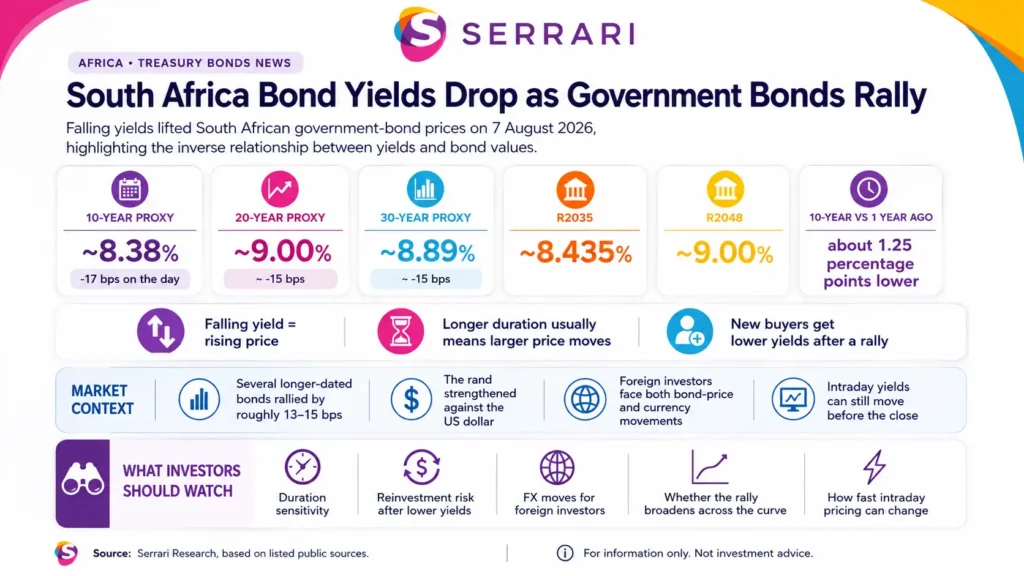
South African government bonds rallied sharply on 7 August 2026 as yields fell across the fixed-rate curve. The R2030 was approximately 13 basis points lower at 7.845%, the R2035 fell about 14 basis points to 8.435%, the R2037 stood near 8.725%, the R2044 around 9.035%, the R2048 approximately 9.00% and the R2053 about 8.92%. The graphic explains the inverse relationship between bond prices and yields: when yields fall, existing fixed-rate bonds generally rise in price, producing mark-to-market gains for existing holders while lowering the yield available to new buyers. It also notes that longer-duration bonds are usually more sensitive to yield changes.
The Rand Adds Another Return Layer
Foreign investors in South African domestic government bonds do not receive only a bond return.
They also face movements in the rand.
At the research snapshot, USD/ZAR was around 16.13, with the rand stronger against the US dollar.
For a dollar-based investor, a stronger rand can increase returns when the value of the South African investment is converted back into dollars.
This means a foreign bondholder can potentially benefit from two movements at the same time:
- The rand bond price rises; and
- The rand strengthens against the dollar.
However, currency exposure works both ways.
If the rand weakens sharply, the currency loss can reduce or completely offset a positive local-currency bond return.
A foreign investor must therefore assess the government bond and the exchange rate together.
Local Investors Do Not Face the Same FX Risk
A South African investor whose income, expenses and portfolio are measured in rand does not face the same direct USD/ZAR translation issue.
For that investor, the more relevant questions may be:
- Nominal yield;
- Inflation;
- Tax;
- Duration;
- Reinvestment risk; and
- Alternative local investments.
This difference explains why the same government bond can produce a different economic experience for a Johannesburg-based pension fund and a dollar-based international asset manager.
Lower Yields Change Reinvestment Choices
Falling yields create another problem for investors whose bonds are approaching maturity.
Reinvestment risk occurs when an investor receives principal or coupon payments but can only reinvest that cash at a lower prevailing rate.
Suppose an investor previously locked in a government bond at 10%.
If comparable new securities later offer 8.5%, the investor’s old bond has become valuable.
But once it matures, the investor may struggle to replace the old 10% income stream.
This is why falling yields can be good for current portfolio valuations but less attractive for investors seeking to deploy fresh cash.
Bond Funds Feel the Rally Quickly
Bond mutual funds and fixed-income unit trusts generally mark their portfolios to market.
When government bond prices rise, the fund’s net asset value may rise as well.
This means investors in bond funds can benefit from falling yields even before the underlying securities mature.
Long-duration funds are normally more sensitive.
A fund holding mainly 15-, 20- and 30-year securities could experience a larger move than a short-duration fund holding mostly near-term bonds.
However, that greater upside also creates greater downside if yields subsequently rise.
Duration therefore amplifies both directions.
Pension Funds May Welcome the Rally
South African pension funds are major fixed-income investors because they have long-term liabilities.
Long-dated government bonds can help match payments expected many years into the future.
A decline in yields raises the market value of existing bond assets.
However, pension funds must also consider what happens to the value of their liabilities when long-term rates fall.
A lower discount rate can increase the present value of future obligations.
For a pension fund, a bond-market rally is therefore more complex than simply saying that higher bond prices are always positive.
Asset and liability duration need to be considered together.
Insurers Face a Similar Calculation
Insurance companies also hold significant fixed-income portfolios.
Premiums received today may be invested until future claims are paid.
A bond rally increases the market value of some existing assets.
But lower yields also reduce the rate at which future premiums and maturing investments can be reinvested.
For life insurers with long-term obligations, the duration of assets relative to liabilities is particularly important.
The same 15-basis-point yield move can therefore have different consequences for a bond trader, money manager, pension fund and insurance company.
Government Borrowing Costs Can Eventually Benefit
Lower secondary-market yields can also matter to the National Treasury.
When investors demand lower yields for government securities, future borrowing may become cheaper if those improved conditions carry into new primary-market auctions.
The government does not automatically save interest simply because an existing bond rallies in the secondary market.
The coupon on existing fixed-rate debt does not change.
The benefit occurs when the government issues or refinances debt at lower prevailing rates.
The National Treasury fixed-rate auction calendar provides the schedule through which South Africa continues issuing domestic fixed-rate debt.
A sustained reduction in government yields can therefore gradually reduce marginal borrowing costs.
The Treasury Still Faces Fiscal Risk
A rally does not remove South Africa’s sovereign-credit or fiscal risks.
Government bond investors still need to monitor:
- Budget deficits;
- Debt-service costs;
- Government debt levels;
- Economic growth;
- Tax revenue;
- State-owned enterprise support;
- Inflation;
- Currency movements; and
- Political policy decisions.
If investors become more concerned about the government’s ability to manage its finances, they may demand higher yields again.
Today’s rally changes the market price of risk.
It does not eliminate the risk itself.
Liquidity Also Differs Across Bonds
South Africa has a relatively deep bond market, but every government security does not trade with identical liquidity.
Some benchmark lines attract substantially more activity than others.
Liquidity affects how easily investors can transact without moving the market price.
A highly liquid benchmark can normally absorb larger trades.
A less active bond may have:
- Wider bid-offer spreads;
- Fewer buyers and sellers;
- Less frequent trading; and
- Larger price moves around transactions.
Investors should therefore avoid assuming that two bonds with similar maturities can always be traded equally easily.
The JSE bond market data products include both intraday and end-of-day market information used to evaluate trading and pricing conditions.
Coupon Is Not the Same as Yield
Another important distinction is between a bond’s coupon and its yield.
The coupon is the contractual interest payment established when the bond is issued.
Its yield changes as the market price changes.
Imagine a bond has a fixed coupon of 9%.
If investors become willing to pay more than its original face value, its effective yield can fall below 9%.
If its market price falls substantially, the yield can rise above the coupon.
Therefore today’s declining South African yields do not mean National Treasury suddenly reduced the coupons on all outstanding securities.
The cash flows stayed largely fixed.
The market prices changed.
Capital Gain Depends on Duration
A useful approximation connects duration with price changes.
Very broadly:
Approximate bond-price change ≈ -Duration × Change in yield
Suppose a bond has modified duration of eight years.
If its yield falls by 0.15 percentage points, or 0.0015 in decimal terms:
Approximate price change:
-8 × -0.0015 = +1.2%
This is only an approximation.
Convexity, coupon dates and the size of the yield move affect the actual result.
But it shows why a 15-basis-point rally can create a much larger percentage price change than the yield movement itself.
A longer-duration bond could gain even more.
Why Today’s Rally Matters to Income Investors
For an investor considering South African government bonds today, the rally creates a trade-off.
A lower yield can be interpreted as the market assigning a lower required return to the bond.
That produces an immediate benefit for existing holders.
But someone purchasing after the rally accepts a lower prospective yield.
The investor must therefore decide whether:
- Current yields remain attractive;
- Rates are likely to fall further;
- Inflation will moderate;
- The rand will remain supportive;
- Fiscal conditions will improve; and
- The chosen duration fits the investment horizon.
There is no universal answer.
The same yield may be attractive for one portfolio and unsuitable for another.
What Investors Should Monitor
The first variable is whether today’s rally continues.
One session does not establish a long-term trend.
Investors should monitor whether the R2035, R2048 and other benchmarks hold their lower yields over subsequent sessions.
Other important indicators include:
- South African inflation;
- SARB policy expectations;
- US Treasury yields;
- Federal Reserve expectations;
- USD/ZAR;
- National Treasury borrowing;
- Government auction demand;
- Fiscal deficits;
- Foreign bond flows; and
- Oil and commodity prices.
The SARB monetary operations and auction data and National Treasury auction programme provide official reference points for domestic monetary and sovereign-funding conditions.
Investors should also distinguish between intraday pricing and closing levels.
Today’s individual R-bond yields may continue moving before the final market marks are published.
Conclusion
South African government bonds staged a broad rally on 7 August 2026, with yields falling sharply across the fixed-rate curve.
The 10-year market proxy declined to approximately 8.38%, around 17 basis points lower on the session and 1.25 percentage points below its level a year earlier.
Several individual longer-dated government bonds were approximately 13 to 15 basis points lower at the research snapshot.
For existing investors, the move demonstrates one of the central mechanics of bond investing:
Yield down → price up.
Existing bondholders benefit because their fixed cash flows become more valuable when prevailing yields decline.
New investors face the reverse effect. They must pay more for those cash flows and therefore receive a lower yield.
Long-duration investors generally experience the largest price changes, while foreign investors must also consider movements in the rand.
The rally may have been supported by a combination of global rate movements, domestic expectations and investor positioning.
However, one day’s move does not remove South Africa’s fiscal, inflation or currency risks.
The most important lesson for investors is therefore not simply that government bonds rallied.
It is that the same fall in yields creates winners and trade-offs at the same time: higher market values for existing holders, but lower future income opportunities for new money.
FAQs
1. Why do bond prices rise when yields fall?
A bond’s coupon and maturity payments are usually fixed. When prevailing market yields decline, those existing fixed payments become relatively more attractive. Investors are willing to pay a higher price to receive them. Because the investor now pays more for the same future cash flows, the bond’s effective yield falls. This creates the inverse relationship between bond prices and yields.
2. Does a 15-basis-point yield fall mean a 15% gain?
No. A 15-basis-point decline means the yield fell by 0.15 percentage points. The associated bond-price gain depends on the bond’s duration, coupon, maturity, starting yield and convexity. A long-duration bond could record a meaningful percentage gain from a 15-basis-point move, but the gain cannot be calculated accurately from the yield change alone.
3. Why are falling yields bad for new investors?
Falling yields are not necessarily bad, but they mean a new investor is purchasing the bond at a higher price relative to its future fixed payments. The prospective yield is therefore lower than it was before the rally. Existing investors benefit from higher market prices, while investors with new cash face lower reinvestment opportunities.
4. How does the rand affect foreign bond investors?
A foreign investor normally experiences both the return on the rand-denominated bond and the movement in the rand against their home currency. If the bond price rises and the rand strengthens, the two effects can reinforce each other. If the rand weakens sharply, currency losses can offset some or all of the local bond gain. Foreign investors therefore need to monitor both yields and exchange rates.
Sources: Trading Economics current ten-year yield page, JSE official bond market data page, JSE bond market data products, Rbond South African government yield curve, National Treasury fixed-rate auction calendar and SARB monetary operations and auction data.
Your financial future isn’t something you wait for—it’s something you build.
The real question is: when do you begin?
Move beyond simply staying informed.
Navigate the markets with clarity—track trends through the Serrari Group Market Index, uncover opportunities in the Serrari Marketplace, and build practical knowledge with our Curated Wealth Builder Platform.
Stay connected to what truly matters.
Get daily insights on macro trends and financial movements across Kenya, Africa, and global markets—delivered through the Serrari Newsletter.
Growth opens doors.
Advance your career through professional programs including ACCA, HESI A2, ATI TEAS 7 , HESI EXIT , NCLEX – RN and NCLEX – PN, Financial Literacy!🌟—designed to move you forward with confidence.
See where money is flowing—clearly and in real time.
Track Money Market Funds, Treasury Bills, Treasury Bonds, Green Bonds, and Fixed Deposits, alongside global and African indexes, key economic indicators, and the evolving Crypto and stablecoin landscape—all within Serrari’s Market Index