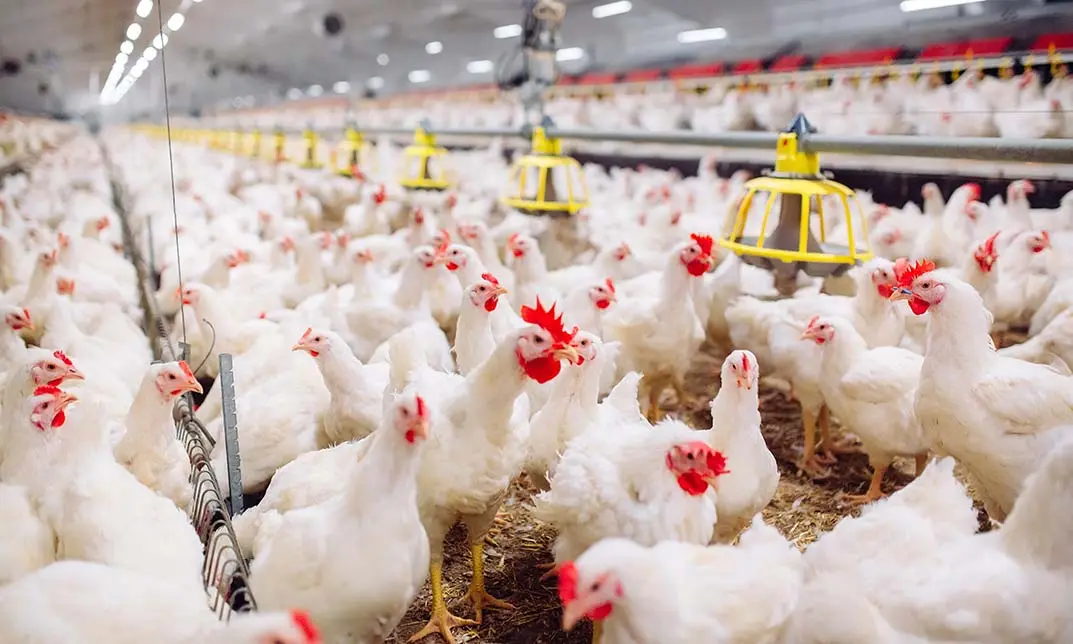
South Africa’s poultry sector has undergone a remarkable turnaround since the launch of the Poultry Masterplan in 2019, with industry investment exceeding R2.1 billion (about US$126 million) and weekly production climbing 26%. The progress was celebrated at the first Economic Oversight Committee meeting between the Department of Trade, Industry and Competition, the Department of Agriculture, and key industry stakeholders. Once battered by a flood of cheap imported chicken, the sector is now the country’s largest agricultural industry, valued at R74 billion and supporting over 110,000 jobs. A 2025 competitiveness benchmark by Wageningen University confirmed that South Africa now produces chicken more cheaply than both the European Union and the United States, trailing only Brazil globally. However, the recovery has not come easily — producers have had to navigate the devastating 2023 avian influenza outbreak, persistent infrastructure failures, and rising input costs.
Key Overview
- Total Investment (2019–2025): Over R2.1 billion (approximately US$126 million)
- Production Growth: 26% increase — from 19.7 million to 23 million birds slaughtered per week
- Sector Valuation: R74 billion, South Africa’s largest agricultural industry
- Jobs Supported: More than 110,000 across the value chain
- Transformation Projects: 32 large-scale operations with a 100% reported success rate
- Export Growth: 9% increase in aggregate chicken meat exports (2019–2025)
- Global Ranking: Second most cost-competitive poultry producer, behind only Brazil
- Agricultural Contribution: 19.1% of total agricultural gross value; 44.4% of animal products gross value
South Africa’s poultry industry has staged one of the most significant agricultural recoveries in the country’s recent history. What was once a sector in sustained decline — battered by a surge in cheap imported chicken products throughout the decade preceding 2019 — has been transformed into a globally competitive powerhouse under the Poultry Masterplan.
The turnaround was the focus of the first Economic Oversight Committee (EOC) meeting held between the Department of Trade, Industry and Competition (DTIC), the Department of Agriculture, and industry stakeholders. The gathering both reviewed progress and celebrated the milestones achieved since the plan’s 2019 launch, painting a picture of a sector that has defied difficult conditions to deliver real economic gains.
Billions Invested, Production Surging
The numbers tell a compelling story. Between 2019 and 2025, the industry channelled more than R2.1 billion in investment into expanded capacity and improved operations. Over the same period, weekly production rose 26%, climbing from 19.7 million to 23 million birds slaughtered per week — a reflection of improved efficiency and the tangible impact of coordinated public-private partnership.
A key highlight at the EOC meeting was the recognition of 32 project leaders who established large-scale poultry operations, each with an average investment of around R45 million. Among these, the KC Hatchery stood out with a single investment exceeding R135 million. A further 20 broiler contract farmers were acknowledged, alongside the development of three new hatcheries and approximately eight egg-laying facilities. Collectively, these 32 projects reported a 100% success rate with total investment surpassing R1 billion, cementing the sector’s standing as a leader within South African agriculture.
Today, the poultry industry is the country’s largest agricultural sector, valued at R74 billion and supporting more than 110,000 jobs across the full value chain. According to industry data, the sector accounts for 19.1% of total agricultural gross value and 44.4% of animal products gross value. Chicken meat exports — including fresh, frozen, whole, portioned, and offal products — recorded 9% growth between 2019 and 2025, with the USDA forecasting further export increases to around 65,000 metric tons in 2026.
The Dumping Problem and Anti-Dumping Response
The Masterplan’s origins lie in the crisis that preceded it. For years, local producers were undercut by dumped chicken imports from multiple countries. Investigations by the International Trade Administration Commission (ITAC) confirmed that nine countries were dumping poultry products into South Africa, causing material harm to the local industry and threatening thousands of jobs.
The government responded with a series of trade protection measures. In 2020, tariffs were raised to 62% on frozen bone-in chicken portions and 42% on frozen boneless portions. Anti-dumping duties were imposed on imports from Germany, the Netherlands, and the United Kingdom as early as 2015, withprovisional duties later extended to Brazil, Denmark, Ireland, Poland, and Spain in late 2021. In 2024, ITAC recommendedmaintaining anti-dumping duties on US chicken imports after concluding that their removal would likely lead to renewed dumping and further injury to South African producers.
These trade defences have been credited by industry leaders as a vital component of the sector’s recovery, allowing local producers the space to invest and grow without being undercut by unfairly priced imports. However, recent data cited by the FairPlay Movement has noted that imports of bone-in chicken portions increased sharply in early 2026 compared to the same period the previous year, suggesting the import challenge has not been entirely resolved.
Context is everything. While you follow today’s updates, use the Serrari Group Market Index and Marketplace to spot emerging shifts. Need to sharpen your edge? Our Wealth Builder Platform turns these insights into a professional-grade strategy.
Surviving the 2023 Avian Influenza Crisis
The industry’s growth is all the more striking given the devastating blow dealt by the 2023 outbreak of Highly Pathogenic Avian Influenza (HPAI). Two separate virus strains — H5N1 and H7N6 — swept through commercial flocks across the country, with the H7N6 variant alone resulting in the loss of approximately 6.82 million birds, representing about 20% of the national egg-laying flock and nearly 30% of the broiler breeder flock.
Overall, the 2023 outbreaks directly impacted close to 13.8 million commercial birds across more than 100 commercial premises, with Gauteng province bearing the worst of it. The South African Poultry Association estimated that 25% of the country’s breeding chickens were affected. The USDA has since noted that the industry is on a recovery trajectory, with chicken meat production forecast to reach 1.68 million tons in 2026, supported by falling feed costs and rebuilt flocks.
Infrastructure Headwinds Persist
While the production figures are encouraging, the industry continues to operate under significant structural constraints. Stakeholders at the EOC meeting pointed to persistent challenges including unreliable electricity supply, poor road networks, port inefficiencies, and water shortages. Municipal service delivery failures have further complicated operations for producers, particularly those in rural areas.
Rising input costs also remain a pressure point. Feed and day-old chicks together account for just over 80% of total production costs, and although the nominal price of feed rations in 2024 was 26% higher than in 2015, the feed-related cost per kilogram of chicken produced rose by only 8%, thanks largely to improved conversion efficiency.
A Global Competitiveness Success Story
Perhaps the most significant validation of the Masterplan’s impact comes from beyond South Africa’s borders. The Bureau for Food and Agricultural Policy’s (BFAP) 2025 Competitiveness Benchmark Report, produced in collaboration with Wageningen University in the Netherlands, found that South Africa has become the second most cost-competitive poultry producer in the world. For over 13 years, the country has produced chicken at a lower cost than the European Union, and it has now surpassed the United States in cost efficiency as well. Only Brazil currently produces chicken at a lower cost.
South Africa’s technical efficiency is equally impressive. The country boasts the lowest feed conversion ratio globally, averaging around 1.4 kg of feed per 1 kg of meat — compared to 1.55 kg in the Netherlands and Germany, 1.69 kg in the US, and 1.7 kg in Brazil. This means South African producers convert feed into meat more efficiently than any of their major international competitors.
Looking Ahead
The mood within the industry is one of cautious optimism. “The poultry industry is no longer in distress. It is a globally competitive, growing sector that continues to deliver affordable protein to South African consumers,” said Izaak Breitenbach, CEO of the Broiler Organisation at the South African Poultry Association.
As the Masterplan enters its second phase, with a renewed focus on reducing imports and expanding exports, the industry is pursuing access to high-value markets including the European Union, the United Kingdom, and Saudi Arabia. EU authorities inspected South African facilities in May 2025, though their report is still awaited. A shortage of state veterinarians remains a bottleneck for export certification — a constraint identified in Phase 1 of the Masterplan that has yet to be fully addressed.
Still, the trajectory is clear. A sector that was once haemorrhaging investment and market share has rebuilt itself into a globally competitive industry generating billions in economic value. Whether South Africa can now capitalise on export opportunities will determine whether this recovery story becomes a true growth story.
Sources: Poultry World / Business Report / Farmers Review Africa / Agribook Digital / IOL / Farmer’s Weekly / Moneyweb / WATTPoultry / The Poultry Site / Wiley Online Library / Freight News / Zootecnica International / African News Agency / CAJ News Africa / African Farming / USDA FAS
Your financial future isn’t something you wait for—it’s something you build.
The real question is: when do you begin?
Move beyond simply staying informed.
Navigate the markets with clarity—track trends through the Serrari Group Market Index, uncover opportunities in the Serrari Marketplace, and build practical knowledge with our Curated Wealth Builder Platform.
Stay connected to what truly matters.
Get daily insights on macro trends and financial movements across Kenya, Africa, and global markets—delivered through the Serrari Newsletter.
Growth opens doors.
Advance your career through professional programs including ACCA, HESI A2, ATI TEAS 7 , HESI EXIT , NCLEX – RN and NCLEX – PN, Financial Literacy!🌟—designed to move you forward with confidence.
See where money is flowing—clearly and in real time.
Track Money Market Funds, Treasury Bills, Treasury Bonds, Green Bonds, and Fixed Deposits, alongside global and African indexes, key economic indicators, and the evolving Crypto and stablecoin landscape—all within Serrari’s Market Index.