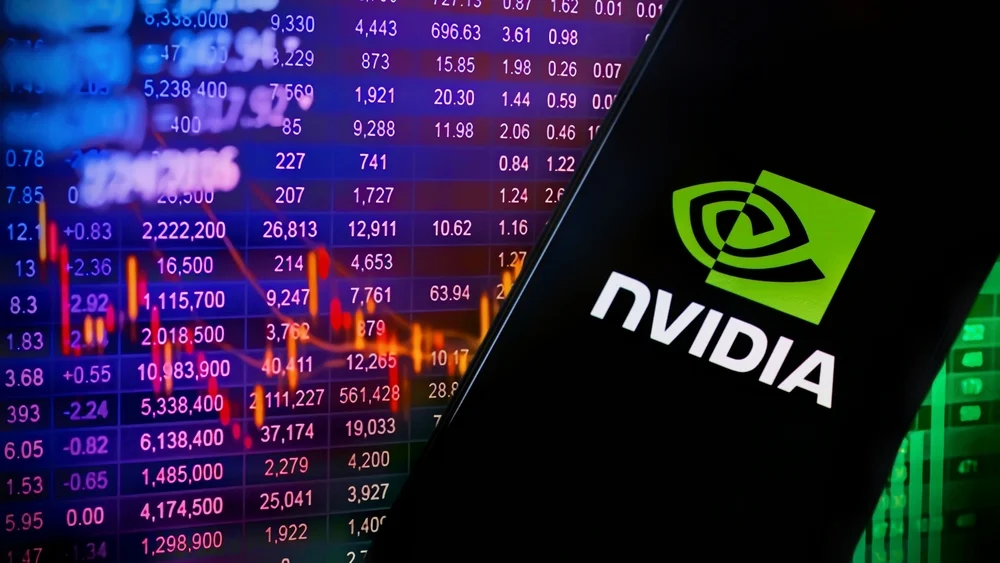
Nvidia delivered another record-breaking quarter, reporting first-quarter fiscal 2027 revenue of $81.6 billion — an 85% jump year-on-year — driven by insatiable demand for its AI data centre chips. Net income more than tripled to $58.3 billion, and the company issued bullish guidance of $91 billion for the next quarter. Yet the stock slipped in after-hours trading, a sign that even extraordinary results may no longer be enough to excite investors who have come to expect outperformance from the world’s most valuable company. Adding to the mixed sentiment, CEO Jensen Huang openly conceded that Nvidia has been effectively pushed out of China’s AI chip market by Huawei, while competition from hyperscaler-designed custom chips continues to intensify.
Key Overview
- Q1 Revenue: $81.6 billion (up 85% year-on-year, 20% quarter-on-quarter)
- Net Income: $58.3 billion (more than tripled from $18.8 billion a year ago)
- Data Centre Revenue: $75.2 billion (up 92% year-on-year)
- Q2 Guidance: $91 billion in projected revenue
- Shareholder Returns: $80 billion share buyback programme; quarterly dividend raised from $0.01 to $0.25 per share
- China Market: Nvidia concedes China AI chip market to Huawei amid US export restrictions
- Market Valuation: Approximately $5.3 trillion, making Nvidia the world’s most valuable public company
Nvidia just posted the kind of financial results most companies can only dream of — and investors barely flinched. The chipmaker reported first-quarter fiscal 2027 revenue of $81.6 billion, an 85% surge from the same period last year and a 20% sequential increase. Net income came in at $58.3 billion, more than tripling from $18.8 billion a year earlier. Earnings per share reached $2.39 on a GAAP basis, comfortably beating Wall Street estimates of $1.78. By any conventional measure, it was a blowout quarter.
Yet shares fell roughly 1.6% in after-hours trading, continuing a pattern that has emerged over Nvidia’s last several earnings reports. The company has beaten expectations in 18 of its last 20 quarters, yet the stock has declined after each of the three most recent results. The message from the market is clear: for a company that now accounts for roughly 8% of the S&P 500, simply delivering stellar numbers is no longer sufficient to drive the stock higher.
The Data Centre Engine Keeps Roaring
The overwhelming majority of Nvidia’s revenue now comes from a single source: its data centre business. That segment generated $75.2 billion in Q1 revenue, up 92% year-on-year and up 21% from the prior quarter. Data centre products now account for approximately 90% of Nvidia’s total sales, a dramatic shift from just a few years ago when gaming was the company’s flagship segment.
The growth was fuelled by the ongoing ramp of Nvidia’s Blackwell GPU architecture, which has become the workhorse of large-scale AI training and inference workloads. Hyperscaler revenue, from customers including Amazon, Microsoft, Google, and Meta, remained at approximately 50% of data centre sales, while the remaining half came from a diversifying base of AI cloud providers, enterprise buyers, and sovereign AI projects.
CEO Jensen Huang framed the demand in dramatic terms during an earnings call with analysts. “Demand has gone parabolic,” Huang said. “The reason is simple: the era of agentic AI is here.” The company forecasts that global spending on AI infrastructure could reach between $3 trillion and $4 trillion annually by the end of this decade — a staggering figure that underscores the scale of the opportunity Nvidia is chasing.
Looking Ahead: Vera Rubin and a $91 Billion Quarter
Nvidia is not standing still. The company guided second-quarter revenue to $91 billion, well above what many analysts had anticipated. Meanwhile, its next-generation chip platform — Vera Rubin — is already in full production ahead of schedule, with samples shipped to customers. The platform, first unveiled at CES 2026, consists of six codesigned chips including the Vera CPU and Rubin GPU and claims to deliver five times the inference performance and 3.5 times the training performance of its Blackwell predecessor.
Nvidia’s CFO Colette Kress said during the earnings call that the company’s new Vera CPU opens a “$200 billion” addressable market, with every major hyperscaler and system maker partnering to deploy it. AWS, Google Cloud, Microsoft Azure, and Oracle Cloud Infrastructure are among the first cloud providers expected to offer Vera Rubin-based instances later in 2026.
To sweeten the picture for shareholders, Nvidia announced an $80 billion share buyback programme and raised its quarterly dividend from one cent per share to 25 cents — a 25-fold increase that signals management’s confidence in the company’s cash flow trajectory.
Context is everything. While you follow today’s updates, use the Serrari Group Market Index and Marketplace to spot emerging shifts. Need to sharpen your edge? Our Wealth Builder Platform turns these insights into a professional-grade strategy.
Why Investors Aren’t Celebrating
Despite all the good news, market enthusiasm has cooled. Ruth Foxe-Blader, managing partner at US venture capital firm Citrine Venture Partners, attributed the reaction to the “law of large numbers.” At a market capitalisation of around $5.3 trillion, Nvidia needs enormous absolute growth just to move the needle. “Unless there’s a belief in this continued parabolic growth it’s difficult for investors to get super excited,” she told the BBC.
Victoria Scholar, head of investment at interactive investor, echoed that view, noting that investors had already “bought the rumour, sold the fact” as the stock rallied ahead of earnings. She also highlighted growing concerns about hyperscalers developing their own custom AI chips, which could gradually erode Nvidia’s dominance. Google’s TPU v6, Amazon’s Trainium, and Meta’s MTIA processors are all scaling rapidly inside their respective data centres, and the share of custom ASICs in AI servers is expected to rise from about 21% in 2025 to nearly 28% in 2026, according to TrendForce, while the GPU share is projected to contract.
Meanwhile, AMD continues to chip away at the market with its MI300 series accelerators, and companies like Broadcom are helping hyperscalers design custom silicon. The big four hyperscalers alone are projected to spend roughly $710 billion on capital expenditure in 2026, a massive sum that sustains Nvidia’s order book even as these same customers build alternatives.
The China Concession
Perhaps the most striking development from the earnings call was Huang’s candid admission about China. Speaking to CNBC, the CEO said Nvidia has “largely conceded” China’s AI chip market to Huawei, after escalating US export controls effectively shut the company out. China once accounted for at least one-fifth of Nvidia’s data centre revenue, making it a strategically vital market.
Nvidia confirmed that no data centre chip shipments to China occurred during Q1, compared with $4.6 billion in the same quarter a year earlier. Huang told investors to “expect nothing” regarding near-term approvals, though he expressed a desire to return if conditions improve. Huang was a last-minute addition to President Donald Trump’s recent official trip to Beijing, though it remains unclear whether semiconductor trade was part of the discussions.
The loss of China is significant but, as several analysts pointed out, not fatal. Alvin Nguyen, senior analyst at Forrester, argued that global AI demand outside China is more than enough to sustain Nvidia’s growth trajectory. The company’s ability to post record results while effectively writing off one-fifth of its previous data centre addressable market is a testament to just how broad the current AI spending wave has become.
The Bottom Line
Nvidia finds itself in a peculiar position: delivering historically exceptional financial performance that the market has largely priced in. The company remains the undisputed leader in AI infrastructure, with a product roadmap that stretches years ahead of its nearest competitors. But at a $5.3 trillion valuation, the burden of proof has shifted. Investors are no longer asking whether Nvidia can grow — they’re asking whether it can grow fast enough to justify its position as the world’s most valuable company, even as China slips away and hyperscalers build rival silicon.
For now, the numbers suggest it can. Whether that remains the case as the competitive landscape evolves will be the defining question of Nvidia’s next chapter.
Sources: SEC.gov / Kiplinger / CNBC / Benzinga / Seeking Alpha / Asia Business Outlook / NewsBytes / Tekedia / Crypto Briefing / Data Center Dynamics / Tom’s Hardware / Nvidia Newsroom / The Motley Fool / 24/7 Wall St. / Financial Content / Intellectia / Futurum Group
Your financial future isn’t something you wait for—it’s something you build.
The real question is: when do you begin?
Move beyond simply staying informed.
Navigate the markets with clarity—track trends through the Serrari Group Market Index, uncover opportunities in the Serrari Marketplace, and build practical knowledge with our Curated Wealth Builder Platform.
Stay connected to what truly matters.
Get daily insights on macro trends and financial movements across Kenya, Africa, and global markets—delivered through the Serrari Newsletter.
Growth opens doors.
Advance your career through professional programs including ACCA, HESI A2, ATI TEAS 7 , HESI EXIT , NCLEX – RN and NCLEX – PN, Financial Literacy!🌟—designed to move you forward with confidence.
See where money is flowing—clearly and in real time.
Track Money Market Funds, Treasury Bills, Treasury Bonds, Green Bonds, and Fixed Deposits, alongside global and African indexes, key economic indicators, and the evolving Crypto and stablecoin landscape—all within Serrari’s Market Index.