

















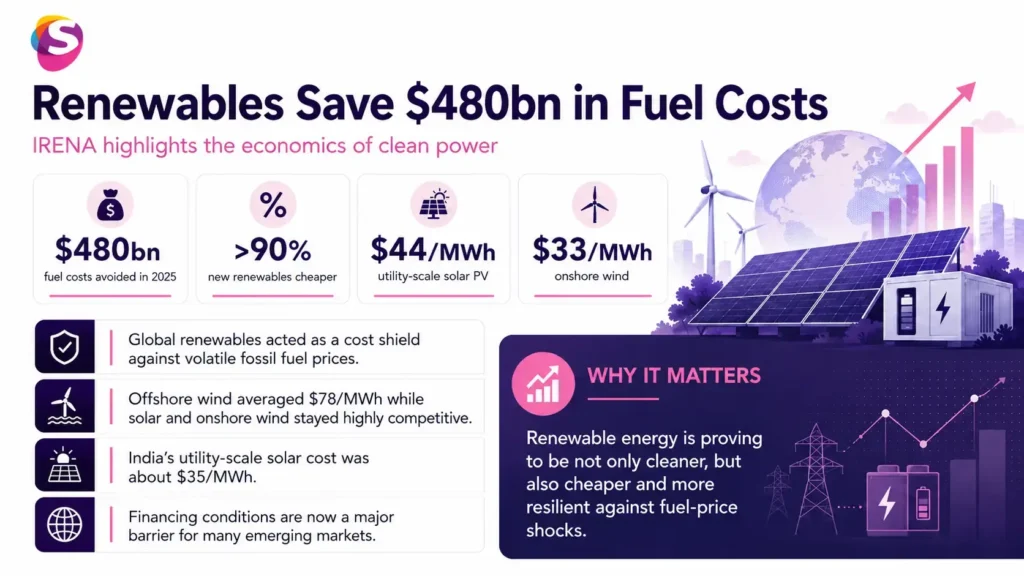
Renewable energy saved an estimated $480 billion in fossil fuel costs in 2025, according to the latest cost analysis from the International Renewable Energy Agency. The finding shows that renewables are no longer only an emissions-reduction tool: they are increasingly acting as a financial hedge against volatile coal, gas and oil markets.
The same report found that more than 90% of newly commissioned utility-scale renewable capacity generated electricity more cheaply than the lowest-cost new fossil-fuel alternative. Solar photovoltaic costs held at $44 per megawatt-hour globally, while onshore wind fell to $33/MWh and offshore wind to $78/MWh.
Key Overview
- Renewables avoided about $480 billion in fossil fuel costs globally in 2025.
- More than 90% of new utility-scale renewable capacity was cheaper than new fossil-fuel alternatives.
- Global solar PV costs held at $44/MWh, onshore wind fell to $33/MWh and offshore wind to $78/MWh.
- India recorded one of the world’s lowest utility-scale solar costs at $35/MWh.
- Financing conditions, rather than technology costs alone, are becoming the biggest barrier in emerging markets.
Renewables Widen Their Cost Advantage
The economics of renewable power remained strong in 2025 even as the pace of cost declines began to stabilise. According to IRENA’s Renewable Power Generation Costs in 2025, more than 90% of newly commissioned utility-scale renewable capacity delivered electricity below the cost of the cheapest newly built fossil-fuel alternative.
Solar PV remained unchanged from 2024 at a global weighted average of $44/MWh. Onshore wind improved further to $33/MWh, while offshore wind declined to $78/MWh.
The long-term shift is even more pronounced. Since 2010, solar PV costs have fallen by 89%, onshore wind by 71% and offshore wind by 63%. IRENA says renewables are now the cheapest source of new electricity in most markets.
At the same time, the economics of new gas-fired power worsened. A shortage of gas turbines roughly doubled capital expenditure for new combined-cycle plants in the United States to about $2,400 per kilowatt. In high-gas-cost markets such as Italy, Germany and Japan, new gas-fired electricity costs moved toward $100/MWh.
$480 Billion in Avoided Fuel Costs
The biggest economic finding in the report is the scale of avoided fossil-fuel expenditure. IRENA estimates that the global use of renewables saved about $480 billion in fossil fuel costs and avoided 8.4 gigatonnes of carbon dioxide emissions in 2025.
That saving came from the wider renewable fleet already operating around the world, not only projects completed during 2025. Because wind, solar and other renewable technologies do not require ongoing fuel purchases once operating, their financial value rises when coal and gas prices become more volatile.
Across 20 major economies representing roughly four-fifths of global renewable electricity generation, renewable power avoided an estimated $377 billion in fossil-fuel purchases. China accounted for $177 billion of those savings, followed by the United States at $35 billion and Brazil at $32 billion. India and Germany each avoided about $18 billion, while Japan saved roughly $15 billion.
The same resilience was visible in Southeast Asia. Existing renewable capacity in Indonesia, Thailand and the Philippines displaced about $5.7 billion in coal and gas purchases during 2025. IRENA estimated that the value of those avoided purchases would have risen to $6.5 billion at the higher fuel prices seen during the 2026 Middle East energy crisis.
Context is everything. Stay ahead of shifting trends with today’s market updates, and uncover emerging opportunities using the Serrari Group Market Index and Marketplace. Then, take control of your own financial future by exploring our Money & Life Reset Transformation Blueprint ™ to build stronger habits, create better systems, and design a path toward lasting wealth.
India Strengthens Its Low-Cost Position
India emerged as one of the strongest examples of how lower-cost renewable power can reduce exposure to imported fuels. IRENA estimated that the country avoided about $18 billion in fossil-fuel costs during 2025.
The country also recorded one of the lowest utility-scale solar costs among major markets. IRENA placed India’s average solar PV levelised cost of electricity at about $35/MWh, compared with a global average of $44/MWh.
The report makes clear that the next stage of cost reduction will depend less on equipment prices alone and more on financing, grids and system integration.
Financing Is Becoming the Main Divide
Technology costs are no longer the only factor separating cheap renewable markets from expensive ones. IRENA’s cost-of-capital model found that country-level macroeconomic conditions such as sovereign risk, inflation and interest rates explain about 56% of the variation in financing costs.
Technology itself accounts for about 24%.
That means the same solar or wind project can be much more expensive in a high-risk emerging market than in a mature economy, even when the equipment is identical. For many developing countries, the cost of capital is becoming the binding constraint.
The report warns that supply-chain conditions could also create short-term pressure. Clean-technology manufacturing investment more than halved between its 2023 peak and the end of 2025, while commodity prices, industrial consolidation and policy changes could push some project costs higher during 2026.
The Long-Term Cost Trend Remains Intact
Despite those headwinds, IRENA still expects renewable technology costs to keep falling over the next decade, although more slowly than before.
Installed costs are projected to decline by about 40% for solar PV and 20% for onshore wind through 2035. Battery economics are also improving rapidly. The installed cost of four-hour utility-scale batteries fell by almost 30% in 2025 to around $140 per kilowatt-hour, about 95% below 2010 levels.
The 2026 energy-security shock linked to the Strait of Hormuz reinforced the risks of dependence on fuel imports and global shipping routes.
For governments, the policy challenge is now clear: cheaper generation technology must be matched by affordable finance, stronger grids, storage and lower investment risk. Without those supporting systems, some of the countries that stand to benefit most from low-cost renewable power may remain unable to deploy it at scale.
Sources: International Renewable Energy Agency / Reuters
Your financial future isn’t something you wait for—it’s something you build.
The real question is: when do you begin?
Move beyond simply staying informed.
Navigate the markets with clarity—track trends through the Serrari Group Market Index, uncover opportunities in the Serrari Marketplace, and build practical knowledge with our Curated Wealth Builder Platform.
Stay connected to what truly matters.
Get daily insights on macro trends and financial movements across Kenya, Africa, and global markets—delivered through the Serrari Newsletter.
Growth opens doors.
Advance your career through professional programs including ACCA, HESI A2, ATI TEAS 7 , HESI EXIT , NCLEX – RN and NCLEX – PN, Financial Literacy!🌟—designed to move you forward with confidence.
See where money is flowing—clearly and in real time.
Track Money Market Funds, Treasury Bills, Treasury Bonds, Green Bonds, and Fixed Deposits, alongside global and African indexes, key economic indicators, and the evolving Crypto and stablecoin landscape—all within Serrari’s Market Index.