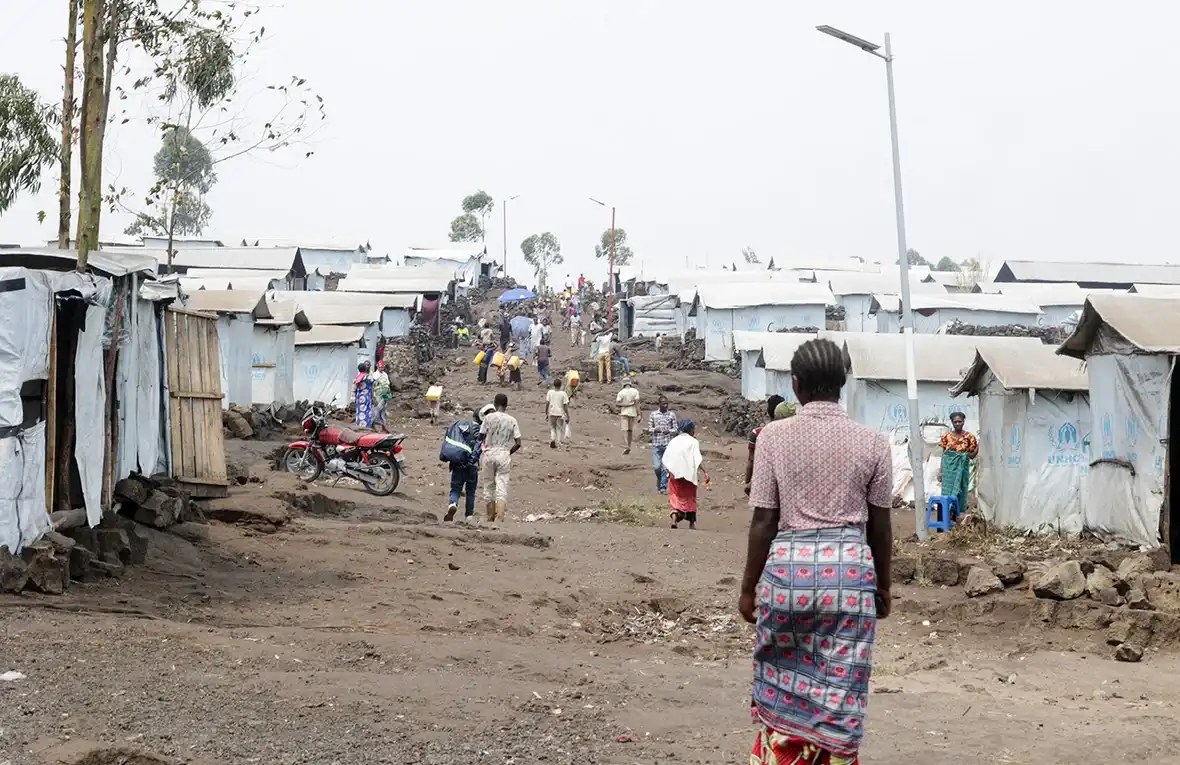
Africa’s displaced populations generate an estimated $27.7 billion in annual income, according to a new study that challenges the assumption that refugees and internally displaced people are economically passive.
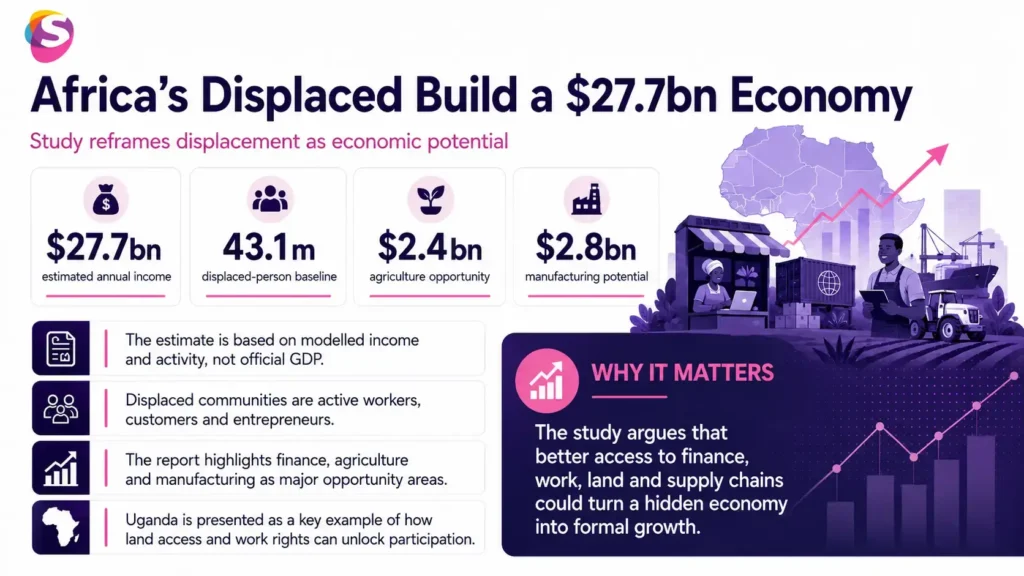
The figure comes from the Amahoro Coalition’s Hiding in Plain Sight: Africa’s $27B Displacement Market Opportunity, produced with dfcu Bank. The study estimates that Africa’s internally displaced people earn about $22.1 billion a year, while refugees generate another $5.6 billion.
The report argues that this activity already forms a large but under-recognised market spanning entrepreneurship, agriculture, finance, supply chains and manufacturing. Its findings are based on modelled income estimates rather than formal national accounts, making the $27.7 billion figure an estimate of economic potential and activity rather than a directly measured GDP total.
Key Overview
- Africa’s displaced population is estimated to generate $27.7 billion in annual income.
- The report uses a 43.1 million displaced-person baseline drawn from 2024 data.
- It estimates a $4.1 billion annual opportunity from displaced-led businesses.
- Agriculture could produce $2.4 billion if displaced households gained better land access.
- Manufacturing activity linked to displaced workers could generate $2.8 billion annually.
- Uganda is presented as a leading example of how work rights, movement and land access can unlock economic participation.
A Hidden Economy Already Operating at Scale
The Amahoro Coalition study starts from a 43.1 million displaced-person baseline across Africa. It estimates that this population generates $27.7 billion in annual income, split between $22.1 billion from internally displaced people and $5.6 billion from refugees.
The study estimates that 56% of displaced people are economically active and applies a 12% entrepreneurship rate. On that basis, it projects about three million displaced entrepreneurs, 3.4 million businesses and annual earning potential of roughly $4.1 billion.
These are modelled figures built from population data, income proxies and research from selected displacement settings. The report itself acknowledges methodological limits, including the use of some single-market evidence to estimate broader continental patterns.
That distinction matters. The study is not saying that $27.7 billion is fully captured in official statistics. Its central argument is that a large share of the economic activity taking place in displacement settings remains informal, fragmented or poorly measured.
Finance Could Unlock Existing Commercial Activity
Financial exclusion is one of the biggest barriers identified in the report. Many displaced people lack recognised identification, fixed addresses, collateral or formal credit histories, making it difficult to access ordinary bank products.
Yet the report says refugee-focused lenders have recorded repayment rates of at least 95% in some programmes. It also argues that mobile money adoption in displacement settings can exceed that of surrounding host communities.
The opportunity is therefore not only charitable finance. It includes payments, savings, working-capital lending, insurance and products designed around irregular incomes and non-traditional identity records.
The business case is strengthened by the wider scale of displacement. The latest global displacement data show that 117.8 million people were forcibly displaced worldwide at the end of 2025, including 68.7 million people displaced within their own countries by conflict and violence.
Africa remains at the centre of that crisis. According to the 2026 internal displacement report, sub-Saharan Africa recorded 17.3 million internal displacements during 2025 and ended the year with 31.7 million internally displaced people.
Context is everything. Stay ahead of shifting trends with today’s market updates, and uncover emerging opportunities using the Serrari Group Market Index and Marketplace. Then, take control of your own financial future by exploring our Money & Life Reset Transformation Blueprint ™ to build stronger habits, create better systems, and design a path toward lasting wealth.
Agriculture Offers a $2.4 Billion Opportunity
Agriculture is one of the report’s clearest examples of how policy determines economic outcomes.
The study estimates that displaced households could generate $2.4 billion in agricultural output if they had adequate land access. It calculates a potential 1.8 million hectares under cultivation across about 3.6 million displaced households engaged in farming.
The main constraint is land tenure. The report says 88% of African countries lack effective land-access frameworks for displaced people, leaving much of the estimated agricultural opportunity unrealised.
Uganda is highlighted as a contrasting model. Its settlement system gives many refugees freedom of movement, the right to work and access to small plots. The report says 91% of refugees in settlements have plots, while more than $200 million has been invested in refugee-hosting districts since 2017.
A case study on Omia Agribusiness says its farmer-hub model has served more than 49,000 refugee and host-community farmers and channelled over $413,000 directly to them by 2022.
Manufacturing Could Generate $2.8 Billion
Manufacturing presents another sizeable opportunity. The report estimates that displaced workers involved in agro-processing, textiles, assembly, repairs and other light industries could generate about $2.8 billion in annual output.
The estimate is based on projected workforce participation and low-income African manufacturing productivity benchmarks. The report also cautions that participation rates vary widely by policy environment and that some assumptions may represent an upper bound.
The strongest opportunities are likely to be in industries with lower capital requirements and direct links to local demand. Agro-processing is singled out because displacement settlements create concentrated markets for food while often sitting near agricultural production zones.
The Business Case Does Not Replace the Humanitarian Case
The report’s commercial argument does not reduce displacement to a market opportunity. Africa’s crises remain severe.
Sudan ended 2025 with 9.1 million people internally displaced, while the Democratic Republic of Congo saw millions of new movements during the year. Humanitarian needs remain high even as funding pressures intensify.
The report’s broader point is that aid and economic participation should not be treated as opposites. Displaced people can need protection while also being workers, customers, farmers and business owners.
For companies and policymakers, the opportunity lies in removing structural barriers that keep existing activity informal and under-financed. Better access to identification, banking, work rights, land and supply chains could turn a largely hidden economy into a more productive part of Africa’s formal growth story.
Sources: Amahoro Coalition / dfcu Bank / UNHCR / Internal Displacement Monitoring Centre
Your financial future isn’t something you wait for—it’s something you build.
The real question is: when do you begin?
Move beyond simply staying informed.
Navigate the markets with clarity—track trends through the Serrari Group Market Index, uncover opportunities in the Serrari Marketplace, and build practical knowledge with our Curated Wealth Builder Platform.
Stay connected to what truly matters.
Get daily insights on macro trends and financial movements across Kenya, Africa, and global markets—delivered through the Serrari Newsletter.
Growth opens doors.
Advance your career through professional programs including ACCA, HESI A2, ATI TEAS 7 , HESI EXIT , NCLEX – RN and NCLEX – PN, Financial Literacy!🌟—designed to move you forward with confidence.
See where money is flowing—clearly and in real time.
Track Money Market Funds, Treasury Bills, Treasury Bonds, Green Bonds, and Fixed Deposits, alongside global and African indexes, key economic indicators, and the evolving Crypto and stablecoin landscape—all within Serrari’s Market Index.