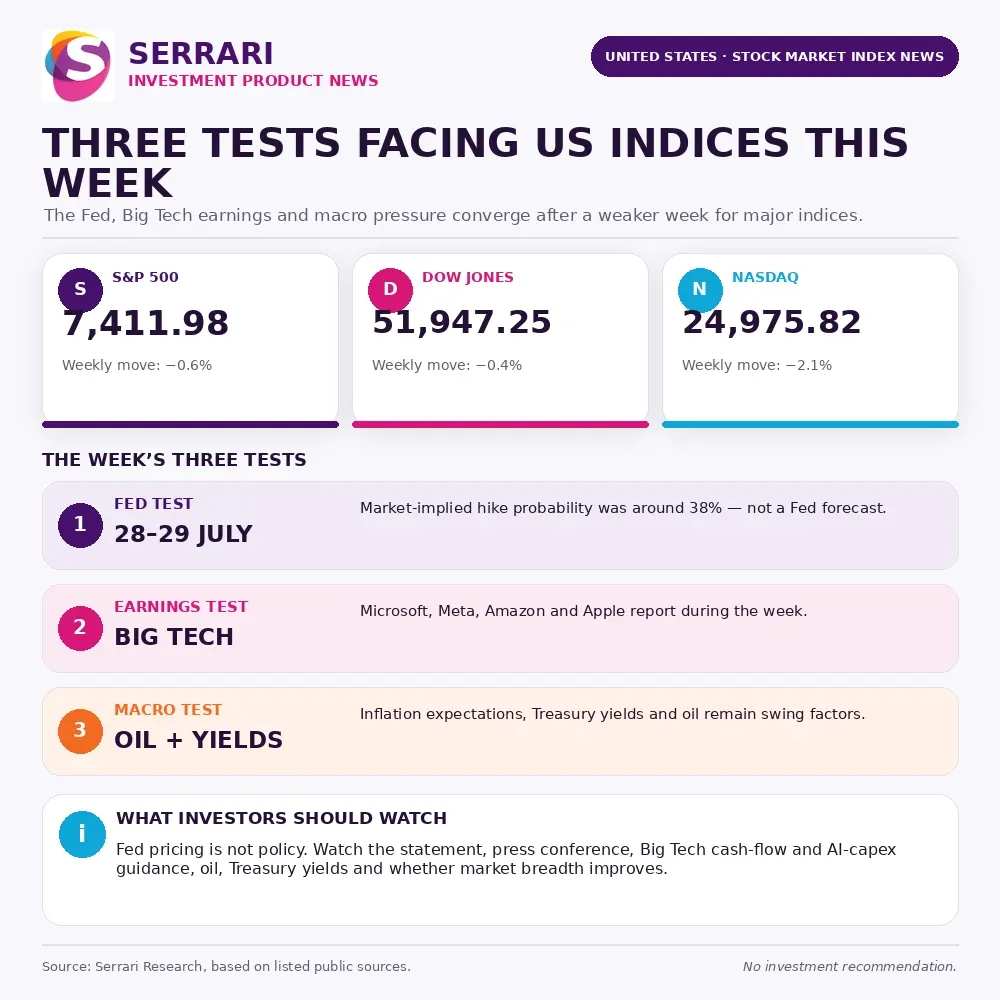
The S&P 500 week ahead is defined by two tests: the Federal Reserve decision and Big Tech earnings. The Fed is scheduled to decide policy on 29 July, while Microsoft, Meta, Amazon and Apple report in a week when about one-third of S&P 500 companies are expected to release results. Investors are watching whether AI-related capital spending can produce enough earnings and cash flow to justify technology valuations. Oil prices and Treasury yields add another risk layer because inflation concerns can change market expectations for Fed policy.
Key Overview
- S&P 500 Friday close: 7,411.98.
- Dow Friday close: 51,947.25.
- Nasdaq Composite Friday close: 24,975.82.
- Weekly moves: S&P 500 down 0.6%, Dow down 0.4%, Nasdaq down 2.1%.
- Year-to-date returns: S&P 500 up 8.3%, Dow up 8.1%, Nasdaq up 7.5%.
- Fed meeting: 28–29 July 2026.
- Apple earnings call: 30 July 2026.
- Amazon, Apple, Meta and Microsoft report during the week.
- Market pricing recently placed the probability of a July hike near 38%, but this is not a Fed forecast.
US Stock Market Outlook Faces Fed and Big Tech Test
The Market Starts From a Weaker Base
The week begins with softer momentum. AP’s Friday recap showed all three major US indices down for the week, with the Nasdaq suffering the largest decline. Brent crude fell nearly 4% on Friday to US$96.78 per barrel after trading above US$102 a day earlier, showing how oil remains a swing factor for inflation expectations and market sentiment.
The weakness does not erase year-to-date gains, but it changes the tone. Investors are now asking whether the market can absorb higher energy prices, higher Treasury yields and a heavy earnings calendar at the same time.
The Fed Is the First Test
The Federal Reserve calendar confirms the next FOMC meeting on 28–29 July, with a press conference after the two-day meeting.
The market largely expects policy to be held steady, but recent oil moves have revived the risk of a rate hike. MarketWatch reported that the probability of a rate increase rose to about 38% from 13% the prior week, based on market pricing, as Treasury yields rose and oil-driven inflation fears returned.
That probability is not a Fed forecast. It is a market-implied estimate that can change quickly as oil, inflation data and Fed commentary shift.
Big Tech Is the Second Test
Investopedia’s week-ahead preview says the focus is on Amazon, Apple, Meta and Microsoft earnings, with investors paying particular attention to AI capital expenditure rather than headline profits alone.
This follows the pressure seen after Alphabet and Tesla results. The market is increasingly asking whether large AI infrastructure programmes will translate into cash flow, margins and sustainable earnings.
Apple Anchors the End of the Week
Apple’s investor-relations page confirms that its fiscal Q3 2026 conference call is scheduled for Thursday, 30 July, at 2:00 p.m. PT / 5:00 p.m. ET.
Apple matters because it is a major index weight and a global consumer-technology bellwether. Its guidance can influence not only Apple suppliers, but also sentiment toward hardware, services and megacap technology more broadly.
Why AI Spending Matters
The Nasdaq’s larger weekly decline reflects a more cautious attitude toward AI-linked valuations. Investor’s Business Daily reported that concerns remain over hyperscalers’ rising AI capital expenditure without clear corresponding returns, after weakness in Google and Tesla last week.
For index investors, this matters because AI-linked companies have driven a large share of recent market leadership. If investors start demanding faster cash-flow proof, valuation multiples may become less forgiving.
Context is everything. Stay ahead of shifting trends with today’s market updates, and uncover emerging opportunities using the Serrari Group Market Index and Marketplace. Then, take control of your own financial future by exploring our Money & Life Reset Transformation Blueprint ™ to build stronger habits, create better systems, and design a path toward lasting wealth.
Oil and Yields Add a Macro Layer
Oil remains a second pressure point. AP reported that Brent fell to US$96.78 on Friday after rising above US$102 the prior day, while Treasury yields moved lower at the end of the week.
Even after Friday’s retreat, oil remains central because higher energy prices can lift inflation expectations, raise Treasury yields and reduce the present value of future technology earnings.
What Investors Should Watch
Investors should watch the Fed decision, the tone of the press conference, Apple’s call, hyperscaler capex guidance and whether the Nasdaq stabilises after last week’s 2.1% decline.
They should also watch market breadth. A rally led only by a few megacaps may be more vulnerable than one supported by financials, industrials, healthcare and small caps.
Conclusion
The US Stock Market Outlook is entering a high-risk information week. The S&P 500, Nasdaq and Dow are still positive for the year, but last week’s losses show that investors are becoming more selective.
The market needs two things: a Fed message that does not shock rates higher, and Big Tech earnings that prove AI spending can translate into durable returns. Without both, volatility may remain elevated.
FAQs
1. Why is this week important for US stocks?
This week brings the Federal Reserve’s July decision and earnings from major technology companies including Apple, Microsoft, Meta and Amazon. Both could influence index direction, Treasury yields and growth-stock valuations.
2. How did US indices perform last week?
The S&P 500 fell 0.6%, the Dow fell 0.4% and the Nasdaq Composite fell 2.1%. The Nasdaq’s larger decline reflected renewed pressure on technology and AI-linked stocks.
3. Is the Fed expected to raise rates?
Markets recently priced a roughly 38% chance of a July hike, but that is not a confirmed policy decision. The Fed decision is scheduled for 29 July.
4. Why do Big Tech earnings matter?
Big Tech earnings matter because large technology companies carry heavy index weights and are central to the AI investment story. Investors want evidence that capital expenditure is producing revenue, margins and free cash flow.
5. What should investors monitor?
Investors should monitor Fed guidance, Treasury yields, oil prices, Apple’s earnings call, Microsoft / Meta / Amazon capex commentary and whether the Nasdaq recovers from last week’s weakness.
Sources: Associated Press, Investopedia, Reuters / Investing.com, Federal Reserve, Apple Investor Relations, MarketWatch, S&P Dow Jones Indices.
Your financial future isn’t something you wait for—it’s something you build.
The real question is: when do you begin?
Move beyond simply staying informed.
Navigate the markets with clarity—track trends through the Serrari Group Market Index, uncover opportunities in the Serrari Marketplace, and build practical knowledge with our Curated Wealth Builder Platform.
Stay connected to what truly matters.
Get daily insights on macro trends and financial movements across Kenya, Africa, and global markets—delivered through the Serrari Newsletter.
Growth opens doors.
Advance your career through professional programs including ACCA, HESI A2, ATI TEAS 7 , HESI EXIT , NCLEX – RN and NCLEX – PN, Financial Literacy!🌟—designed to move you forward with confidence.
See where money is flowing—clearly and in real time.
Track Money Market Funds, Treasury Bills, Treasury Bonds, Green Bonds, and Fixed Deposits, alongside global and African indexes, key economic indicators, and the evolving Crypto and stablecoin landscape—all within Serrari’s Market Index.