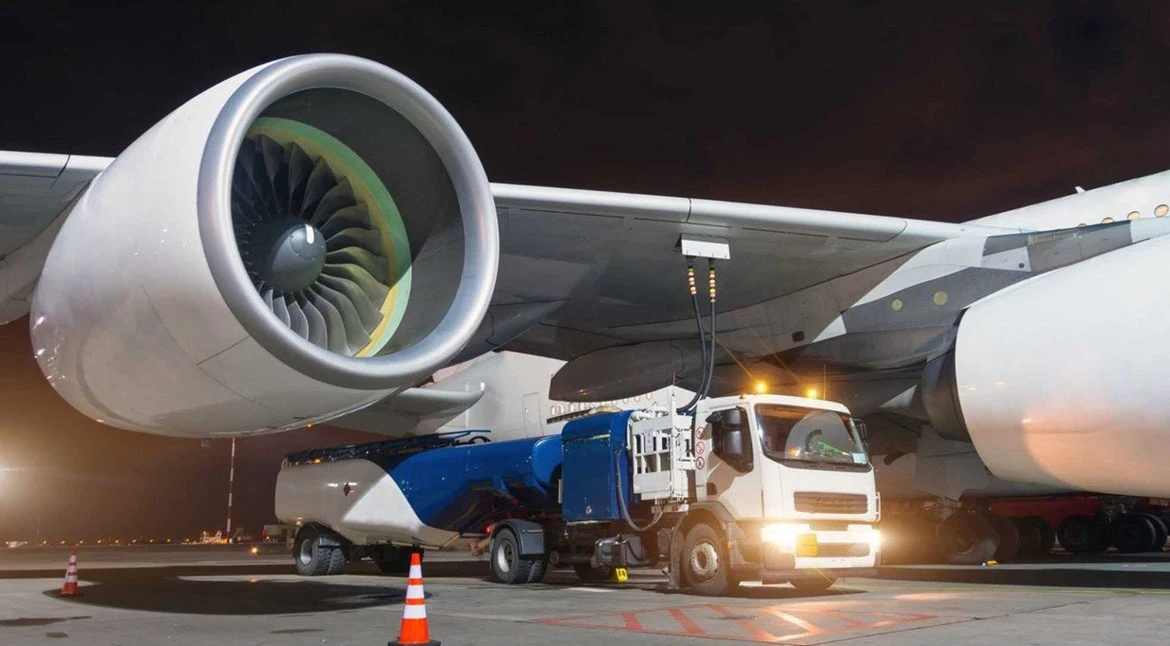
Nigeria’s government has moved to cap jet fuel prices and grant airlines a 30-day credit facility for fuel purchases in a bid to prevent a catastrophic shutdown of the country’s aviation sector. The intervention, detailed in a government document seen by Reuters, comes after the Airline Operators of Nigeria (AON) warned that Jet A1 prices had surged by up to 300% — from roughly ₦900 per litre in late February to as much as ₦3,500 — prompting threats of a nationwide seven-day operational halt from April 30. The price explosion, triggered by the global energy shock from the US-Iran war and compounded by allegations of downstream profiteering by fuel marketers, has pushed Africa’s largest aviation market to the edge, even as the continent’s biggest refinery — the Dangote facility — operates at full capacity and supplies over 95% of domestic jet fuel.
Markets move fast; don’t get left behind. We’ve paired the Serrari Group Market Index with a curated Marketplace and a comprehensive Wealth Builder Platform to ensure you have the data—and the skills—to act on it.
Key Overview
- Price cap range: ₦1,760–₦1,988 per litre in Lagos; ₦1,809–₦2,037 in Abuja (benchmarked April 17–23)
- Pre-crisis Jet A1 price: ~₦900 per litre (February 2026)
- Peak crisis price: Up to ₦3,500 per litre at some suppliers
- Price surge: 270–300% increase in under two months
- Airline credit window: 30-day payment facility for fuel purchases
- Debt relief: President Tinubu approved 30% relief on airlines’ debts to aviation agencies
- Dangote Refinery: Supplies over 95% of Nigeria’s Jet A1; gantry price at ₦1,732 per litre
- Global context: Africa’s jet fuel costs account for 30–40% of airline operating expenses, well above the global average of 20–25%
- Regulatory body: Nigerian Midstream and Downstream Petroleum Regulatory Authority (NMDPRA)
The Crisis Unfolds: How 300% Fuel Hikes Brought Nigerian Aviation to Its Knees
Nigeria’s domestic aviation sector has been plunged into its worst crisis in years after jet fuel prices spiralled out of control in the wake of the US-Iran war that began in late February 2026. The conflict led to Iran’s effective closure of the Strait of Hormuz, through which roughly a fifth of the world’s crude oil and liquefied natural gas normally passes, sending global energy prices sharply higher and triggering what the International Energy Agency has called the largest oil supply disruption in history.
In Nigeria, the knock-on effects were swift and severe. The cost of Jet A1 aviation fuel, which sat at approximately ₦900 per litre before the crisis, rocketed to between ₦2,700 and ₦3,500 per litre within weeks — an increase of roughly 300% that operators described as disproportionate to the global trend. Air Peace CEO Allen Onyema pointed out that while other countries, including elsewhere in Africa, had recorded fuel price increases of roughly 70%, Nigeria’s surge was several times greater, raising sharp questions about profiteering within the domestic fuel distribution chain.
The financial strain proved immediately unsustainable. Fuel now accounts for over 70% of total airline operating expenses in Nigeria, well above the global average of 20–25%. Airlines were forced to hike ticket prices dramatically while simultaneously absorbing losses. At least one operator had already grounded all its flights since mid-March, and the broader industry warned that without intervention, no airline in Nigeria would be flying by the end of April.
The Shutdown Ultimatum
The Airline Operators of Nigeria, the industry’s representative body, escalated pressure on the federal government with a 48-hour ultimatum and a threatened seven-day nationwide shutdown of all domestic flight operations, set to take effect on Thursday, April 30, 2026.
Onyema, who also serves as AON Vice President, delivered the stark warning after two days of emergency talks convened by Aviation Minister Festus Keyamo in Abuja. He argued that the price increases were artificial and not commensurate with global crude oil movements, adding that fuel marketers needed to be called to account.
The threat was far from empty. The Aviation Ground Handlers Association of Nigeria had simultaneously issued its own seven-day ultimatum, warning that ground handling companies including SAHCO and NAHCO could withdraw services over an outstanding debt exceeding ₦9 billion owed by airlines. A dual collapse of both flight operations and ground services would have paralysed the country’s entire air transport network.
In a formal letter dated April 21 and signed by AON President Abdulmunaf Sarina, the operators requested a suspension of all aviation taxes and charges for at least six months, along with the introduction of a non-taxable fuel surcharge — a standard instrument in international aviation — to help carriers pass fuel costs through to passengers in a structured manner.
The Government’s Response: Price Caps and Credit Lines
President Bola Tinubu responded by approving an emergency package of relief measures designed to keep the sector operational. The centrepiece of the government’s intervention is the setting of indicative price caps by the Nigerian Midstream and Downstream Petroleum Regulatory Authority (NMDPRA). According to a government document seen by Reuters, aviation fuel should sell for ₦1,760 to ₦1,988 per litre in Lagos and ₦1,809 to ₦2,037 in Abuja, based on international benchmark data from April 17 to 23.
The NMDPRA cautioned that prices could still fluctuate owing to ongoing market volatility linked to the US-Iran conflict and elevated supplier costs, but the caps provide a ceiling that is significantly below the ₦3,000-plus prices that airlines had been paying.
In addition to the price guidance, the government approved a 30% relief on airlines’ outstanding debts to aviation agencies and directed fuel marketers to offer airlines a 30-day credit window for fuel purchases. Previously, Nigerian airlines paid for fuel upfront — a system that became untenable as prices tripled. The credit facility is designed to ease immediate cash-flow pressures while longer-term solutions are worked out.
The aviation ministry was also tasked with mediating debt disputes between airlines and oil marketers, a reflection of the deep distrust that has developed between the two sides during the crisis.
Context is everything. While you follow today’s updates, use the Serrari Group Market Index and Marketplace to spot emerging shifts. Need to sharpen your edge? Our Wealth Builder Platform turns these insights into a professional-grade strategy.
The Dangote Paradox: Abundant Supply, Soaring Prices
One of the most perplexing aspects of Nigeria’s jet fuel crisis is that it is occurring despite the country now hosting Africa’s largest and most sophisticated refinery. The Dangote Petroleum Refinery in Lekki, Lagos, became fully operational at the start of 2026 and is producing at its maximum capacity of 650,000 barrels per day. The facility now supplies over 95% of all Jet A1 fuel consumed domestically, according to AON spokesperson Obiora Okonkwo, who described the refinery as not just a refinery but “a game changer and a lifesaver” for airline operators.
Yet despite this domestic supply backbone, airline operators allege that intermediaries in the downstream distribution chain have been manufacturing artificial scarcity to inflate prices. The Major Energies Marketers Association of Nigeria (MEMAN) reported that Dangote’s gantry price for jet fuel stood at ₦1,732 per litre, while imported aviation fuel cost ₦1,835. But by the time the product reached airlines at airports, prices had in some cases doubled from those depot levels, with some marketers charging as much as ₦3,500.
The disconnect has fuelled accusations of racketeering. Air Peace’s Onyema asked pointedly how prices could rise by 300% when the Dangote refinery’s supply remained the cheapest option and some marketers sourced directly from the facility. MEMAN itself acknowledged the pricing anomaly, expressing surprise at the ₦3,300 per litre figure cited by airlines and advising operators to seek alternative suppliers offering more competitive rates.
The technical committee convened by the NMDPRA responded by recommending that fuel marketers sell directly to airlines within the regulated price band, cutting out layers of intermediaries. It also urged regulators to engage the Dangote Refinery over recently increased premiums it has applied to international benchmarks used to price jet fuel.
Dangote: Local Lifeline or Global Profiteer?
The Dangote Refinery occupies a complicated position in this crisis. On the one hand, it has shielded Nigeria from the worst of the global supply disruptions. The Presidency has credited the naira-for-crude initiative, launched in October 2024, and the refinery’s scale as the reasons Nigeria has avoided the fuel queues and acute shortages plaguing countries across Asia and parts of Africa.
On the other hand, the refinery is a private enterprise responding to global price signals. A Reuters investigation found that the bulk of the 24 million litres of jet fuel the refinery produces daily is shipped to Europe, where record refining margins have made aviation fuel exports enormously profitable. Alan Gelder, senior vice president at Wood Mackenzie, estimated Dangote’s jet fuel margins at more than double those of European refiners, which themselves earned about $15 per barrel. As Gelder noted, building a large refinery does not automatically translate into lower local fuel prices, particularly in a deregulated market.
A senior Dangote Group official acknowledged that while the refinery has been subsidising petrol and diesel prices to cushion Nigerians from global shocks, it could not extend that approach to jet fuel. Aviation fuel is sold at market prices, the official said, pointing to the steep rise in crude oil costs — Brent crude jumped from $66 per barrel on February 28 to above $100 — as the fundamental driver.
Adding to the complexity is the crude supply challenge. Despite Nigeria’s status as Africa’s largest oil producer, the Dangote Refinery has faced a persistent shortfall of domestic crude supply. Between October 2025 and March 2026, the facility experienced a deficit of approximately 79.53 million barrels against its requirements, forcing it to import feedstock from the US, Brazil, and other African producers — purchases denominated in dollars that add significant cost pressure.
The Naira-for-Crude Factor and Foreign Exchange Exposure
Among the more forward-looking recommendations from the NMDPRA technical committee is the proposal to include jet fuel in Nigeria’s naira-for-crude initiative. Launched by President Tinubu in October 2024, the programme allows the state oil company NNPC to sell crude to domestic refineries in naira, with refined products then sold back into the local market in the same currency. The arrangement was designed to reduce demand for foreign exchange and stabilise the naira.
However, the initiative has not fully insulated Nigeria from global price movements. The NNPC has been supplying the Dangote Refinery with fewer cargoes than required — roughly five per month against a need of thirteen — and those cargoes are priced at international market rates plus a premium. The shortfall has forced the refinery to source crude on international markets in dollars, undermining the naira-denominated benefits of the programme.
Extending the naira-for-crude framework to cover jet fuel transactions could help airlines avoid the foreign exchange exposure that has amplified cost pressures. Nigerian carriers currently face a dollarised cost structure in an economy where interest rates range between 30 and 35%, making credit prohibitively expensive and intensifying the financial squeeze.
Structural Reforms: Fewer Middlemen, Greater Transparency
Beyond immediate price relief, the government’s intervention package targets deeper structural problems in Nigeria’s aviation fuel supply chain. The NMDPRA committee recommended validating airside fuel distributors to ensure only those with adequate infrastructure retain authorisation to supply airports. This measure could reduce the number of authorised suppliers and eliminate marginal players who, according to industry stakeholders, have contributed to price inflation without adding meaningful logistical value.
The push for direct fuel sales from marketers to airlines is aimed at improving supply-chain transparency, a long-standing concern in Nigeria’s deregulated downstream petroleum sector. Under the current system, multiple intermediaries can stand between the refinery gate and the aircraft fuel tank, each adding margin. By collapsing that chain, regulators hope to bring what airlines pay closer to the depot price.
Aviation analyst Fred Chukwuelobe cautioned against scapegoating individual carriers, noting that the crisis was systemic rather than company-specific. He emphasised that resolving it would require sustained government engagement with both fuel marketers and airline operators, not just one-off emergency measures.
What Comes Next
The immediate question is whether the government’s intervention will be sufficient to avert the threatened shutdown. As of April 28, the pricing framework and credit facility had been agreed in principle, but the NMDPRA and the aviation ministry had not yet publicly commented on implementation details. Airlines were still waiting to see whether fuel marketers would comply with the indicative price bands.
Longer-term, Nigeria’s aviation crisis underscores a set of tensions that extend far beyond any single commodity. Africa’s biggest economy has a world-class refinery producing at full capacity, yet its domestic airline industry was brought to the verge of collapse by intermediaries, foreign exchange fragility, and a pricing architecture that failed to translate domestic production into affordable local supply. The Dangote Refinery’s plans to expand capacity to 1.4 million barrels per day and its upcoming IPO will only sharpen questions about the balance between export profitability and domestic obligation.
For the airlines and the millions of Nigerians who depend on domestic air travel, the answer cannot wait until the end of the decade. It needs to arrive before Thursday.
Your financial future isn’t something you wait for—it’s something you build.
The real question is: when do you begin?
Move beyond simply staying informed.
Navigate the markets with clarity—track trends through the Serrari Group Market Index, uncover opportunities in the Serrari Marketplace, and build practical knowledge with our Curated Wealth Builder Platform.
Stay connected to what truly matters.
Get daily insights on macro trends and financial movements across Kenya, Africa, and global markets—delivered through the Serrari Newsletter.
Growth opens doors.
Advance your career through professional programs including ACCA, HESI A2, ATI TEAS 7 , HESI EXIT , NCLEX – RN and NCLEX – PN, Financial Literacy!🌟—designed to move you forward with confidence.
See where money is flowing—clearly and in real time.
Track Money Market Funds, Treasury Bills, Treasury Bonds, Green Bonds, and Fixed Deposits, alongside global and African indexes, key economic indicators, and the evolving Crypto and stablecoin landscape—all within Serrari’s Market Index.