















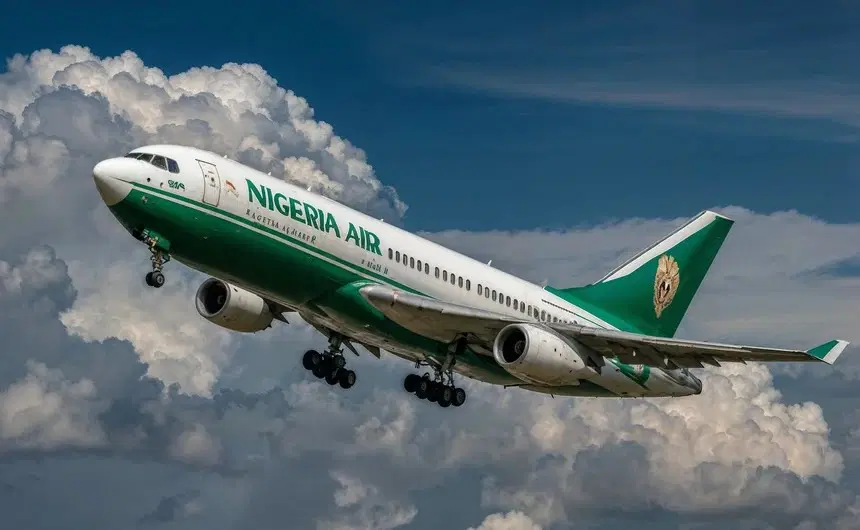
Nigeria’s domestic aviation industry is on the brink of collapse as jet fuel prices have surged by up to 270–300% in less than two months, a spike airline operators describe as disproportionate, artificial, and unique to the country. The cost of Jet A1 fuel has jumped from around ₦900 per litre at the end of February 2026 to ₦3,300 per litre, forcing the Airline Operators of Nigeria (AON) to issue a shutdown ultimatum and prompting direct presidential intervention. Air Peace CEO Allen Onyema says other countries, including those in Africa, have recorded roughly 70% increases in the same period — raising pointed questions about profiteering within Nigeria’s downstream fuel distribution chain. Critically, the Dangote Refinery now supplies more than 95% of all Jet A1 consumed domestically and sells at comparatively lower rates, deepening suspicion that marketers are inflating prices beyond what supply fundamentals justify. Aviation Minister Festus Keyamo has convened emergency meetings and announced debt relief for airlines, but negotiations with fuel marketers have so far ended in deadlock. Airlines have warned they may halt all flights from Thursday 30 April if no resolution is reached.
Markets move fast; don’t get left behind. We’ve paired the Serrari Group Market Index with a curated Marketplace and a comprehensive Wealth Builder Platform to ensure you have the data—and the skills—to act on it.
Key Overview
- Price spike: Jet A1 fuel rose from ₦900 to ₦3,300 per litre between 28 February and mid-April 2026 — an increase of over 300%.
- Disparity: Nigerian operators report a 250–270% increase versus roughly 70% in other countries, including elsewhere in Africa.
- Shutdown threat: Airlines warned of suspension effective 30 April 2026 if no resolution is achieved within a 7-day window.
- Dangote supply: The refinery supplies over 95% of Nigeria’s Jet A1 and exported 1.1 billion litres to Europe in March–April alone.
- Profiteering allegations: AON accuses fuel marketers of creating artificial scarcity despite adequate supply from the Dangote Refinery.
- Government response: Minister Festus Keyamo convened emergency meetings, with President Tinubu approving debt discounts for airlines and a pricing review committee.
- Negotiations: Talks between airlines, marketers and regulators ended in deadlock, with focal teams given 48–72 hours to propose a pricing framework.
- African context: Jet fuel accounts for 30–40% of operating costs for African airlines, well above the global average of 20–25%.
A Crisis Unlike Anywhere Else
Nigeria’s aviation industry faces an existential crisis that its operators say has no parallel anywhere in the world. While the Middle East conflict has driven global jet fuel prices sharply higher, the Airline Operators of Nigeria contend that the increase in their country has been wildly disproportionate — roughly three to four times the magnitude seen in comparable markets.
In a letter dated 14 April 2026 and addressed to the Major Energies Marketers Association of Nigeria (MEMAN), AON disclosed that the cost of Jet A1 fuel had surged from ₦900 per litre as of 28 February to ₦3,300 per litre, an increase exceeding 300% within weeks. The operators described this spike as “astronomical and artificial,” pointing out that international crude oil prices had risen by approximately 30% over the same period, and that other countries — including those in Africa — had experienced increases of around 70%.
Air Peace Chairman and CEO Allen Onyema amplified those concerns after a closed-door meeting between AON and government officials. He told reporters that the standard globally is for by-product prices to move proportionally with crude oil, and that what Nigeria is experiencing represents an abnormal deviation from that pattern. He asked bluntly how fuel prices could rise by as much as 300% when the Dangote Refinery sells its products at comparatively lower rates and some marketers source directly from the refinery.
From ₦900 to ₦3,300: The Price Trajectory
The speed of the fuel price escalation has left airlines with almost no room to adjust. At ₦900 per litre, Jet A1 was already a significant burden for Nigerian carriers operating in a high-interest-rate environment where access to credit comes at 30–35% borrowing costs. At ₦3,300, the economics of flying have become fundamentally unviable.
AON’s letter to MEMAN stated that airline revenues are now insufficient to cover the cost of fuel alone — just one of many daily operational expenses. The operators said they had absorbed the rising costs for more than four weeks out of what they described as patriotism and service to the nation, but warned the situation had become unbearable and clearly unsustainable.
The impact was already being felt before the ultimatum. According to AON, one airline had grounded all operations since 13 March 2026 due to the escalating cost of fuel. Others were teetering on the edge, facing an impossible choice: raise ticket prices to reflect fuel costs and risk collapsing passenger demand, or continue operating at a loss until reserves are exhausted.
The Dangote Paradox
What makes Nigeria’s fuel crisis particularly confounding is that the country now has its own world-class refinery producing jet fuel at scale — and yet prices at the pump have spiralled far beyond international benchmarks.
AON spokesperson Obiora Okonkwo disclosed in a televised interview that the Dangote Petroleum Refinery currently supplies over 95% of the Jet A1 fuel consumed across Nigeria. He described the facility as “not just a refinery but a game changer and a lifesaver” for airline operators during a period of acute global supply disruption.
The refinery has also been exporting aggressively. Industry data show that Dangote shipped approximately 876,000 metric tonnes of jet fuel to Europe in March and the first three weeks of April — roughly 456,000 tonnes in March and a further 420,000 tonnes by 20 April. These export volumes underscore that the refinery has both the production capacity and the logistics infrastructure to meet demand domestically and internationally.
Yet despite this ample supply, prices at the point of sale to airlines have exploded. Okonkwo attributed the disconnect to sharp practices within the downstream distribution chain, alleging that some marketers are creating artificial scarcity despite adequate supply from the refinery, leading to disproportionate price increases.
Allen Onyema reinforced this point, noting that even Aliko Dangote himself was “surprised” by the price trajectory because his refinery’s products remain the cheapest on the market. The implication is clear: the cost inflation is being driven not by supply constraints or international pricing, but by intermediary markups within Nigeria’s fuel distribution chain.
Context is everything. While you follow today’s updates, use the Serrari Group Market Index and Marketplace to spot emerging shifts. Need to sharpen your edge? Our Wealth Builder Platform turns these insights into a professional-grade strategy.
The Government Steps In
The severity of the crisis has drawn direct intervention from the highest levels of the Nigerian government. Aviation Minister Festus Keyamo convened an emergency stakeholders’ meeting on 22 April 2026 in Abuja, bringing together airline operators, fuel marketers, regulators and government officials with presidential backing.
In a letter to AON dated 16 April, Keyamo acknowledged the sharp hike from ₦900 to ₦3,300 per litre and commended airlines for their resilience in continuing operations under difficult conditions. He urged operators to refrain from both fare increases and flight suspensions, warning that either action would impose significant hardship on ordinary Nigerians and undermine ongoing reforms within the aviation sector.
However, the meeting itself ended without resolution. Keyamo told journalists after a four-hour closed-door session that while discussions were frank, no agreement was reached on how to immediately stabilise Jet A1 prices. Marketers outlined their own operational constraints, while airlines emphasised that they had been stretched to the breaking point.
To break the impasse, the minister announced the appointment of designated focal persons from airlines, marketers, regulators and government. The committee was given 48–72 hours to develop a transparent and sustainable pricing framework.
In a separate intervention, the Federal Government disclosed that President Tinubu had approved the first phase of emergency relief, including significant discounts on debts owed by airlines to agencies such as the Federal Airports Authority of Nigeria, the Nigerian Airspace Management Agency and the Nigerian Civil Aviation Authority. Keyamo described the measure as emergency relief rather than a subsidy. There are also plans for a presidential committee to review and potentially eliminate multiple taxes and levies embedded in domestic airfares — an issue airlines have long argued inflates ticket prices and constrains growth.
The African Dimension
Nigeria’s fuel crisis, while exceptionally severe, sits within a broader continental challenge. Africa imports approximately 70% of its jet fuel and kerosene, and the continent’s carriers are structurally more exposed to fuel price shocks than their global peers.
According to the African Airlines Association (AFRAA), jet fuel typically accounts for between 30% and more than 40% of operating costs for African airlines, compared with a global average of 20–25%. For low-cost African carriers, the figure can reach 50–55% of direct operating expenses, making them acutely vulnerable to sustained crude price elevations.
The closure of the Strait of Hormuz — through which approximately 20% of global oil supplies transit — has compounded these structural weaknesses. South African low-cost carrier FlySafair reported that coastal airports in the country saw jet fuel prices rise by 70% in a single week, estimating an additional cost of roughly R35,000 ($2,071) per flight hour for each of its 37 Boeing 737-800 aircraft. The carrier does not hedge its fuel purchases.
What distinguishes Nigeria’s situation from the broader African experience is the magnitude of the gap. A 70% increase is painful but broadly consistent with global trends. A 270–300% increase — in a country that produces and refines its own jet fuel through the Dangote Refinery — suggests factors at work that go well beyond the geopolitical supply shock.
The Airline Ultimatum
With negotiations stalled and no pricing agreement in sight, Nigerian airlines have set a hard deadline. Operators warned on 24 April that they would suspend all domestic flights from Thursday 30 April if urgent action is not taken.
Onyema was unequivocal, stating that no airline in the country will be able to fly within seven days unless something drastic changes — not because they do not want to fly, but because the pricing of fuel products may not be available to them, given that they cannot sustain borrowing at 30–35% interest rates just to pay fuel marketers.
The potential consequences of a shutdown are severe. AON has warned that halting operations would disrupt millions of livelihoods, impact the banking sector, erode public confidence and potentially worsen insecurity across Africa’s most populous nation. Aviation remains a sector of strategic national importance, the operators stressed, and the continued arbitrary rise in jet fuel prices is both unhealthy and detrimental to national wellbeing.
Questions of Accountability
At the heart of the crisis is a question of market accountability. Nigeria’s downstream petroleum sector operates under a deregulated framework, but Keyamo acknowledged that a free market is not a licence to operate without checks. He told journalists that whether any form of collusion exists among fuel marketers would become clearer in the coming days.
The Nigerian Midstream and Downstream Petroleum Regulatory Authority (NMDPRA) has also been drawn into the discussions, with its CEO Saidu Aliyu Mohammed assuring stakeholders that efforts are under way to review pricing templates and ensure a balance between fuel supply and market stability.
For Nigeria’s airlines, the clock is ticking. The focal teams appointed by Keyamo have been given a narrow window to propose a pricing framework that both marketers and carriers can accept. If they fail, the country’s aviation sector — already battered by years of currency devaluation, high borrowing costs and infrastructure deficits — could face its most damaging disruption in living memory.
What Lies Ahead
The immediate outlook hinges on whether the government can broker a deal before the 30 April deadline. President Tinubu’s direct engagement — including a phone call to his aviation minister during a recent meeting with operators — signals that the crisis has reached the highest levels of political attention. The combination of debt relief, a pricing review committee and the threat of investigating fuel marketers for possible collusion represents a multi-track approach.
But the structural issues run deeper than any single intervention can resolve. Nigerian airlines operate in an environment of chronic forex scarcity, interest rates that make commercial borrowing prohibitively expensive, and a fuel distribution system that appears capable of converting global supply shocks into vastly amplified domestic price spikes. Until those systemic vulnerabilities are addressed, the industry will remain a hostage to the next commodity cycle — and to the intermediaries who control the last mile between the refinery gate and the aircraft wing.
Your financial future isn’t something you wait for—it’s something you build.
The real question is: when do you begin?
Move beyond simply staying informed.
Navigate the markets with clarity—track trends through the Serrari Group Market Index, uncover opportunities in the Serrari Marketplace, and build practical knowledge with our Curated Wealth Builder Platform.
Stay connected to what truly matters.
Get daily insights on macro trends and financial movements across Kenya, Africa, and global markets—delivered through the Serrari Newsletter.
Growth opens doors.
Advance your career through professional programs including ACCA, HESI A2, ATI TEAS 7 , HESI EXIT , NCLEX – RN and NCLEX – PN, Financial Literacy!🌟—designed to move you forward with confidence.
See where money is flowing—clearly and in real time.
Track Money Market Funds, Treasury Bills, Treasury Bonds, Green Bonds, and Fixed Deposits, alongside global and African indexes, key economic indicators, and the evolving Crypto and stablecoin landscape—all within Serrari’s Market Index.