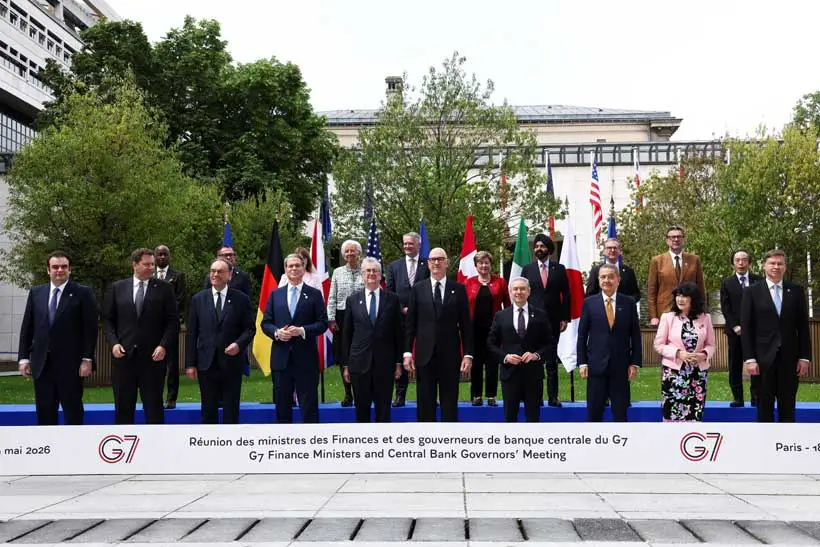
G7 finance ministers meeting in Paris on 18–19 May 2026 agreed that global trade imbalances had become unsustainable and called for domestic policy action to address fragmentation across the world economy. US Treasury Secretary Scott Bessent led calls for stronger protections against a surge of cheap Chinese exports, while France’s Finance Minister Roland Lescure framed the problem more broadly, pointing to overconsumption in the United States and underinvestment in Europe alongside Chinese overproduction. The two-day meeting also addressed the economic fallout from the Iran war, the closure of the Strait of Hormuz, critical mineral supply chain diversification, and divisions over a US decision to extend a sanctions waiver on Russian seaborne oil.
Key Overview
- Venue: French Ministry of Economy and Finance, Paris
- Key Attendees: G7 finance ministers and central bank governors
- Core Theme: Global economic imbalances declared unsustainable
- US Position: Bessent warns Europe needs trade protections against Chinese industrial overcapacity
- French Position: Lescure identifies three-way imbalance — China under-consumes, US over-consumes, Europe under-invests
- Iran/Hormuz: G7 says reopening the Strait of Hormuz is “imperative”
- Russia Tensions: US extends Russian oil sanctions waiver for 30 days, drawing European criticism
- Critical Minerals: G7 pledges deeper cooperation, working on price-floor mechanisms
- Next Step: G7 leaders’ summit in Evian-les-Bains, France, 15–17 June 2026
G7 finance ministers concluded a two-day meeting in Paris on 19 May with a shared acknowledgement that global economic imbalances have become unsustainable, though they offered few concrete measures to address them. The meeting, hosted by French Finance Minister Roland Lescure under France’s G7 presidency, grappled with the economic fallout from the Iran war, rising oil prices, volatile bond markets, and deepening trade friction, all while attempting to maintain a unified front ahead of the leaders’ summit in Evian next month.
US Treasury Secretary Scott Bessent used the forum to press European counterparts on what he characterised as an urgent need for trade protections against a flood of cheap Chinese imports. In an interview with Reuters, Bessent said he had warned allies that China was accelerating its manufacturing output as chronically weak domestic demand pushed more goods into export markets.
Japan’s Finance Minister Satsuki Katayama echoed these concerns, saying there was broad agreement that China’s industrial policies and market-distorting behaviour were driving imbalances and that Beijing showed no willingness to self-correct. Katayama said pressure was mounting for G7 leaders to agree on concrete actions at the June summit.
A Three-Way Imbalance
While the US and Japan focused their criticism squarely on China, France sought to frame the issue more broadly. Lescure described a pattern of structural misalignment in which China under-consumes, the United States over-consumes, and Europe under-invests, a dynamic he said had been building for over a decade and was now fuelling trade friction and risking a turbulent unwinding in financial markets.
The framing reflects a tension within the G7 over how directly to target China. Lescure acknowledged large Chinese export surpluses as part of the problem but noted that discussions in the broader G20, where China holds a seat, had not yielded significant progress.
The scale of China’s trade surplus underscores the urgency. According to the US Congressional Research Service, China’s global trade surplus reached $1.2 trillion in 2025, with exports accounting for a third of economic growth, the highest share since 1997. The IMF has assessed that the volume of Chinese exports is creating adverse spillover effects and destabilising the global economy, and in early 2026 estimated the renminbi was undervalued by 16 percent.
A study commissioned by the European Parliament found that China’s trade surplus doubled between 2015 and 2025, while the EU’s trade deficit with China also doubled in value and expanded roughly fourfold in physical terms over the same period, intensifying debate over how to respond.
The G7 ministers agreed that their domestic agendas needed to include plans to increase investment, improve productivity, and curb policies that distort markets, with Lescure calling on the IMF to strengthen its monitoring and analysis of global imbalances.
The Iran War Shadow
Beyond trade, the Paris meeting was dominated by the economic consequences of the ongoing Iran conflict. G7 ministers said in a joint statement that it was imperative to ensure the return of free and safe transit through the Strait of Hormuz, a vital waterway for global energy, food, and fertiliser supply.
Brent crude futures rose approximately 2.6 percent on 19 May to close above $112 per barrel amid growing concerns over tight supply with the strait still closed. The IMF’s April 2026 World Economic Outlook warned that under a severe scenario involving persistent energy market turbulence, the global economy could enter recession, with growth slipping to around 2 percent and overall global inflation approaching 6 percent.
US President Donald Trump said on the same day that he had paused a planned attack on Iran, talking up the chances of reaching a nuclear deal. However, other G7 countries have expressed frustration that Washington and Israel launched strikes against Iran without adequately considering the economic fallout from the foreseeable closure of the strait.
Bessent called on G7 and other allies to enforce financial sanctions on Iran more aggressively, while urging Asian allies to tackle Iran’s shadow fleet to prevent the transfer of oil to non-sanctioned tankers.
Context is everything. While you follow today’s updates, use the Serrari Group Market Index and Marketplace to spot emerging shifts. Need to sharpen your edge? Our Wealth Builder Platform turns these insights into a professional-grade strategy.
Russia Waiver Divides the Group
While the joint statement affirmed unwavering G7 support for Ukraine and condemnation of Russia, a US decision to extend a sanctions waiver allowing purchases of Russian seaborne oil for an additional 30 days proved a source of open disagreement. Bessent announced the extension on 18 May, saying the general licence would provide flexibility for energy-vulnerable countries unable to access Gulf shipments due to the closure of the Strait of Hormuz.
Lescure said it was for Bessent to justify the waiver, while European Economic Commissioner Valdis Dombrovskis acknowledged that G7 members were “not always 100% aligned on everything,” calling the Russian oil waiver one of those areas of divergence.
Critical Minerals: Building a Common Toolbox
A second major priority of the meeting was reducing G7 dependence on China for critical minerals and rare earths, essential inputs for electric vehicles, renewable energy, defence systems, and semiconductors. China dominates the global supply chain, refining between 47 and 87 percent of copper, lithium, cobalt, graphite, and rare earths, according to the International Energy Agency.
The Paris discussions built on a January 2026 meeting in Washington convened by Bessent, which brought together G7 finance ministers alongside officials from Australia, Mexico, South Korea, and India to explore supply chain diversification strategies. At that earlier gathering, Germany’s Finance Minister Lars Klingbeil said discussions included a potential rare earths price floor and partnerships to boost alternative supplies, while cautioning against framing the effort as an anti-China coalition.
In Paris, ministers pledged to deepen and expand cooperation among G7 members and like-minded partners on critical minerals. Bessent said the group was working on inventory reserves, pricing mechanisms, and price-floor structures to prevent China from undercutting alternative supply efforts. Lescure added that the aim was to ensure that no single country could ever again hold a monopoly over such materials.
The G7 countries are attempting to agree on a common toolbox of measures that could include price floors for producers, pooled purchases, and potentially tariffs, with the full package expected to be finalised at the June leaders’ summit in Evian.
Road to Evian
The Paris meeting laid the groundwork for what promises to be a consequential leaders’ summit, but also exposed the limits of G7 cohesion on critical economic and security issues. France, as chair, has positioned global imbalances and supply chain resilience as defining themes of its presidency, but bridging differences on Russia sanctions, Iran strategy, and the scale of response to Chinese trade practices will remain a challenge in the weeks ahead.
Sources: Reuters / Investing.com / MarketScreener / BusinessWorld Online / US News / Vision Times / EU Today / Mining Weekly / Kathmandu Post / Fortune / Congressional Research Service / European Parliament / ExportPlanning / IMF
Your financial future isn’t something you wait for—it’s something you build.
The real question is: when do you begin?
Move beyond simply staying informed.
Navigate the markets with clarity—track trends through the Serrari Group Market Index, uncover opportunities in the Serrari Marketplace, and build practical knowledge with our Curated Wealth Builder Platform.
Stay connected to what truly matters.
Get daily insights on macro trends and financial movements across Kenya, Africa, and global markets—delivered through the Serrari Newsletter.
Growth opens doors.
Advance your career through professional programs including ACCA, HESI A2, ATI TEAS 7 , HESI EXIT , NCLEX – RN and NCLEX – PN, Financial Literacy!🌟—designed to move you forward with confidence.
See where money is flowing—clearly and in real time.
Track Money Market Funds, Treasury Bills, Treasury Bonds, Green Bonds, and Fixed Deposits, alongside global and African indexes, key economic indicators, and the evolving Crypto and stablecoin landscape—all within Serrari’s Market Index.