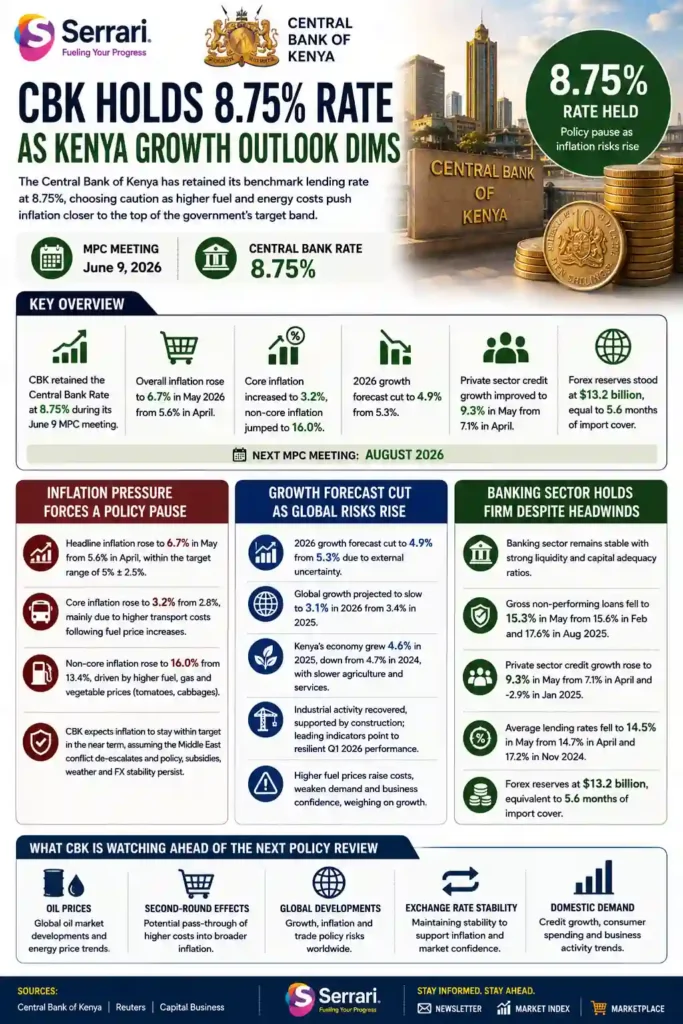
The Central Bank of Kenya has retained its benchmark lending rate at 8.75%, choosing caution as higher fuel and energy costs push inflation closer to the top of the government’s target band. The decision was made during the Monetary Policy Committee meeting held on June 9, 2026.
CBK also cut Kenya’s 2026 economic growth forecast to 4.9% from 5.3%, citing continued uncertainty from the Middle East conflict, elevated global energy prices and trade policy risks. While the banking sector remains stable and private sector credit is recovering, the central bank signalled that oil markets will remain central to its next policy review.
Key Overview
CBK retained the Central Bank Rate at 8.75% during its June 9 MPC meeting.
Kenya’s overall inflation rose to 6.7% in May 2026 from 5.6% in April.
Core inflation increased to 3.2%, while non-core inflation jumped to 16.0%.
The 2026 growth forecast was revised down to 4.9% from 5.3%.
Private sector credit growth improved to 9.3% in May from 7.1% in April.
Foreign exchange reserves stood at $13.2 billion, equal to 5.6 months of import cover.
The next MPC meeting is scheduled for August 2026.
Inflation Pressure Forces a Policy Pause
CBK said the current monetary policy stance remains appropriate to keep inflation expectations anchored and maintain exchange rate stability. In its June policy statement, the central bank said the Middle East conflict had disrupted global supply chains and pushed up energy and transportation costs.
Kenya’s headline inflation rose to 6.7% in May from 5.6% in April, remaining within the target range of 5% plus or minus 2.5 percentage points. The increase was largely driven by higher energy prices linked to global oil market pressures.
Core inflation, which excludes volatile food and energy items, rose to 3.2% from 2.8%, mainly due to higher transport costs following fuel price increases. Non-core inflation rose more sharply to 16.0% from 13.4%, reflecting higher fuel, gas and vegetable prices, especially tomatoes and cabbages.
CBK expects inflation to stay within target in the near term, assuming the Middle East conflict de-escalates. The outlook is also supported by appropriate policy action, government interventions including subsidies and temporary VAT reduction on fuel, favourable weather conditions and a stable exchange rate.
Context is everything. Stay ahead of shifting trends with today’s market updates, and uncover emerging opportunities using the Serrari Group Market Index and Marketplace. Then, take control of your own financial future by exploring our Money & Life Reset Transformation Blueprint ™ to build stronger habits, create better systems, and design a path toward lasting wealth.
Growth Forecast Cut as Global Risks Rise
The MPC lowered Kenya’s 2026 growth projection to 4.9% from 5.3%, pointing to continued external uncertainty. According to market reporting, economists had expected the central bank to hold the rate unchanged for the second straight policy meeting.
Kenya’s economy expanded by 4.6% in 2025, down from 4.7% in 2024, with slower growth in agriculture and services. However, CBK said industrial activity recovered strongly, supported by construction, while leading indicators pointed to resilient performance in the first quarter of 2026.
The downgrade shows that higher fuel prices are not only an inflation issue. They can raise transport, production and household costs, weaken demand and reduce business confidence. CBK said global growth is projected to slow to 3.1% in 2026 from 3.4% in 2025 due to higher inflation, weaker demand and elevated uncertainty.
Banking Sector Holds Firm Despite Headwinds
Kenya’s banking sector remained stable, with strong liquidity and capital adequacy ratios. The ratio of gross non-performing loans fell to 15.3% in May from 15.6% in February and 17.6% in August 2025, helped by improvements in personal and household lending, transport and communications, and mining and quarrying.
Private sector credit growth also improved, rising to 9.3% in May from 7.1% in April and -2.9% in January 2025. CBK said credit to sectors such as trade, construction, agriculture and consumer durables remained strong, reflecting improved demand as lending rates declined.
Average commercial bank lending rates fell to 14.5% in May from 14.7% in April and 17.2% in November 2024. That decline suggests previous rate cuts are still feeding through the market, giving CBK room to pause rather than tighten immediately.
Foreign exchange reserves stood at $13.2 billion, equivalent to 5.6 months of import cover, giving Kenya a buffer against short-term external shocks. CBK said it will continue monitoring oil prices, second-round inflation effects and global developments before the next MPC meeting in August.
Sources used: Central Bank of Kenya / Reuters / Capital Business
Your financial future isn’t something you wait for—it’s something you build.
The real question is: when do you begin?
Move beyond simply staying informed.
Navigate the markets with clarity—track trends through the Serrari Group Market Index, uncover opportunities in the Serrari Marketplace, and build practical knowledge with our Curated Wealth Builder Platform.
Stay connected to what truly matters.
Get daily insights on macro trends and financial movements across Kenya, Africa, and global markets—delivered through the Serrari Newsletter.
Growth opens doors.
Advance your career through professional programs including ACCA, HESI A2, ATI TEAS 7 , HESI EXIT , NCLEX – RN and NCLEX – PN, Financial Literacy!🌟—designed to move you forward with confidence.
See where money is flowing—clearly and in real time.
Track Money Market Funds, Treasury Bills, Treasury Bonds, Green Bonds, and Fixed Deposits, alongside global and African indexes, key economic indicators, and the evolving Crypto and stablecoin landscape—all within Serrari’s Market Index.