India’s Ministry of Agriculture is supporting 11 pilot projects to develop carbon credit opportunities for farmers through regenerative agriculture. The initiative aims to build technical capacity, establish approved methodologies for carbon credit generation and integrate smallholder farmers into the country’s emerging carbon market under the Carbon Credit Trading Scheme (CCTS).
Key Overview
- India is supporting 11 pilot projects focused on agricultural carbon credits.
- The projects are being implemented by seven ICAR institutes and four state agricultural universities.
- The government has released a draft Programme of Activities (PoA) under the Carbon Credit Trading Scheme (CCTS).
- Farmer Producer Organisations (FPOs), NGOs and project developers will be able to aggregate small farms for carbon credit generation.
- Two agriculture-related carbon credit methodologies have already been approved.
India Expands Carbon Credit Opportunities for Farmers
The Ministry of Agriculture and Farmers Welfare is supporting 11 pilot projects to help farmers participate in the voluntary carbon market, marking a significant step toward integrating India’s agricultural sector into carbon credit generation.
The projects are being implemented through seven ICAR institutes and four state agricultural universities, according to a written reply presented in Parliament by Minister of State for Agriculture Ramnath Thakur.
The initiative is designed to build technical expertise and develop scientifically robust methodologies that enable farmers to generate carbon credits by adopting regenerative agricultural practices.
Building a Framework for Agricultural Carbon Credits
According to the ministry, the pilot projects will provide technical support and strengthen institutional capacity for measuring and verifying carbon reductions from agricultural activities.
They will also help develop approved methodologies for generating carbon credits from regenerative farming practices, creating a scientific foundation for broader participation in voluntary carbon markets.
The government has simultaneously published the draft Detailed Procedure for Programme of Activities (PoA) under the Offset Mechanism of the Carbon Credit Trading Scheme (CCTS).
This framework establishes the procedures for implementing carbon credit projects while ensuring they comply with nationally approved standards.
Supporting Smallholder Farmers
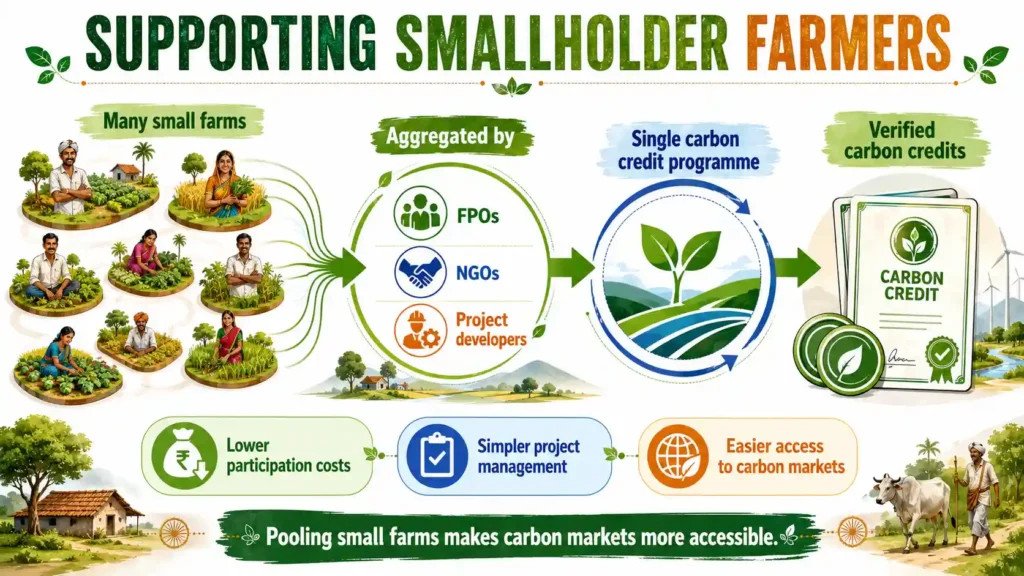
One of the key objectives of the proposed Programme of Activities (PoA) is to make carbon markets more accessible to India’s millions of small and marginal farmers.
Rather than requiring each farmer to develop an individual carbon project, the framework allows Farmer Producer Organisations (FPOs), non-governmental organisations (NGOs) and project developers to combine multiple small-scale farm activities into a single carbon credit programme.
This aggregation model is expected to lower participation costs, simplify project management and enable smaller farms to benefit from carbon markets that would otherwise be difficult to access individually.
By pooling activities under approved methodologies, farmers can collectively generate verified carbon credits that may be sold in voluntary carbon markets.
Carbon Credit Trading Scheme Takes Shape
India’s Carbon Credit Trading Scheme (CCTS), 2023, notified under the Energy Conservation Act, 2001, provides the overarching framework for establishing the country’s domestic carbon market.
The scheme is intended to encourage emissions reductions across multiple sectors while creating financial incentives for climate-friendly practices.
Within agriculture, two methodologies have so far been approved under the CCTS Offset Mechanism:
- Methane Recovery from Livestock and Manure Management at Households and Small Farms
- Emission Reduction through Improved Management Practices in Rice Cultivation
Together with the draft PoA procedures, these methodologies establish the initial framework for agricultural carbon credit generation.
As additional methodologies are developed through the pilot projects, more farming practices could become eligible for carbon credit certification in the future.
Context is everything. Stay ahead of shifting trends with today’s market updates, and uncover emerging opportunities using the Serrari Group Market Index and Marketplace. Then, take control of your own financial future by exploring our Money & Life Reset Transformation Blueprint ™ to build stronger habits, create better systems, and design a path toward lasting wealth.
Income Potential Yet to Be Assessed
Despite the progress in building the regulatory framework, the government acknowledged that it has not yet assessed the potential income farmers could earn through carbon credit generation.
Minister Ramnath Thakur told Parliament that no formal evaluation has been conducted to estimate future revenues from participation in agricultural carbon markets.
Nevertheless, experts believe carbon credits could become an important supplementary source of income for farmers while encouraging the wider adoption of sustainable farming practices that improve soil health, increase carbon sequestration and reduce greenhouse gas emissions.
They also emphasise the need for credible measurement, reporting and verification systems to ensure the environmental integrity of agricultural carbon credits and maintain confidence among carbon market participants.
Promoting Climate-Resilient Agriculture
The Agriculture Ministry noted that it continues to promote climate-resilient farming through various government programmes, recognising that sustainable agriculture is essential for ensuring long-term food security while addressing climate change.
The 11 pilot projects are expected to generate valuable scientific data and practical experience that will inform future policies and expand carbon market opportunities across India’s agricultural sector.
If successful, the initiative could lay the groundwork for scaling carbon credit programmes nationwide, enabling more farmers to benefit from the growing global demand for high-quality carbon credits while supporting regenerative farming and environmental sustainability.
Outlook
India’s decision to launch 11 pilot projects signals growing momentum behind integrating agriculture into the country’s developing carbon market. While the financial benefits for farmers remain uncertain, the projects are expected to establish the scientific methodologies, institutional capacity and regulatory framework needed to support future carbon credit generation. As global demand for high-quality carbon credits continues to increase, India’s efforts could unlock new income opportunities for farmers, accelerate the adoption of regenerative agriculture and strengthen the country’s broader climate and sustainable development objectives.
FAQs
1. What are India’s agricultural carbon credit pilot projects?
They are 11 government-supported pilot projects designed to help farmers generate carbon credits through regenerative agricultural practices.
2. Who is implementing the pilot projects?
The projects are being implemented by seven ICAR institutes and four state agricultural universities with support from the Ministry of Agriculture.
3. What is the Carbon Credit Trading Scheme (CCTS)?
The Carbon Credit Trading Scheme (CCTS), 2023 is India’s framework for establishing a domestic carbon market and supporting emissions reduction through carbon credits.
4. Can small farmers participate in the carbon market?
Yes. Under the proposed Programme of Activities (PoA), Farmer Producer Organisations (FPOs), NGOs and project developers can aggregate multiple small farms into a single carbon credit programme, making participation easier and more cost-effective.
Sources: Outlook Business, Rediff, News Arena India
Your financial future isn’t something you wait for—it’s something you build.
The real question is: when do you begin?
Move beyond simply staying informed.
Navigate the markets with clarity—track trends through the Serrari Group Market Index, uncover opportunities in the Serrari Marketplace, and build practical knowledge with our Curated Wealth Builder Platform.
Stay connected to what truly matters.
Get daily insights on macro trends and financial movements across Kenya, Africa, and global markets—delivered through the Serrari Newsletter.
Growth opens doors.
Advance your career through professional programs including ACCA, HESI A2, ATI TEAS 7 , HESI EXIT , NCLEX – RN and NCLEX – PN, Financial Literacy!🌟—designed to move you forward with confidence.
See where money is flowing—clearly and in real time.
Track Money Market Funds, Treasury Bills, Treasury Bonds, Green Bonds, and Fixed Deposits, alongside global and African indexes, key economic indicators, and the evolving Crypto and stablecoin landscape—all within Serrari’s Market Index.