
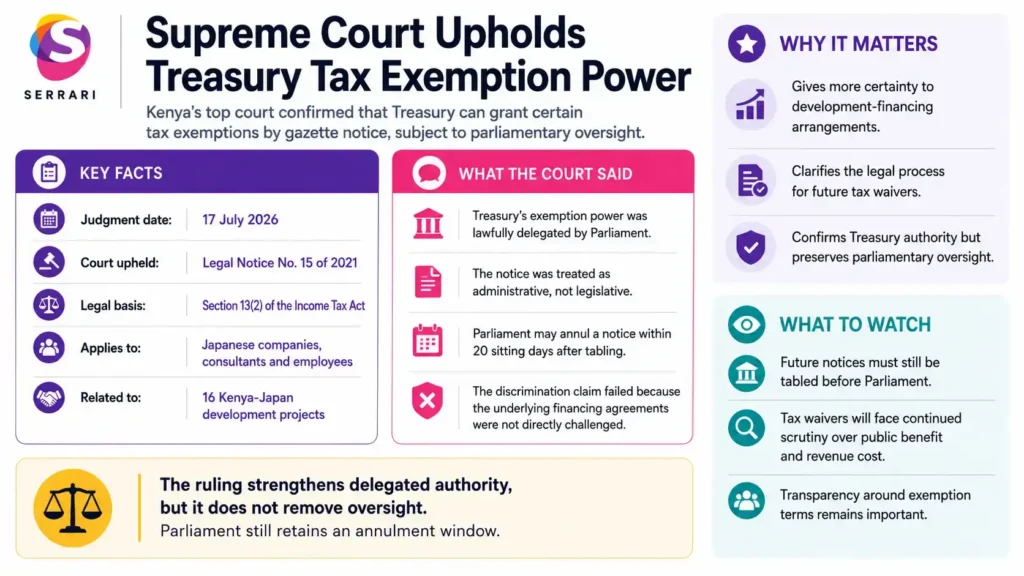
Kenya’s Supreme Court has upheld the National Treasury’s authority to exempt specified income from tax through a gazette notice. In a judgment delivered on July 17, 2026, the court dismissed Eliud Karanja Matindi’s challenge to exemptions granted to Japanese companies, consultants and employees working on projects financed through Kenya–Japan agreements.
The decision confirms that the power comes from legislation passed by Parliament. It does not give Treasury an unrestricted ability to waive taxes without oversight: the notice must be placed before the National Assembly, which can annul it within 20 sitting days.
Key Overview
- The Supreme Court dismissed Matindi’s appeal and upheld Legal Notice No. 15 of 2021.
- Section 13(2) of the Income Tax Act authorises Treasury to exempt an income or class of income through a gazette notice.
- The court classified the disputed notice as administrative rather than legislative.
- Public participation rules applying to statutory instruments were therefore not triggered.
- Parliament retains the power to annul an exemption notice after it is tabled.
- The discrimination claim failed because the underlying financing agreements were not directly challenged or produced as evidence.
Court Confirms Treasury’s Delegated Authority
In the July 17 Supreme Court judgment, the five-judge bench affirmed that Parliament had lawfully delegated exemption authority to the Cabinet Secretary through Section 13 of the Income Tax Act.
The relevant income-tax provision allows the Cabinet Secretary to exempt any income or class of income accrued in or derived from Kenya, to the extent specified in a gazette notice.
However, the statutory process still gives Parliament a role. Section 13(3) requires the notice to be laid before the National Assembly without unreasonable delay. Parliament may pass a resolution annulling it within 20 days on which the Assembly next sits.
This means the ruling does not support the broad proposition that Treasury can permanently grant tax relief entirely outside parliamentary control. Instead, Treasury can issue the notice under delegated authority, while Parliament retains a defined power to reject it.
Why Public Participation Was Not Required
Legal Notice No. 15 of 2021 implemented exemptions contained in financing agreements signed between Kenya and Japan from 2007 to 2020. The beneficiaries were Japanese companies, consultants and employees earning income connected to the specified projects.
The court found that the notice did not create a new rule binding the public generally. It communicated and implemented commitments already contained in bilateral financing agreements. On that basis, it was executive or administrative action rather than a statutory instrument requiring the separate public-participation process argued for by Matindi.
The parliamentary consideration record shows that the notice was tabled and considered in 2021. The projects included Mombasa port works, the Dongo Kundu Special Economic Zone, Olkaria geothermal developments, Mwea irrigation and power-distribution improvements in Nakuru and Mombasa.
Recent reporting on the judgment valued the 16 covered projects at approximately KSh328 billion.
Context is everything. Stay ahead of shifting trends with today’s market updates, and uncover emerging opportunities using the Serrari Group Market Index and Marketplace. Then, take control of your own financial future by exploring our Money & Life Reset Transformation Blueprint ™ to build stronger habits, create better systems, and design a path toward lasting wealth.
High Court Victory Reversed on Appeal
Matindi initially succeeded before the High Court. Its February 2023 decision quashed the notice, declared Section 13(2) unconstitutional and held that income-tax waivers should be enacted through a money bill following public participation.
The Court of Appeal overturned that outcome in December 2024. According to a legal analysis of the appellate decision, the judges found that the Cabinet Secretary had acted within authority expressly granted by legislation and that the High Court had ruled on the constitutionality of Section 13(2) even though the issue had not been properly pleaded.
The Supreme Court has now affirmed the appellate court’s reasoning and declined to restore the High Court orders.
Discrimination Claim Failed on Evidence
Matindi argued that exempting Japanese personnel while Kenyans performing comparable work remained taxable created unequal treatment based on nationality.
The Supreme Court did not find that the argument had been proved. It observed that the legal notice contained no detailed exemption conditions because those terms were in the underlying financing agreements. Matindi had neither obtained nor directly challenged those agreements.
Without the documents containing the actual terms, the court held that he could not establish discrimination on a balance of probabilities. The ruling therefore did not declare that nationality-based distinctions can never be unconstitutional; it found that discrimination was not sufficiently pleaded and proved in this case.
What the Judgment Means
The decision gives greater legal certainty to tax commitments negotiated within bilateral development-financing agreements. Foreign contractors and lenders can rely more confidently on exemptions issued under Section 13(2), provided the statutory process is followed.
For taxpayers and Parliament, the judgment also places greater importance on oversight after a notice is issued. The National Assembly’s tabling and annulment powers become the main statutory check, alongside requirements for transparency and public reporting of tax waivers under Kenya’s public-finance framework.
The judgment strengthens Treasury’s delegated authority, but it does not remove the need for clear exemption terms, parliamentary scrutiny and evidence that the resulting public benefits justify the revenue foregone.
Sources
Kenya Law / Parliament of Kenya / Business Daily / Bowmans / The Star
Your financial future isn’t something you wait for—it’s something you build.
The real question is: when do you begin?
Move beyond simply staying informed.
Navigate the markets with clarity—track trends through the Serrari Group Market Index, uncover opportunities in the Serrari Marketplace, and build practical knowledge with our Curated Wealth Builder Platform.
Stay connected to what truly matters.
Get daily insights on macro trends and financial movements across Kenya, Africa, and global markets—delivered through the Serrari Newsletter.
Growth opens doors.
Advance your career through professional programs including ACCA, HESI A2, ATI TEAS 7 , HESI EXIT , NCLEX – RN and NCLEX – PN, Financial Literacy!🌟—designed to move you forward with confidence.
See where money is flowing—clearly and in real time.
Track Money Market Funds, Treasury Bills, Treasury Bonds, Green Bonds, and Fixed Deposits, alongside global and African indexes, key economic indicators, and the evolving Crypto and stablecoin landscape—all within Serrari’s Market Index.