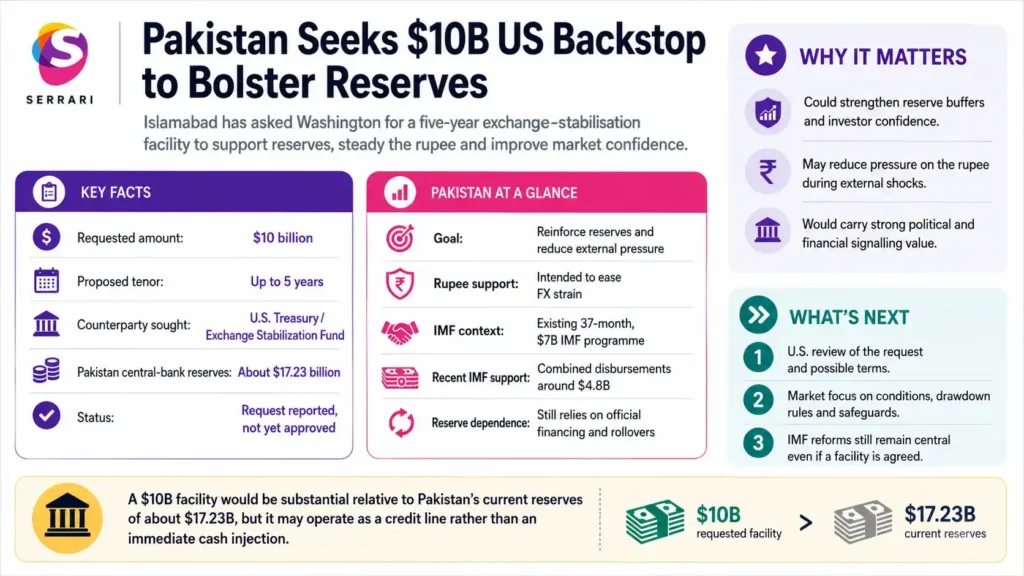
Pakistan has asked the United States for a $10 billion bilateral exchange-stabilisation facility with a maturity of up to five years. The proposed backstop would be intended to reinforce foreign-exchange reserves, reduce pressure on the Pakistani rupee and improve Islamabad’s ability to return to international capital markets.
The request is significant, but it is not yet an approved financing agreement. The U.S. Treasury has not publicly committed funds, while key terms such as pricing, collateral, repayment safeguards, drawdown conditions and policy requirements remain undisclosed.
Key Overview
- Pakistan is seeking a $10 billion facility from the U.S. government with a maturity of up to five years.
- The request was raised during Finance Minister Muhammad Aurangzeb’s Washington engagement with Treasury Secretary Scott Bessent.
- Pakistan’s central-bank reserves stood at approximately $17.23 billion on July 10, 2026.
- The proposed amount is therefore equivalent to about 58% of the central bank’s current reserve holdings.
- Any facility would probably complement, rather than replace, Pakistan’s existing IMF programme.
- No final agreement, disbursement schedule or financial terms have been announced.
Islamabad Seeks an Unusual U.S. Financial Backstop
The reported request for a $10 billion facility was submitted to U.S. Treasury Secretary Scott Bessent, according to a source briefed on the proposal. Islamabad is seeking a bilateral support arrangement lasting up to five years.
Pakistan’s embassy officials in Washington later confirmed that the request had been made, although they did not disclose its structure. The U.S. Treasury declined to comment, meaning the proposal should still be treated as a request rather than an agreed rescue package.
An official account of Aurangzeb’s meeting with Bessent focused more broadly on Pakistan’s transition from macroeconomic stabilisation towards export-led growth. It said Islamabad wanted greater U.S. support for international market access, stronger reserves and improved sovereign credit ratings.
How an Exchange-Stabilisation Facility Could Work
The proposal would likely involve the U.S. Exchange Stabilization Fund, which can provide financing to foreign governments through dollars, foreign currencies and other credit instruments. Its operations require authorisation from the Treasury Secretary.
Such support is different from the permanent dollar swap lines maintained by the Federal Reserve with selected major central banks. An Exchange Stabilization Fund arrangement is negotiated for a particular government and normally includes repayment protections, conditions and a defined maturity.
These arrangements are uncommon. Official October 2025 financial statements recorded a $20 billion agreement with Argentina and a longstanding $9 billion framework with Mexico. Argentina drew $2.5 billion under its arrangement in October 2025 and subsequently repaid the amount.
For Pakistan, a $10 billion headline facility would not necessarily mean that the full amount entered its reserves immediately. It could operate as a maximum credit line, swap arrangement or conditional backstop drawn only when agreed requirements are met.
Context is everything. Stay ahead of shifting trends with today’s market updates, and uncover emerging opportunities using the Serrari Group Market Index and Marketplace. Then, take control of your own financial future by exploring our Money & Life Reset Transformation Blueprint ™ to build stronger habits, create better systems, and design a path toward lasting wealth.
Reserve Buffers Have Improved but Remain Vulnerable
The latest official reserve figures show that the central bank held about $17.23 billion as of July 10, 2026, while commercial banks held a further $5.45 billion. Total liquid foreign-exchange reserves therefore stood at roughly $22.68 billion.
Pakistan’s reserve position has improved substantially from the acute stress that preceded its near-default in 2023. However, the country still relies on multilateral disbursements, bilateral deposits, debt rollovers and support from partners including China and Saudi Arabia.
That dependence leaves the external account vulnerable when large repayments fall due or promised financing is delayed. A credible U.S. backstop could improve market confidence by demonstrating that additional liquidity is available during periods of pressure.
The effect would depend on the agreement’s design. A standby line with strict conditions may reassure investors without being fully drawn, while a direct loan would raise gross reserves but also create a new repayment obligation.
IMF Reforms Would Remain Central
Pakistan is currently operating under a 37-month, $7 billion Extended Fund Facility approved in September 2024. The latest programme review released approximately $1.1 billion under that programme and about $220 million through a separate climate-resilience facility, taking combined disbursements to around $4.8 billion.
The programme requires fiscal discipline, revenue mobilisation, energy-sector reforms and measures intended to improve economic resilience. A U.S. facility would therefore be more likely to reinforce the programme than remove the need for it.
It could reduce Pakistan’s dependence on emergency bilateral deposits and create breathing room during external shocks. However, lenders would still examine debt sustainability, fiscal performance, reserve adequacy and progress against IMF targets.
Washington Ties Add a Strategic Dimension
Pakistan’s request comes as its diplomatic engagement with Washington has expanded beyond traditional security issues. Economic cooperation has increasingly included mining, infrastructure and digital-finance discussions.
The U.S. Export-Import Bank has listed authorised financing of $1.25 billion for the Reko Diq mining project, illustrating growing interest in strategic minerals and large-scale investment.
A currency backstop would carry even greater symbolic weight because it would signal direct U.S. confidence in Pakistan’s economic stabilisation. It could also support Islamabad’s plan to improve its sovereign rating and regain more reliable access to global debt markets.
Nevertheless, the risks remain material. An April 2026 sovereign assessment affirmed Pakistan at B- with a Stable Outlook, noting that rebuilt reserves offered protection while warning that higher energy costs and regional disruptions could weaken the external position.
The central question is therefore not only whether Washington approves the request, but what conditions it attaches. Until those terms are disclosed, the proposed facility remains a potentially powerful liquidity buffer rather than a completed financial rescue.
Sources
Reuters / Dawn / U.S. Department of the Treasury / State Bank of Pakistan / International Monetary Fund / Fitch Ratings / Export-Import Bank of the United States
Your financial future isn’t something you wait for—it’s something you build.
The real question is: when do you begin?
Move beyond simply staying informed.
Navigate the markets with clarity—track trends through the Serrari Group Market Index, uncover opportunities in the Serrari Marketplace, and build practical knowledge with our Curated Wealth Builder Platform.
Stay connected to what truly matters.
Get daily insights on macro trends and financial movements across Kenya, Africa, and global markets—delivered through the Serrari Newsletter.
Growth opens doors.
Advance your career through professional programs including ACCA, HESI A2, ATI TEAS 7 , HESI EXIT , NCLEX – RN and NCLEX – PN, Financial Literacy!🌟—designed to move you forward with confidence.
See where money is flowing—clearly and in real time.
Track Money Market Funds, Treasury Bills, Treasury Bonds, Green Bonds, and Fixed Deposits, alongside global and African indexes, key economic indicators, and the evolving Crypto and stablecoin landscape—all within Serrari’s Market Index.